
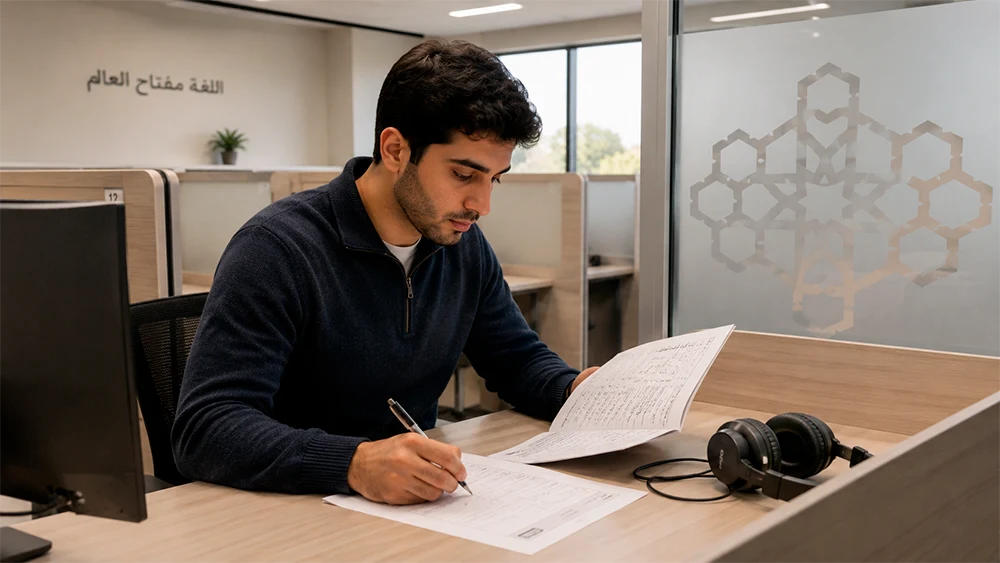
Reading, listening, writing, grammar - an Arabic proficiency test runs all four through the same assessment and hands back a level, not a simple pass or fail. A student applying to an Arabic-language program, a professional dealing with Arabic-speaking clients, and an HR manager checking a candidate's claimed skills end up looking at the same kind of result, even though none of them need it for the same reason.
Four things get measured on an Arabic language test: reading comprehension, listening comprehension, writing accuracy, and grammatical control, combined into one score mapped to a recognizable level scale. Vocabulary size on its own doesn't count for much here, and neither does grammar memorized without context - what actually gets checked is whether someone can use the language to get something done.
Think of the result as a snapshot, not a label stuck on for life. Whatever number comes back reflects where someone stands today, useful for one specific purpose - an application, a job requirement, a personal check-in - rather than a credential meant to last forever.
A student applying to a degree program taught in Arabic needs proof the university can check against its own admission threshold - a self-reported estimate rarely satisfies that requirement. A professional negotiating contracts with clients based in the Gulf region needs something concrete to show a hiring manager who has no way to judge Arabic ability firsthand.
Arabic language certification matters just as much on the receiving end. An HR manager reviewing a resume that lists "fluent Arabic" has no way to verify that claim without a standardized result attached to it - the certification exists specifically to close that verification gap.
Three skill areas make up most standardized Arabic tests, each assessed separately before combining into one overall result.
An Arabic reading test usually moves through increasing difficulty - a street sign or simple notice first, then a short news article, then a more formal document like a contract excerpt or official notice. Questions target both specific details (what date, what amount, what condition) and overall meaning (what is this document actually asking the reader to do).
Short audio clips carry the whole section - two people talking, a public announcement, a brief news segment - with nothing written to fall back on. Cutting the transcript is deliberate. It separates listening ability from reading ability, since the two skills tend to grow at different rates in the same person.
A short message or email on an assigned topic makes up most of this section, graded on accuracy and coherence rather than how many words someone knows. A handful of grammar points show up again and again in these evaluations: gender and number agreement across nouns, adjectives, and verbs; verb conjugation holding up across tense and mood; word order behaving correctly in both nominal and verbal sentences. A sentence can be technically correct and still sound off the moment agreement rules slip - which is exactly what this section is designed to catch.
A1 and A2 cover survival Arabic - reading a street sign, ordering food, introducing yourself in a few sentences without needing to construct anything complex. B1 and B2 mark the shift to independence: reading a news article without a dictionary, writing a coherent email, following a conversation at normal speed on a familiar topic.
C1 and C2 apply to professional and academic contexts specifically - drafting a formal document, following a fast-paced meeting, catching nuances in written Arabic that a lower level would miss entirely. Unlike some European languages, Arabic has no single official body issuing a universally recognized CEFR conversion - most standardized Arabic language exam formats adapt CEFR-style descriptors to fit Arabic's specific structure, rather than mapping onto an officially sanctioned scale.
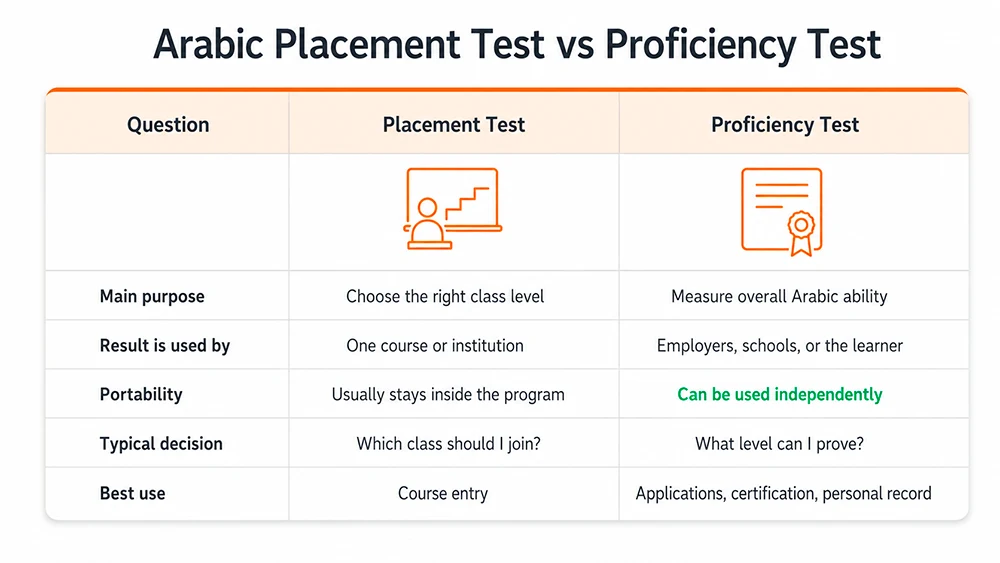
A placement test exists to sort someone into the right class level inside a specific course or school - its result rarely leaves that institution's own system. An Arabic placement test answers one narrow question: which group does this student belong in right now, given the curriculum this particular program teaches.
A proficiency test does something different entirely. It produces a portable, independent result - usable for a job application, a university admission file, or simply personal record - regardless of which course, if any, the test-taker studied with beforehand.
Arabic operates on a genuine split: Modern Standard Arabic handles writing, media, and formal speech, understood consistently by educated speakers across the entire Arab world. Spoken dialects - Egyptian, Levantine, Gulf, Maghrebi, among others - run the daily conversations, and they don't always understand each other. A Moroccan speaker using a fast, local dialect and an Iraqi speaker can genuinely struggle to follow one another without switching to MSA as a common ground.
Most standardized tests, including online formats, assess MSA specifically rather than any single regional dialect. That matters practically: someone preparing to work with clients in one particular region should know that a strong MSA score doesn't automatically translate into ease understanding that region's spoken dialect.
Testizer's online Arabic test covers all four skills in one sitting and produces a CEFR-adapted result right at the end. A downloadable certificate is available for anyone happy with the outcome, complete with a unique ID and QR code - something an employer or institution can check directly instead of taking the number on trust.
Reading, listening, writing, and grammar combine into one level - A1 through C2 - that reflects current ability rather than years studied. Placement tests sort students into courses; proficiency tests produce something portable enough to use anywhere. Most standardized formats measure Modern Standard Arabic specifically, not a regional dialect.
Taking the Arabic proficiency test on Testizer gives a clear, current read on where those four skills actually stand - useful before committing to further study or applying somewhere that requires proof of level.
B2 covers most professional contexts comfortably - reading reports, writing clear emails, following meetings without constant clarification. Roles involving legal or highly technical Arabic often expect C1, where nuance and formal register matter more.
No formal expiration date on most certificates, though language ability itself drifts without regular use. Employers and institutions often lean toward results from the last one or two years for exactly that reason, official cutoff or not.
Yes. An Arabic language quiz like this scores actual ability, not hours logged in a classroom. Someone who picked up Arabic informally - through immersion, self-study, whatever worked - gets measured the same way as someone with years of formal coursework behind them.
No. MSA handles writing and formal speech; daily conversation runs on regional dialects that shift enough between countries that speakers sometimes fall back on MSA just to understand each other.