
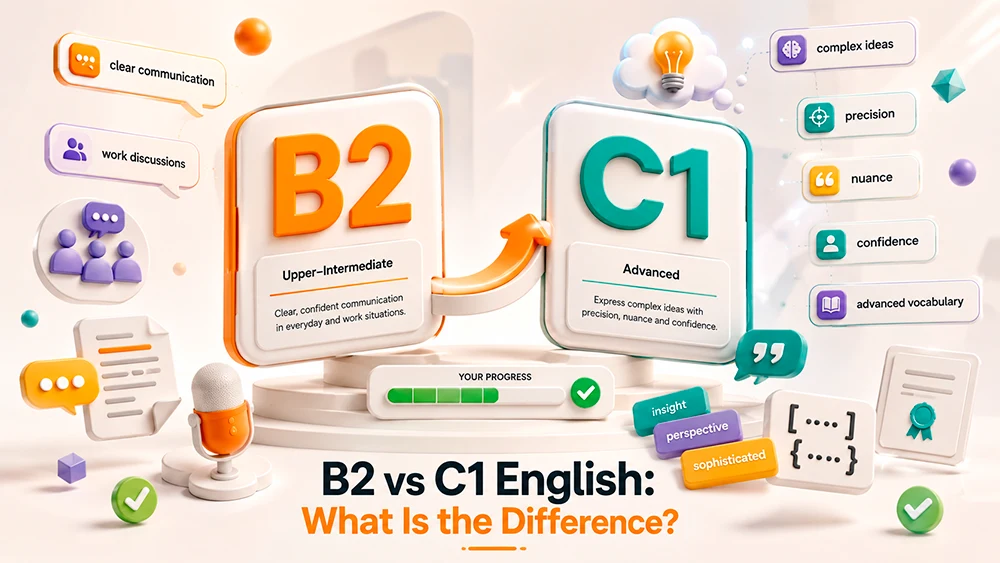
B2 vs C1 looks like a small gap on paper - both count as "independent" or "proficient" users, both can hold a conversation without constant help. The actual gap shows up somewhere else entirely: in a fast-moving argument, a dense unfamiliar text, or an email that needs exactly the right tone. That's where B2 and C1 stop looking similar.
Both levels describe someone who functions independently in English. What separates them is how that independence holds up once the situation stops being familiar.
Picture a work discussion that stays on a topic the speaker knows well. A B2 speaker keeps up comfortably here - following the thread, contributing opinions, responding without long pauses. What is B2 level in practice, really, is confidence on familiar ground. The moment the conversation drifts somewhere unexpected, that same speaker often simplifies what they're trying to say rather than searching for the precise word, trading nuance for speed to keep the conversation moving.
Reading works the same way. A B2 reader gets the main argument of a moderately complex article, including some technical content in a familiar field, but the finer implications between the lines don't always register on a first pass.
Take that same drifting conversation and hand it to a C1 speaker instead. C1 English level meaning, at its core, is flexibility under pressure - the ability to shift topic, register, or tone without losing pace or reaching for simpler substitutes. Word choice adjusts almost automatically, matching whatever the moment actually calls for.
Reading shows the clearest contrast. A C1 reader picks up implicit meaning - the argument the writer never states outright, the assumption buried in a dense paragraph - at a speed that leaves little room for B2-level second-guessing. That gap rarely shows up in casual conversation. It shows up the instant something unfamiliar or fast-moving enters the picture.
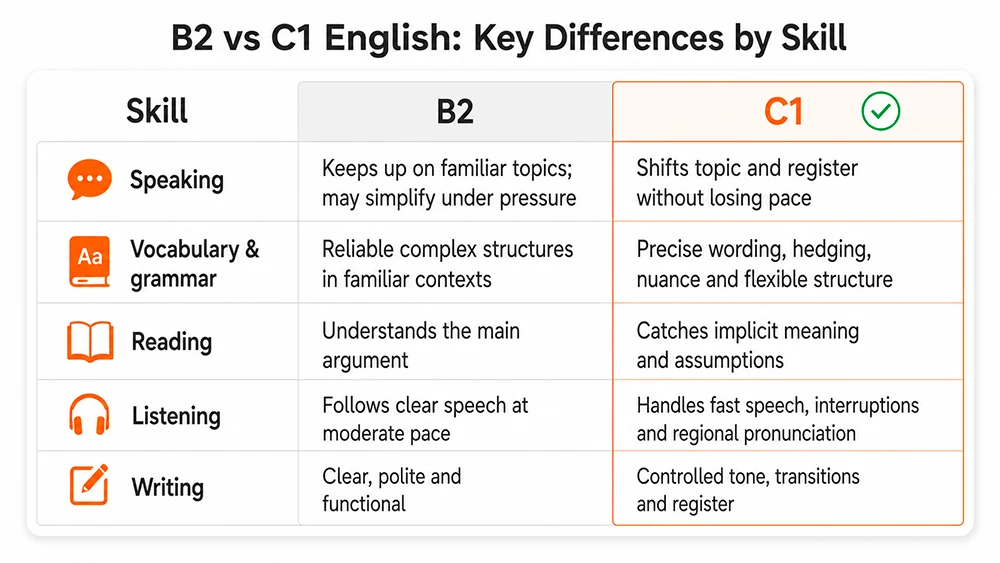
Line the two levels up side by side, skill by skill, and the gap stops sounding theoretical fast.
Same debate, same unfamiliar topic, two different speakers. One keeps pace but reaches for simpler phrasing the moment the exact word won't come - a workaround, not a failure, just enough to keep the sentence moving. The difference between B2 and C1 lives in what happens a beat later: register shifts mid-sentence, precision holds, the argument turns more formal without losing rhythm or dropping into a simpler substitute.
Ask two people to describe a colleague who keeps missing deadlines. One says "difficult" - fine, understood, a little flat. The other reaches past it: "reluctant," not "hesitant." "Frustrating," not just "annoying." Small shifts, but each one carries a slightly different shade the listener actually registers.
Grammar access splits the same way. Conditionals, passive voice, reported speech - all handled reliably in familiar territory at the lower level. Add nuanced modality next: hedging, understatement, disagreement softened just enough to land politely, used on instinct rather than pulled from memorized formulas. Sentence structure gets bent for emphasis too, deliberately and consistently, where the lower level manages it only sometimes.
Hand both a dense article on an unfamiliar subject. The B2 reader extracts the main argument, maybe a supporting point or two, but the writer's underlying assumption - the thing never stated outright - often slips past unnoticed. The C1 reader catches that assumption on the first pass, then evaluates whether it actually holds up.
Listening compounds the gap further. A B2 listener follows a lecture delivered clearly at a moderate pace; a C1 listener follows the same lecture even when the speaker interrupts themselves, trails off mid-thought, or speaks quickly with regional pronunciation.
Both are asked to write a client email declining a request. The B2 proficiency level produces something clear and polite - direct, understandable, functional. The C1 proficiency level produces something that reads as genuinely native in tone, with transitions that soften the refusal and a structure that guides the reader smoothly from bad news to next steps, rather than stating the rejection and moving on. That contrast - clarity versus controlled nuance - is really what B2 vs C1 comes down to across every skill area.
Skill-by-skill breakdowns only tell half the story. Real situations blend several skills at once - and that's exactly where the gap stops being ignorable.
A quarterly review runs on schedule, agenda covered smoothly enough for either level to handle without much strain. Then someone raises a budget concern nobody prepped for. One participant can still respond, but shifts into cautious, simplified phrasing - buying a second to process the curveball. The other barely pauses: same precision, same argument, tone recalibrated to match the sudden shift in stakes, with nothing visibly scrambling underneath.

A seminar assigns a dense theoretical text ahead of class discussion. The B2 student reads it slower than classmates, catches the main claims, but walks in less prepared to challenge the author's underlying assumption - that part didn't fully register on the page. The C1 student reads at a pace closer to a native speaker, spots the gap in the argument beforehand, and opens the discussion with a direct challenge to it rather than a summary.
That fifteen-minute difference in reading speed, multiplied across a full semester of assigned readings, adds up to a meaningfully different academic experience - not because one student works harder, but because processing speed at C1 leaves more mental room for actual analysis.
Self-assessment breaks down right at this boundary. Both B2 and C1 speakers often feel equally confident discussing familiar topics, which makes gut instinct an unreliable guide here specifically. The real signal shows up only under pressure - an unfamiliar subject, a fast-moving exchange, a text that assumes background knowledge the reader doesn't have.
A structured English proficiency test removes that guesswork by testing exactly those conditions directly, rather than relying on how confident someone feels in a comfortable conversation. C1 vs B2 becomes a lot less ambiguous once actual performance under those specific conditions gets measured instead of estimated.
B2 means functioning independently - handling familiar situations well, managing most conversations, getting through most texts. C1 means something more specific: flexibility, precision, and control that hold up even when the situation stops being familiar. The gap isn't really about vocabulary size or grammar rules memorized. It's about what happens the moment things get harder than expected.
Checking a current level on Testizer turns that question into an actual answer, rather than a guess based on how confident a comfortable conversation happened to feel.
Cambridge Assessment English puts the jump at roughly 200 guided learning hours - about the same as any other single step up the CEFR ladder, despite how much harder this particular one tends to feel. Spread across five hours a week, that lands somewhere around ten months; double the weekly hours and it compresses to five. Casual exposure alone, without structured practice, stretches the timeline well past a year for most learners.
In practical terms, yes - C1 speakers handle nearly any conversation without significant strain. It's not identical to native-level command (that's C2), but for professional and academic purposes, C1 functions as fluent in every sense that matters day to day.
Constantly, and it's the norm rather than the exception. Skills track how someone actually spends their time - a heavy reader who rarely speaks the language out loud often shows exactly this split, C1 comprehension paired with speech that still hunts for words under pressure.
Depends entirely on the goal. Everyday life and most casual work run fine on B2 alone. Academic writing, high-stakes negotiation, or any role built around persuasion tend to expose a gap B2 leaves wide open.
Every three to four months hits a reasonable middle ground - often enough to catch genuine movement, spaced out enough that one unusually good or bad day doesn't distort the picture.