

An agent who personally resolves 95% of escalated complaints doesn't automatically know how to teach five other people to do the same thing. Customer service manager skills cover a different job entirely – building a process where the whole team handles customers well, consistently, across dozens of interactions a manager never personally touches. Someone promoted for their own strong track record often discovers this gap only after the promotion, when their personal skill stops being the thing being measured.
These are the abilities that let someone answer for a team's results rather than just their own interactions. A manager needs to read a pattern across dozens of tickets, coach an agent who keeps making the same mistake, and defend a decision to a director when a customer complaint reaches that level. Customer service management skills, in other words, sit one layer above the direct customer interaction itself – closer to running a small operation than to running a single conversation.
The core service manager skills worth building show up repeatedly across strong managers, each covering a distinct part of the role: communication, leadership, problem-solving, coaching, analysis, organization, and technical fluency with the tools the team relies on daily.
A manager reviewing an escalation where the agent was technically correct but the customer stayed furious anyway needs to spot something the transcript alone won't show – that the wording is what triggered the reaction, while the facts underneath were already correct. Catching that distinction, and rewriting the response before it goes out, separates managing communication from simply being polite on a call.
During a seasonal sale, half the team drowns in tickets while two agents sit nearly idle on a different queue. A manager who notices the imbalance mid-shift and reassigns work in real time prevents a backlog that would otherwise show up in next-day metrics – waiting until the end-of-day report to react means the damage already happened.
A customer demands a refund that falls outside the return policy by three weeks, and the frontline agent has no authority to approve it. The manager weighing that request has to balance the cost of a policy exception against the reputational cost of a public dispute – a judgment call no script can make for them, since the right answer changes depending on the customer's history and the size of the request.
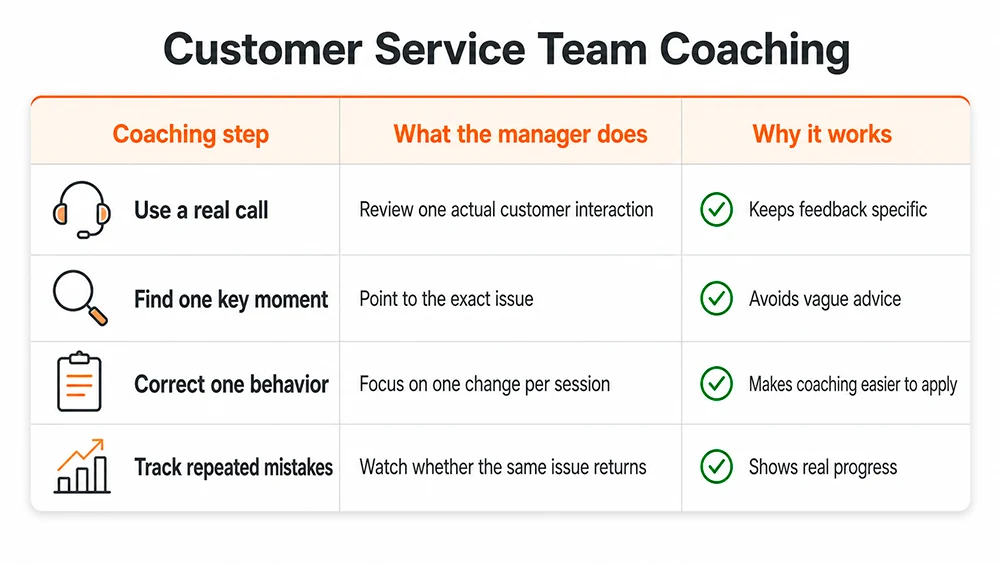
Pulling up a real call recording and pointing to one specific moment – where the agent talked over the customer instead of pausing – teaches more than a general note to "listen better" ever will. One targeted correction per session, tied to something the agent can actually hear themselves doing, sticks in a way vague encouragement doesn't.
Average handle time jumps 15% in a single month. Three suspects sit on the table: a new product confusing agents, a staffing gap spreading everyone thinner, or a process bottleneck dragging on every ticket equally. Chase the wrong one and weeks disappear before anything actually improves – the analysis has to land first.
Closing out the monthly metrics report, working through two active escalations, and building next week's shift schedule can all land on the same afternoon. The manager who handles this well spends the first ten minutes deciding which of the three tasks actually can't wait until tomorrow, before touching any of them.
A manager who has to file a ticket with IT just to pull a report on ticket volume by category loses hours a week to something that should take five minutes. Comfort navigating the CRM, the knowledge base, and whatever call or ticket analytics tool the team uses directly – without waiting on someone else – keeps small questions from turning into multi-day delays.
Quality shows up at the team level – one great call doesn't say much about a support operation, while a pattern holding steady across hundreds of them says everything.
A response that closes the ticket without triggering a follow-up message from the same customer is the clearest sign communication actually landed. Tracking the share of tickets resolved on first contact gives a manager something concrete to watch, rather than relying on a general sense that the team "communicates well."
An agent marks a ticket resolved in four minutes, and the same customer opens a new one two days later about the identical issue. Speed without a real fix just delays the same complaint – a resolution that actually holds counts for more than one that merely closes fast.
One agent hands out a 10% discount without blinking. An hour later, another turns down the identical request from a customer in the same situation. Customers compare notes, and a policy that bends depending on who picks up the phone erodes trust faster than any single mistake ever could. What makes a great customer service representative consistent across a team usually traces back to how clearly the manager has defined the boundaries of discretion, well before individual talent enters into it.
Getting better at this role takes data about the manager's own decisions – two managers with identical tenure can be improving at very different rates depending on what they actually track, regardless of how many years sit on either resume.
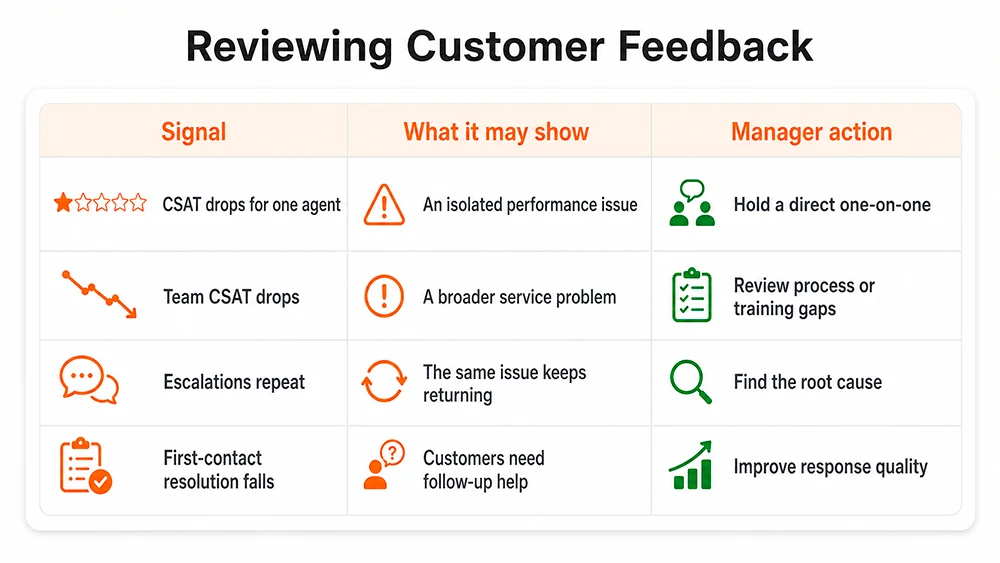
CSAT holds steady across the team overall, but one agent's score has dropped eight points over the past month while everyone else stayed flat. That kind of isolated dip calls for a direct one-on-one conversation – pulling the whole team into a meeting over one person's numbers wastes nine people's time on a problem that belongs to just one. Building these service management skills starts with knowing which number to check before deciding who needs a conversation.
Rehearsing a termination or demotion conversation with a peer manager before it happens with the actual employee catches the moments where wording could land badly – a pause that sounds dismissive, a phrase that sounds more final than intended. That fifteen minutes of practice tends to prevent a conversation from going sideways in ways that are much harder to walk back afterward.
Every escalation that reaches a manager's desk points at either a training gap or a process gap, and telling the two apart matters for what happens next. A customer service manager skills test can surface which specific knowledge gaps are actually driving repeated escalations, in a way that reviewing individual incidents one at a time often misses entirely.
"Excellent communication skills" tells a hiring manager nothing verifiable. A line like "reduced average escalation resolution time by 20% in one quarter by restructuring the handoff between support tiers" does the opposite – it names a specific change and a measurable result.
A few formats that hold up under scrutiny:
Communication catches what a transcript alone would miss. Leadership redistributes work before it becomes a backlog. Analysis identifies the actual cause behind a shifting number instead of guessing. Operational management keeps all of that running on the same afternoon without anything slipping through. A manager strong in three of these can look competent for a long stretch, right up until the one they're weak in becomes the reason a serious problem doesn't get caught in time.
Judgment calls under ambiguity – deciding when to bend a policy, how much authority to give an agent, when a conflict needs the manager's direct involvement. These don't show up on a dashboard the way average handle time or CSAT do, which makes them easy to overlook until a bad call surfaces publicly.
Watch the spread between the strongest and weakest performers – the team average alone can stay flat while that gap quietly widens or closes underneath it. A shrinking gap usually means coaching is actually reaching the agents who need it most, while a stable average with a widening gap can hide real problems behind one or two standout performers.
Their weight shifts with team size. A manager running a five-person team often pulls their own reports and configures their own CRM views; a manager overseeing fifty people usually delegates that work and spends more time on analysis and people management instead.
Small teams reward hands-on involvement – the manager knows every agent's strengths individually and adjusts coaching accordingly. Large departments demand more structure: standardized metrics, documented escalation paths, and less day-to-day personal contact with each agent's individual calls.
Partially. The management layer – coaching, analysis, conflict resolution – transfers reasonably well across industries. Product-specific knowledge doesn't transfer at all, so a strong manager new to an industry still needs a real ramp-up period before their judgment calls carry full weight.