
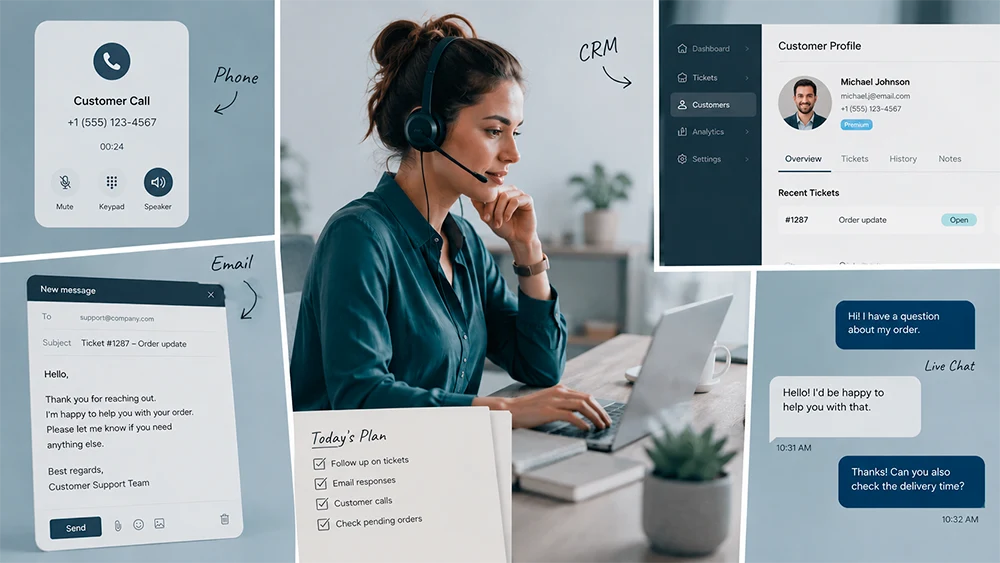
Every customer interaction carries a risk – not just of failing to solve the problem, but of damaging the relationship entirely. Customer service skills determine how that risk plays out in practice. A technically correct resolution delivered without empathy or clarity often leaves the customer less satisfied than a partial solution handled well.
Research consistently shows that customers who have a poor service experience are more likely to switch providers than those who simply experienced a product problem. That finding points directly at customer service skills as the variable that separates retention from churn – not product quality alone, but the quality of every interaction around it.
What are customer service skills in a professional context? They are a layered combination of communication, emotional, and practical abilities that allow support professionals to handle customer interactions effectively – across channels, under pressure, and at consistent quality.
Not all of these skills are the same type. Some are behavioral – empathy, patience, emotional regulation. Others are technical – CRM navigation, channel-specific communication, tool proficiency. Others are cognitive – problem diagnosis, prioritization, decision-making under incomplete information. A strong support professional typically needs all three categories working together, because any single interaction may require all of them simultaneously.

Good customer service skills combine behavioral, technical, and cognitive abilities – each one serving a different part of the customer interaction.
Important customer service skills start with communication – but the listening half is consistently underrated. A customer who feels heard resolves faster and leaves more satisfied, even when the outcome is identical to an interaction where they were not. Active listening – confirming understanding, reflecting back key points, avoiding interruption – changes the perceived quality of the interaction without changing the solution itself.
Clear verbal and written communication closes the loop. An explanation that the customer cannot follow produces a repeat contact. One that is accurate and actionable does not.
Emotional intelligence in customer service means reading the customer's state and adjusting tone accordingly – not projecting scripted positivity regardless of context. A frustrated customer who receives cheerful, formulaic responses often escalates rather than de-escalates. Acknowledging frustration before offering a solution consistently produces faster resolution and higher satisfaction.
The skill is not sympathy – it is calibration. Matching tone to emotional reality, then guiding the interaction toward resolution without amplifying the customer's stress.
Most customer interactions involve some form of problem. The skill is not knowing every answer but knowing how to reach one quickly – and what to do when the situation falls outside standard procedure. Edge cases are where support quality becomes most visible: a request that does not fit a template, a complaint that has no clear owner, a situation that requires judgment rather than script.
Adaptability is what separates average from strong support performance in those moments.
In high-volume support environments, time management is a performance metric. A representative who handles interactions efficiently – without cutting corners on quality – sustains performance across a full shift in a way that slower responders cannot.
Attention to detail carries equal weight. Missed specifics – a wrong order number, an unconfirmed address, a misread account status – generate second contacts that cost twice the time of the original interaction and damage customer confidence in the process.
Customer service representative skills show up differently depending on the channel and situation – the same core abilities apply, but the execution changes.
Complaint handling is where most customer service skills are tested simultaneously – communication, empathy, problem-solving, and time management all activate at once. The sequence matters as much as the skills themselves: acknowledge the issue first, confirm the facts before offering a solution, then set a clear and realistic expectation for the resolution timeline.
Skipping the acknowledgment step – moving directly to problem-solving – is one of the most common reasons complaints escalate. The customer needs to know their situation has been understood before they are ready to hear a solution.
Tone, pacing, and structure work differently across channels. Phone requires verbal clarity and controlled pacing – silence reads as disconnection, and pace affects how confident the representative sounds. Email requires structured writing with a clear action point visible early in the message. Chat requires speed without sacrificing accuracy, and shorter sentences that are easier to read on a screen.
A representative who performs well on phone may underperform on chat without channel-specific practice. The core communication skill transfers, but the execution does not automatically follow.
CRM proficiency is a technical skill that directly affects speed and accuracy in daily work. A representative who navigates a CRM quickly – pulling up account history, logging interactions, flagging follow-ups – spends more time on the customer and less time on the system. That shift is visible in handle time metrics and in the quality of information available for follow-up contacts.
Tool familiarity also reduces cognitive load during difficult interactions, freeing attention for the customer rather than the interface.

Customer service skills examples become clearer when tied to specific situations rather than general descriptions.
A customer contacts support about a delayed delivery. The representative acknowledges the delay without deflecting, verifies the order status in the CRM, provides a realistic updated timeline, and logs a follow-up task for the expected delivery date. No false promises, no scripted apology loop – a clear process that closes the interaction with a specific next step attached.
The customer may still be dissatisfied with the delay. They are unlikely to be dissatisfied with the interaction itself.
A technically correct answer that the customer cannot follow produces a repeat contact. The skill is translating accurate information into language the customer can act on without further help – matching vocabulary to the customer's apparent familiarity with the product, breaking multi-step instructions into a sequence rather than a paragraph, and confirming understanding before closing the interaction.
One clear explanation costs less time than two adequate ones.
Trust builds through consistency – the same quality of response regardless of channel, time of day, or complexity of the request. A customer who has had three positive service interactions develops a different relationship with the company than one who has had one exceptional and two poor ones.
Research on customer retention consistently shows that the relationship value of consistent service outweighs the value of any single resolved issue. Individual interactions matter; the pattern across interactions matters more.
Skills needed for customer service roles vary by level and industry, but certain abilities appear across every hiring context – from entry-level support to senior account management.
Hiring for customer service roles rarely comes down to a CV scan alone. Behavioral interview questions do most of the work – "how did you handle a customer who refused every solution?" reveals more than a list of skills ever could. Recruiters are looking for evidence of how the candidate behaves under pressure, not just what they claim to know.
The technical side gets checked separately. CRM familiarity, channel experience, and basic digital literacy are either confirmed through a structured test or surface quickly in the first weeks on the job. Companies that screen before hiring tend to use short assessments – a written task, a simulated interaction, or a skills test – to separate candidates who describe competence from those who demonstrate it.
Common competencies that appear across most customer service job descriptions:
Two years ago, strong phone communication was enough for most support roles. Today, the same position often requires chat proficiency, async communication, and familiarity with multiple support platforms. The job has changed faster than most training programs have kept up.
That gap has a practical consequence. A representative whose experience is limited to one channel faces a skills deficit that affects both daily performance and hiring outcomes. The shift to omnichannel support has turned channel flexibility from a differentiator into a baseline requirement – and that threshold will continue to move as tools and customer expectations evolve.
Customer service skills training produces measurable results when it is tied to real interaction patterns rather than generic communication theory. Training that uses actual call recordings, real complaint scenarios, and channel-specific simulations improves performance metrics faster than classroom-style instruction – because the closer training is to real conditions, the faster skills transfer to live interactions.
The gap between knowing a principle and applying it under pressure is where most generic training fails. A representative who has practiced a difficult complaint scenario twenty times in a simulated environment handles the real version with noticeably more control than one who has only read about de-escalation techniques. Repetition under realistic conditions builds the kind of automatic response that does not require conscious effort during a live interaction.
Training also works best when it targets specific gaps rather than covering all skills simultaneously. A representative who struggles with written communication on email channels needs different input than one who performs well in writing but loses composure on phone calls. Diagnostic assessment before training – identifying which skills need work – makes the investment more efficient and the improvement more visible.

Improving skills related to customer service requires a combination of deliberate practice, external feedback, and structured benchmarking – not just more experience on the job.
Skills for customer service develop faster when practice is tied to specific feedback rather than general encouragement. A representative who reviews their own interaction recordings and identifies one concrete improvement per session progresses faster than one who relies on periodic manager reviews alone.
The feedback loop matters more than the volume of practice. Ten interactions reviewed and analyzed produce more skill development than a hundred interactions completed without reflection. Self-directed feedback – identifying what went wrong, why, and what a better response would have looked like – accelerates the cycle significantly.
Difficult scenarios are easier to handle the second time. Simulations create that second time artificially – exposing representatives to complaint escalations, channel-switching pressure, and edge-case requests before those situations appear in live interactions. The representative who has already navigated a hostile call in a training environment arrives at the real version with a different baseline than one encountering it for the first time.
A structured test takes a different angle. Rather than practicing responses, it measures skills in customer service against a consistent standard – identifying which areas hold up under assessment conditions and which reveal gaps that practice alone has not closed.
Testizer's Customer Service Skills Test offers a structured benchmark – free to take, with results delivered by email and an optional verifiable certificate available after completion.
Strong customer service skills cover more ground than most job descriptions suggest – communication, empathy, problem-solving, technical proficiency, and channel adaptability all contribute to the quality of every interaction. Each one improves through deliberate practice, specific feedback, and periodic benchmarking against a consistent standard.
The most practical next step is to identify which skills need the most attention before investing time in broad training. A structured assessment gives that picture clearly and quickly.
Take a free Customer Service Skills Test on Testizer to find out where your current level stands and which areas to focus on first.
Emotional intelligence under pressure is consistently the most difficult. Communication and tool skills improve through practice relatively quickly. Staying calibrated during a hostile or emotionally charged interaction – reading the customer's state accurately and adjusting without losing composure – requires sustained experience and deliberate reflection that takes longer to build.
Yes. Communication clarity, active listening, empathy, and problem-solving transfer directly into sales, account management, project coordination, and any role involving regular interaction with clients or colleagues. Employers outside support functions increasingly value these abilities because they affect collaboration quality and client relationship outcomes.
Most hiring managers use behavioral interview questions – "Tell me about a time when a customer was angry and how you handled it." The answers reveal how the candidate diagnoses situations, manages emotional pressure, and structures solutions. Some companies add a written task or a structured skills test to complement the interview assessment.
Communication skills are one component of customer service skills – the ability to express information clearly and listen actively. Customer service skills also include empathy, problem-solving, tool proficiency, channel adaptability, and the ability to manage interactions under pressure. Communication is necessary but not sufficient on its own.
Basic communication and tool skills can improve noticeably within weeks of focused practice. Emotional intelligence and complex problem-solving take longer – typically several months of real interaction volume combined with consistent feedback. Progress accelerates when practice is tied to specific identified gaps rather than general experience accumulation.
More so than in office environments. Remote support removes the visual and environmental cues that help manage interactions in person – tone, written clarity, and response pacing carry more weight when there is no face-to-face element. Channel flexibility and written communication quality become particularly important in async and chat-based remote support roles.