
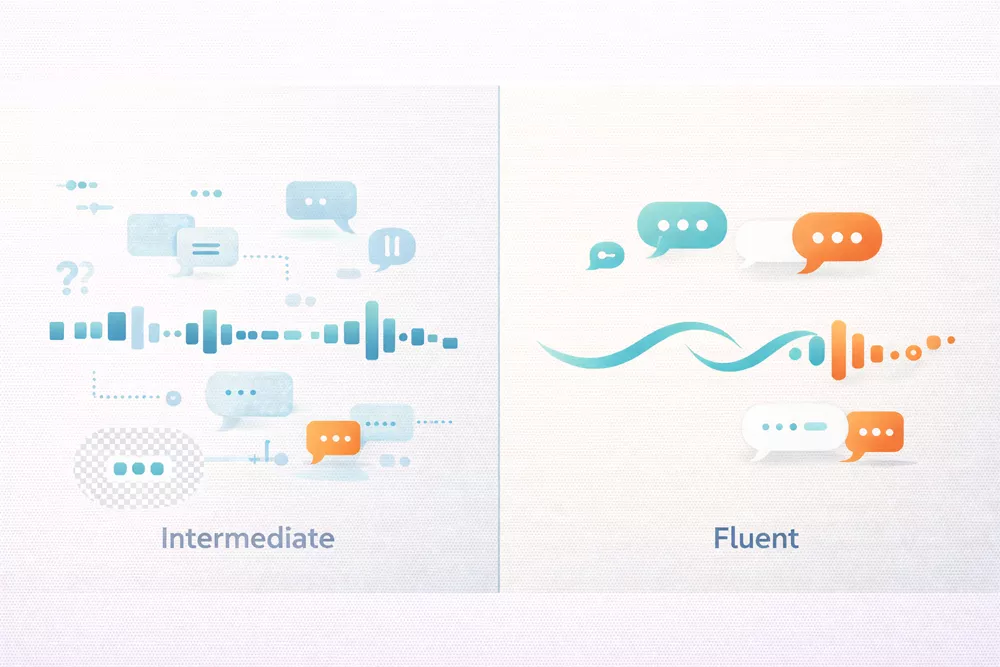
A job posting asks for "fluent English." The candidate reading it calls their own level "intermediate" and has no idea whether that disqualifies them before the interview even happens. The gap between those two words matters more in moments like this than in casual conversation, where nobody's checking credentials – and what actually separates fluent vs intermediate comes down less to the label itself than to which tasks someone can handle without friction.
What does intermediate mean in practice, beyond the label on a resume? Someone at that level can usually get through a short work call about a familiar topic, though the pace slows and pauses creep in once the conversation shifts somewhere unexpected. Writing a message explaining a problem works fine on familiar ground – a delayed shipment, a scheduling conflict – but the same task on an unfamiliar subject tends to expose gaps fast. Following the main point of a meeting is manageable; catching every side comment usually isn't. When a specific word won't come, an intermediate level speaker often stops and searches for it rather than working around it mid-sentence.
Typical intermediate tasks:
Handling routine situations such as travel or basic work coordination;
Following the main idea in structured content like short presentations or articles;
Writing short, clear messages with occasional grammar or vocabulary errors.
By this stage, sentences get built from scratch rather than recycled from memorized phrases, which opens up describing familiar experiences in some detail. The friction shows up specifically when a conversation veers off-script – someone explaining their job smoothly can still stall completely when a colleague asks an unexpected follow-up question that requires reworking the whole explanation on the spot, not just repeating it slower.
Signs you're intermediate, not beginner:
You combine known words to express new ideas;
You understand everyday conversations on familiar topics;
You still pause when searching for precise vocabulary.
What does fluent mean, then, if not perfect grammar or a flawless accent? What it actually means is holding up a conversation with relatively little visible effort – explaining an idea without a long pause first, without mentally drafting the sentence in another language, without stalling out when a word doesn't come immediately. A fluent speaker on the same work call handles the topic shift that would trip up an intermediate one, keeps writing the same problem-explanation email at a similar pace, and answers the meeting's side comments along with its main points.
A fluent speaker asked an unexpected follow-up question mid-explanation tends to just keep going – rephrasing on the fly, working around a missing word by describing it another way, rather than stopping to search. None of this requires perfect grammar or a flawless accent; a fluent speaker can absolutely mangle a verb tense and still finish the thought without losing the thread of the conversation.
Resumes, job ads, and course descriptions all lean on the same handful of levels of language fluency – intermediate, fluent, advanced – without agreeing on what any of them actually require. A hiring manager reading "fluent" on one resume and "advanced" on another has no real way to know which candidate handles a harder conversation, since neither word maps to a fixed, universal standard.
That gap is exactly why official proficiency scales exist. A test score or a CEFR level describes a specific, checkable set of abilities rather than a label someone assigned themselves – useful precisely in situations, like exams or formal applications, where a structured scale gets compared across many candidates at once. Day-to-day conversation rarely bothers with this precision, and doesn't need to.
|
Where the label appears |
Why clearer levels help |
|
Resumes |
Employers try to gauge whether someone can actually work in the language or only manage basic conversation |
|
Job advertisements |
The stated level hints at how complex the role's communication will be |
|
Language courses |
Level descriptions help place learners in a class that's neither too easy nor too hard |
|
Exams |
Standardized scales make results easier to compare across different candidates |
Intermediate ability generally lands somewhere around B1-B2 in the CEFR framework, depending on which specific skill gets measured. "Fluent" isn't one of CEFR's official bands at all – it's an informal label people often reach for once they're operating comfortably at a strong B2 or above, but that usage varies by context and doesn't guarantee equal strength across reading, writing, listening, and speaking. ACTFL uses its own terminology entirely, so the exact wording shifts depending on which institution is doing the describing.
When to use CEFR wording:
When applying for jobs or academic programs;
When comparing language courses across schools;
When tracking progress over time with clear benchmarks.
Is fluent or intermediate better for a particular job or study goal? Neither wins outright – the better fit depends entirely on which tasks someone actually needs to handle, not on which label sounds more impressive on a resume.
If you need work meetings → focus on explaining ideas clearly, asking follow-up questions, and summarizing decisions.
If you need exams → target a specific scale level and keep all four skills balanced.
If you need daily life → prioritize stable listening comprehension and quick responses in routine conversations.
An intermediate level can carry someone through plenty of international roles just fine, provided the actual day-to-day tasks stay within what that level supports; it's the mismatch between label and task, not the label itself, that tends to cause trouble.
Intermediate generally means handling real tasks with some visible friction – simplifying, pausing, losing pace once the situation shifts. Fluency means keeping the conversation moving with much less effort, recovering quickly after a gap, paraphrasing instead of freezing. The clearest way to tell which one actually describes you: try the same few tasks – a short work call, an email explaining a problem, a two-minute explanation with no script – and notice where the friction actually shows up. Testizer's online level check works as one way to get a second data point on that before setting a target to improve toward.
If familiar tasks go smoothly even with occasional pauses or simplified wording, that's intermediate – the key marker is understanding without leaning on memorized scripts. Recording a 60-second explanation of something familiar and counting the restarts gives a rough, honest measure.
Yes, and it's common enough that specifying "spoken fluency" is fair when that's the accurate picture. Writing tends to expose accuracy gaps that speech glides past unnoticed.
Mostly in recovery speed. A fluent speaker missing a word rephrases and keeps moving; an intermediate speaker often loses several seconds mid-sentence searching for the exact term before continuing.
It depends heavily on how much live conversation and correction someone gets, not just total study hours – passive exposure alone tends to move the needle far more slowly than regular real-time practice with feedback.