
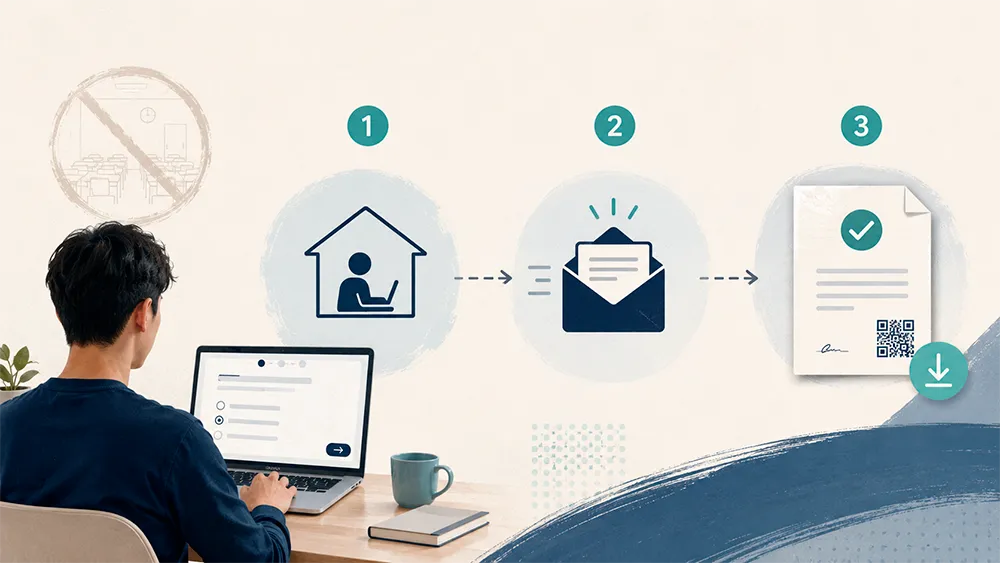
A verifiable language certificate exists that you can earn entirely online today, no test center booking required. You get a proficiency result and a downloadable certificate employers can check in seconds.
A recruiter asked for proof of Spanish, and the applicant spent the evening comparing exam boards instead of updating the actual application. That's the trap: the real question was never "which credential is most official in general" – it was "does this specific certificate satisfy this specific request." A job posting mentioning B2 French rarely cares which accreditation body issued the result, only that a result exists and looks credible.
Once the actual requirement gets named – a line on a resume, a LinkedIn skill badge, an internal HR checklist – a language certificate without a test center usually covers it fine, and the search for the "most legitimate" option turns out to be solving a problem nobody asked about.
Twenty-five minutes covers the test itself. Results land in your inbox the moment you submit – no waiting period, no grading queue. If a certificate is needed on top of the result, it becomes available right after a $10 payment, already carrying your name, language, and level. Someone starting at lunch could have a finished, verifiable online language certificate in hand before the workday ends.
Job applications, CV updates, LinkedIn profiles, corporate HR screening, and internal skills assessments all accept this kind of result comfortably – none of them require a physical exam behind it. Visa applications and official university admissions sit in a different category entirely, where internationally accredited exams and official immigration tests are typically the only accepted proof. Mixing up these two categories is the single most common source of disappointment, so it's worth checking which one actually applies before assuming either way.
A PDF lands with your name, the language tested, your CEFR level, and the date – plus a QR code an employer can scan to pull up a public verification page instantly. No phone calls, no waiting on a reference check, no separate email confirming authenticity. That scan either confirms the certificate or it doesn't, on the spot.
A CEFR certificate online only carries weight if the scoring behind it is consistent, which is why the test itself was built by methodologists and linguists rather than assembled from generic trivia questions. Twenty-five questions, roughly 25 to 45 minutes depending on the level being tested, and a result mapped directly onto the six standard CEFR bands from A1 to C2 – the same scale recognized across dozens of countries and industries. That consistency is what lets a verifiable language certificate online actually function as a stand-in for a longer, in-person process.
Testizer runs this process end to end. Open the platform, pick the language you need tested, complete the assessment, then get your result by email with the certificate available to download right after. Four steps, no scheduling, no travel – the entire thing fits into a lunch break for most languages.
The same process works across the full range of languages Testizer covers, not just one – an online language proficiency certificate in French looks and functions identically to one in Spanish or Russian, each scored against its own CEFR benchmarks. Testing more than one language just means repeating the same four steps.
Roughly 25 minutes for most languages, start to finish. Results arrive by email the moment the test ends, with no separate processing wait.
For job applications, CV updates, and internal screening, yes – the QR code lets them verify it directly rather than taking your word for it. Visa and university admissions offices are the exception; those typically require a specific accredited exam instead.
Yes, each language runs as a separate test with its own result and certificate. Nothing stops you from testing two or three languages back to back if a role calls for it.
It's valid for what it's designed for – professional and HR contexts that just need a verifiable proficiency signal. It's not a substitute for an accredited exam anywhere that specifically requires one, like immigration paperwork.