

Nobody can give an exact answer to how many words are in the English language – and that is not a gap in research. The language changes constantly: new words enter, old ones fall out of use, and technical fields generate terminology faster than any dictionary can track.
That methodological problem is why estimates range from 500,000 to over a million. But still – how many words are there in the English language? The answer shifts depending on what counts as a word and who is doing the counting.
The core problem is definitional. Exactly how many English words are there? The answer shifts dramatically depending on whether you include technical terminology, archaic forms, dialectal variants, or inflected versions of the same root. Count every known chemical compound name and the total runs into the tens of millions – far beyond what any dictionary records or any speaker encounters.
Compound words create another layer of difficulty. "Blackbird," "black bird," and "black-bird" can be treated as one word, two words, or a hyphenated form depending on the style guide. Multiply that ambiguity across hundreds of thousands of entries and the count becomes a methodological question as much as a linguistic one.
How many words are in the English dictionary depends on which dictionary and how entries are counted. The Oxford English Dictionary – the most comprehensive historical record of the language – contains over 600,000 definitions, but definitions and individual words are not the same count. Estimates for words in current active use across major dictionaries sit closer to 170,000–230,000 entries.
A dictionary is a curated selection, not a complete inventory. Editorial teams decide which words meet the threshold for inclusion – which means most technical jargon, proper nouns, highly specialized terminology, and recently coined slang never appear. The OED itself takes years to add new terms through a formal review process. What a dictionary contains reflects those decisions as much as it reflects the language itself.
The number of words in English most commonly cited by researchers falls between 500,000 and 1 million, depending on methodology. The Global Language Monitor estimated that English passed 1 million words around 2009 – a figure that generated significant attention but also significant disagreement among linguists, largely because the counting method included technical and scientific terms that most speakers never encounter.
Most linguists treat such estimates cautiously. The useful takeaway is not the specific number but the scale: English has a vocabulary range that no single speaker comes close to covering, and any precise figure reflects a set of methodological choices as much as a measurable reality.
English vocabulary size varies significantly between active and passive knowledge. A native speaker's active vocabulary – words used regularly in speech and writing – sits at roughly 20,000–35,000 words. Passive vocabulary, which includes words recognized when encountered but rarely produced, can reach 40,000–70,000.
Research by Nation and Waring found that knowing the 1,000 most frequent English words covers approximately 85% of everyday spoken conversation. The gap between "how many words exist" and "how many words a person needs" is significant – fluency does not require anywhere near the full breadth of the language.
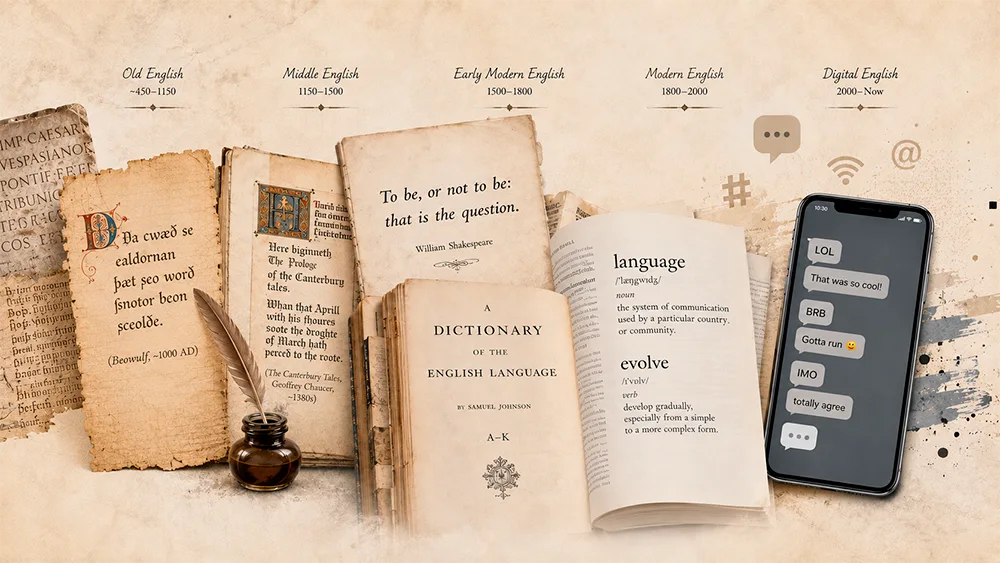
English accumulated vocabulary from multiple sources over centuries – a process that has no equivalent in most other major languages. The result is a lexicon that draws from Germanic, Romance, and classical roots simultaneously.
Roughly 29% of English vocabulary traces to French, 29% to Latin, and 26% to Germanic sources. The Norman Conquest of 1066 accelerated that mixing dramatically – thousands of French words entered English within generations, often creating synonym pairs where other languages have one word. "Ask" and "inquire," "buy" and "purchase," "begin" and "commence" each came from different linguistic streams and both survived. That layering is why English has so many near-synonyms and why its total word count dwarfs most comparable languages.
The Oxford English Dictionary adds approximately 1,000 new words, senses, and sub-entries per quarter. That pace reflects how many English words exist across technology, social media, scientific naming, and cultural borrowing – all of which generate new vocabulary faster than formal review processes can track.
Some additions come from obvious sources. "Selfie" entered the OED in 2013; COVID-related terminology appeared within months of the pandemic. Others arrive more quietly – specialist terms from medicine, computing, or finance that cross into general use gradually, without a single identifiable moment of adoption. The language does not wait for permission to expand.
The total number of English words cannot be fixed to a single figure – the language is too large, too varied, and too active for a stable count. Dictionaries capture a curated slice, estimates depend on methodology, and the language keeps adding entries faster than any inventory can close.
If you want to check how your English vocabulary and comprehension hold up in practice, Testizer's English tests online give a quick CEFR-aligned result by email.
English vocabulary is unusually large by most estimates, partly because of its history of borrowing from French, Latin, Germanic, and other sources simultaneously. Direct comparison is difficult – languages count and categorize words differently, and no universal methodology exists for measuring total vocabulary across languages.
English vocabulary size for a fluent native speaker typically falls between 20,000 and 35,000 words in active use, with passive recognition extending to 40,000–70,000. Fluency does not require knowing most of the language – the most frequent 1,000 words cover the majority of everyday conversation.
Linguistically, yes – slang is a natural part of how language evolves and spreads. Whether slang appears in a dictionary depends on editorial decisions about currency and usage frequency. Many slang terms eventually enter formal dictionaries after sustained use; others disappear before reaching that threshold.
The Oxford English Dictionary adds approximately 4,000 new entries, senses, and sub-entries annually – roughly 1,000 per quarter. That figure covers only what meets the OED's inclusion criteria. Informal coinage, technical terminology, and regional vocabulary that never reaches formal review adds considerably more to the language in active use.
Each dictionary sets its own criteria for inclusion – which technical terms qualify, whether archaic words are retained, how compounds and inflected forms are counted. Those editorial decisions produce different totals even when compilers are working from the same underlying language. A word count is always a reflection of methodology as much as vocabulary.