

Someone spends two years watching shows in English, scrolling through vocabulary apps, and following grammar accounts, then freezes the first time a coworker asks a follow-up question in a live meeting. Figuring out how to improve English at that stage means something different than it did at the start – the plateau usually traces back to one specific skill, since vocabulary, speaking, pronunciation, and grammar rarely stall or improve at the same pace. Getting unstuck starts with naming which one actually fell behind, and building how to improve English practice around that gap specifically.
Progress tracks less with total hours spent around the language and more with how those hours split between absorbing it and producing it. Someone who spends fifty minutes an hour reading or watching content and ten minutes speaking or writing will see vocabulary recognition grow steadily while spoken fluency barely moves for months. Flip that ratio – even to something like thirty minutes of input and twenty of active output – and the two skills start closing distance with each other. English improvement happens fastest when practice time gets allocated deliberately across specific skills rather than defaulting to whatever feels comfortable, which for most adult learners means more consumption than production.
Fifteen to twenty new words a week works well for most adult learners with regular exposure – push past that number and recognition tends to outrun actual retention. A word picked up inside a full sentence sticks in a way an isolated flashcard entry rarely does, since the brain attaches it to a grammatical slot and the words around it, not just a dictionary definition. Learning "reluctant" through "she was reluctant to commit" leaves a different kind of memory than pairing "reluctant" with "unwilling" on a card.
The loop that makes this stick: catch a useful phrase somewhere in something read or heard, jot down the whole sentence it came from, then reuse that exact structure once, out loud or in writing, before the day ends. Most vocabulary apps stall out right at this last step – how to improve vocabulary long-term depends on it more than on how many new words get logged each week.
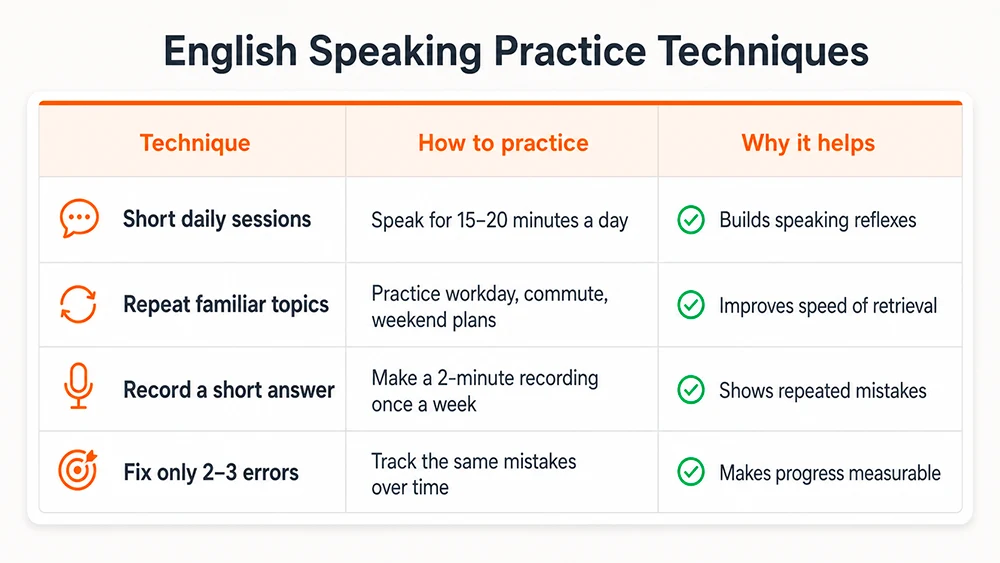
Speaking is a motor skill as much as a mental one, which is why short daily sessions beat a single long one – the muscles and reflexes involved need frequency more than duration, closer to fifteen or twenty minutes a day than an hour crammed into one sitting once a week. Picking two or three recurring topics (the workday, a commute, weekend plans) and cycling through them repeatedly builds more fluency than chasing variety, since the goal at this stage is speed of retrieval, not breadth of subject matter.
Once a week, recording a two-minute answer and listening back for whichever two or three mistakes keep showing up – not every flaw – turns practice into something that actually corrects itself over time. Tracking three specific errors and fixing them one at a time is what how to improve English speaking actually looks like in practice, far more than chasing broad daily conversation on unrelated topics every session.
Shadowing a short clip – twenty to thirty seconds, repeated daily for a week – trains rhythm and stress patterns faster than trying to fix pronunciation sound by sound. Most accent friction traces back to two or three specific sounds or stress patterns that repeat across many words, not a general lack of clarity across the whole language.
Isolating the two or three sounds that actually cause misunderstanding, then drilling only those, is the practical version of how to improve accent in English – smoothing out an entire accent at once almost never works as well.
Study a grammar point only when it's tied to a mistake actually happening in real speech or writing – never just because it's next in the book. Someone who keeps mixing up past simple and present perfect telling a story about yesterday gains more from ten sentences built around that one pattern than from a whole chapter on tenses already handled fine.
Three ways to spot which patterns need the work: record a two-minute answer and mark every tense or article slip, run a written paragraph through a grammar checker and watch for a repeating error type, or ask a fluent speaker to flag only the slips that actually changed a sentence's meaning. One pattern a week, ten sentences built from real personal topics instead of a textbook's fixed order – that's how to improve English grammar once it becomes a habit.
Passive listening expands recognizable vocabulary without training the speed of pulling that same word back out in live conversation – two separate skills that feel connected but develop on different timelines. Someone can understand a word instantly in a podcast and still hesitate for two full seconds trying to produce it themselves mid-sentence.
Most learners skip one step that closes this gap: after a short clip, jot down two or three phrases worth keeping, then say them out loud that same day. That same-day jump from hearing to speaking is what actually ties vocabulary to fluency – skip it, and the two skills just develop side by side without ever touching. This is how to improve English vocabulary and speaking skills together rather than as two separate tracks.
A short meeting or a work email beats any generic conversation drill – the stakes are real and the phrasing needed is specific. Prepping two or three key phrases for one situation (explaining a delay, asking for clarification, disagreeing politely) works better than scripting an entire exchange, since real conversations rarely follow a script anyway.
Walking into a meeting with one ready line – "I need more time on this" – beats improvising the whole sentence live. How to improve communication skills in English at work comes down to that kind of narrow prep, repeated enough times that the phrases stop sounding rehearsed.
Vocabulary, speaking, pronunciation, and grammar rarely move at the same pace, which is exactly why a plateau in one area can coexist with steady progress in another – someone might sound noticeably more fluent in conversation while still making the same grammar mistakes they made a year earlier. Treating these as separate tracks, each with its own realistic weekly target, makes uneven progress far less confusing than expecting everything to improve together.
Checking in periodically with an English language level test shows which specific skills have actually moved and which ones still need the kind of narrow, targeted practice described above – a clearer signal than simply feeling more comfortable in the language overall.
Six to eight weeks of consistent practice, generally – enough for someone else to actually notice a change, though which skill moves first depends entirely on where the effort went. Vocabulary tends to shift fastest of the four, since recognizing a word responds to exposure quicker than a motor pattern like pronunciation ever does.
It helps vocabulary recognition and listening comprehension specifically, but it doesn't train speaking on its own – someone can watch hours of English-language film and still struggle to produce a sentence live, since recognition and production are different skills built through different practice.
A new word can be used correctly the same day it's learned. A grammar pattern needs to become automatic under real-time pressure, which takes repeated production over weeks rather than a single moment of understanding the rule.
Recording the same kind of speaking task – a two-minute answer to a familiar prompt – once a month and comparing recordings directly shows more than a general feeling of comfort. Fewer repeated mistakes and faster response time in the same task are concrete signs; feeling less anxious in conversation isn't always one.