

A colleague asks a simple follow-up question on a call, and suddenly the English that felt effortless during last night's Netflix episode is nowhere to be found. That's usually where things actually break down – not vocabulary, not grammar rules, just the jump from following along to producing something on the spot. The same gap shows up in study routines too: two lessons a week, faithfully attended, with almost no real use of the language in between.
Before building a plan around either problem, it helps to know where things actually stand. A quick level check – something like Testizer offers – beats weeks of guessing at the wrong material, especially for anyone trying to learn English fast without wasting a month on the wrong textbook.
Speed, in the way that actually matters, means something narrower than most people assume. Someone who can handle a short work call, write a plain email, or answer a question at a hotel desk without mentally translating first is already moving fast – even with unremarkable grammar. The real test shows up under mild pressure, in the moment there's no time to think in another language before responding.
Most progress happens closer to an hour a day, most days, than in occasional marathon sessions. Sixty minutes repeated daily outperforms a single three-hour Sunday block followed by six quiet days – repetition spread out simply sticks better than the same hours crammed together.
Three habits tend to separate people who learn English quickly from everyone else: daily contact with the language, even briefly; actually producing it – speaking or writing – instead of only absorbing more of it; and staying close enough to the same three or four recurring mistakes to actually fix them, rather than letting a fresh one slip through every week.
Watching shows and listening to podcasts creates a specific illusion worth naming: a word heard for the hundredth time starts to feel familiar, and that familiarity gets mistaken for actually knowing it. Recognizing something on the fly and producing it from scratch mid-sentence draw on entirely different mental processes – which is exactly how someone can follow native-speed audio comfortably and then stall out trying to say that same word a minute later in a live exchange.
A second, quieter trap is picking the wrong difficulty level. Material that's too advanced burns people out within a couple of weeks. Material that's too easy feels comfortable enough to keep repeating without much real gain – arguably the more common mistake, since it doesn't feel like failure while it's happening.
The last issue is what gets tracked. Counting hours studied feels satisfying, but hours alone don't reveal what changed. Someone who logged twenty hours last month with no sense of which mistakes got corrected knows less about their own progress than someone who tracked five recurring errors and fixed three of them.
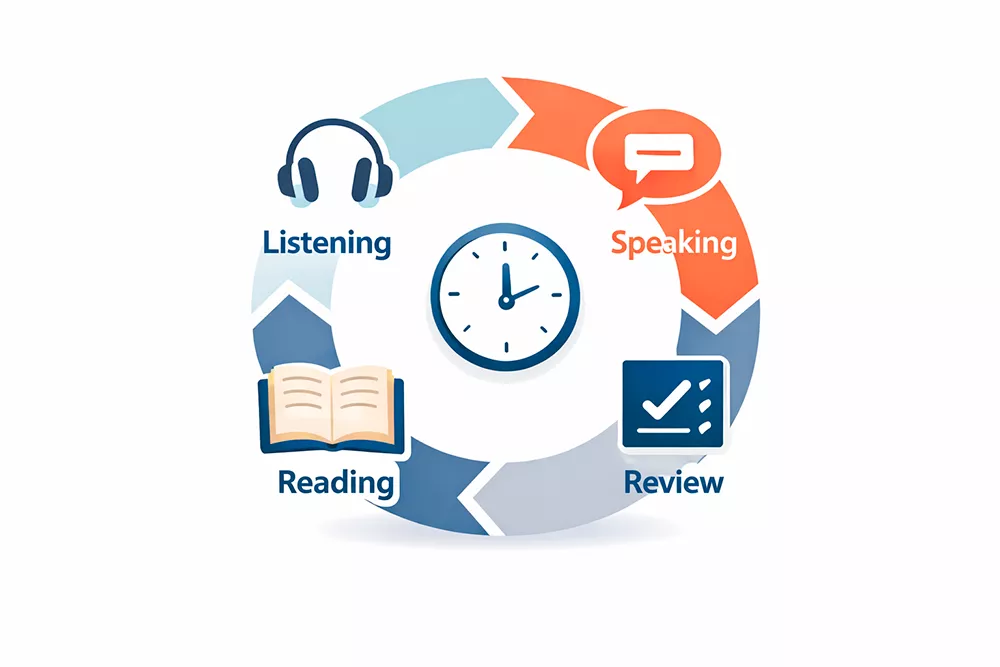
A handful of habits explain most of the gap between fast progress and months stuck on the same plateau. None of them demand more hours – they just aim the hours already there at the right target.
"On the way." "I'm supposed to…" "Could you…?" These earn their spot because real conversation leans on them constantly, and learning the whole chunk means it's ready the moment a similar situation shows up. Take "I'm supposed to" – it works because it strips out grammatical planning mid-sentence entirely. No calculating modal verb order on the fly, just grabbing something already assembled, which leaves more attention free for the actual point being made. That's most of what easy learning English comes down to in practice: fewer stray words memorized one at a time, more ready-made chunks. Drop a new expression into a full sentence rather than a bare translation, and the words around it stay stuck to it too.
Most people delay speaking until their vocabulary "feels ready," and that wait is usually what causes the freeze – plenty of understanding, almost nothing coming out. A smaller starting point works better: thirty seconds on something familiar, like a job or a commute, then sixty seconds once that stops feeling awkward. Weekend plans or a recent purchase work just as well as topics – the point is talking about things already known, not reaching for new vocabulary mid-sentence.
Once those shorter answers feel manageable, stretching one to a full two minutes and recording it works as a natural next step. Listening back specifically for the two or three mistakes that keep repeating – not every small slip – tends to matter more than the recording itself.
Grammar earns its study time only when it targets a mistake actually being made, not the next chapter in a textbook. Mixing up past simple and present perfect while describing yesterday, for instance, rarely confuses a listener – but the speaker hears their own hesitation every time it happens, and that repeated self-correction erodes confidence faster than the grammar error itself ever would. That's the real argument for picking one pattern a week based on where errors cluster, then building ten spoken sentences around it using topics that actually come up.
The best way to learn English rarely comes from a new method – it comes from a fixed daily plan that removes the need to decide, every single day, what to listen to, read, or review. Once the plan exists, showing up becomes the only decision left.
A workable structure runs about 60-90 minutes: fifteen minutes of listening to something mostly followable, fifteen minutes reading a short piece and pulling out a few chunks worth keeping, twenty minutes of speaking through timed answers and shadowing, ten minutes writing a short message, and a final ten minutes fixing whatever mistakes surfaced that day.
A weekly rhythm keeps that daily plan from turning into scattered, directionless study. Five or six days should follow the model above. One weekly pressure test works well as the centerpiece – a three-minute talk, a short email, or a mock interview answer, whichever fits that particular week – closed out by listing the ten mistakes that came up most and rewriting each one correctly.
Listening, speaking, reading, and writing work best chained together around one topic rather than practiced in separate boxes. Take an upcoming work trip: listen to a short clip about travel, pull three phrases worth keeping, say them out loud with personal details swapped in, then write four or five sentences reusing the same chunks. One phrase, three different uses, inside a few minutes – that's some of the more practical English learning tips for making anything actually stick.
Ten focused minutes daily beat an hour crammed in once a week – the brain stays warmed up instead of cold-starting each time. A small notebook of phrases works too, as long as it's limited to things actually sayable this week, not rare words that'll never come up.
Switching your phone and social media to English costs almost nothing and puts you in contact with the kind of everyday language you'll genuinely run into. Short podcasts or clips work for listening; slow the playback if the speaker moves too fast. Letting it play in the background isn't enough – summarize the idea afterward in a couple of sentences, or jot down a phrase or two worth keeping.
Sentence mining is worth trying too: collect full sentences as they come up, then reuse them later with small swaps. That habit, more than most others, is what makes language feel ready when a real conversation happens.
A quick level check before adjusting the routine gives a baseline worth building from.

The right activity depends heavily on where someone's starting from – the same task that helps one learner can waste another's time completely.
At the beginner stage, the priority is survival output: introducing yourself, asking basic questions, ordering food, getting directions, handling a simple work message. Graded stories with audio work well here, since they're built to follow without pausing every sentence. Reading five to ten lines aloud each day, then sending one short voice message to a partner using a couple of phrases from that day's material, builds momentum faster than most people expect.
Intermediate learners tend to hit a different wall – plenty of input, but little practice turning opinions into clear, connected speech. A weekly twenty-minute "real talk" session with a partner, corrections saved until the end rather than interrupting mid-sentence, tends to move the needle faster than another hour of passive listening. Building vocabulary around concrete goals – an upcoming interview, a relocation, a trip – beats working through random word lists at this stage.
For advanced learners, the friction usually isn't a missing word – it's reaching for the first word that comes to mind instead of the more precise one, simply because there's no time left in the conversation to search for something better. Precision at this level is less a knowledge gap and more a matter of how quickly someone can access a wider vocabulary under pressure. Replacing weak verbs and adjectives in writing, then paraphrasing the same idea two different ways, builds exactly that kind of speed. For pronunciation, picking the three most persistent errors and drilling them directly, then shadowing a short clip for five minutes a day, locks in rhythm and stress – often the fastest way to improve English quickly once the basics are already solid.
Improvement doesn't follow a fixed calendar, but it does tend to move in a recognizable order. Comprehension and set phrases usually shift first – within the first few weeks, most learners notice they're following conversations more easily and reaching for stock phrases without hunting for them. Spontaneous, unscripted speaking takes longer, and not because it's harder in some vague sense: a listener can lean on context and let language wash over them, while a speaker has to pull every word out of memory alone, with nothing to fall back on. That asymmetry between understanding and producing isn't a sign of bad methodology – it's just how the two skills work.
Daily time investment stays close to 60–90 minutes at every level, so the real variable is what that time buys, not how much of it there is. A beginner spends it building basic understanding and a stock of set phrases, while spontaneous speaking stays the harder, slower piece for a while longer. An intermediate learner usually notices faster listening and smoother replies arriving first, with range and accuracy across topics taking more time to settle. An advanced learner sees clearer writing and finer nuance show up earliest, while precision under real pressure – a negotiation, a tense meeting – keeps demanding more practice long after everything else has caught up.
None of this moves on a guaranteed schedule. A monthly check-in tends to give a more honest read on whether the plan is actually working than daily self-monitoring does – daily comparisons are too short a window to catch real movement, and they tend to discourage people right when consistency matters most.
Fast, in the sense that actually matters, means reaching real use sooner – a workable conversation, a clear email, a moment handled without translating first – not some finished, effortless fluency arriving all at once. The equation holds regardless of the details: frequent contact, early speaking, a tight focus on whatever mistakes keep recurring.
One concrete move: block out tomorrow's 60-90 minutes right now, and pick one speaking task to finish during it, even a short one.
Convert passive knowledge into short, timed speaking. Thirty to sixty seconds on a simple prompt, then listen back and pull out one or two fixes – not every flaw. Save corrections for after finishing, never mid-sentence. A daily two-minute recording, rewritten with the fixes applied, builds the habit fast.
A small set of fixed phrases, reached for without thinking, does most of the work. Narrating small actions in simple English – making coffee, leaving the house, checking the time – keeps the pressure low enough for it to actually stick. Five default phrases, run through in your head for five minutes a day, tend to surface on their own before long.
Base it on actual roles and situations, not a generic list. High-frequency chunks tied to work, travel, or study earn their place; anything unlikely to come up in the next month probably doesn't. Two columns – use this week, save for later – with nearly all the attention going to the first.
Narrow down to two or three sounds causing most of the confusion, rather than chasing everything at once. Shadowing a clip, then recording and comparing, exposes rhythm and stress problems faster than any rule ever could. Repeating the same twenty seconds daily for a week is usually enough to hear one clear shift.