

Someone hears their own thoughts translate mid-sentence, right when speed matters most in a live conversation. Mental translation adds roughly 200 milliseconds of delay to every sentence - enough to lose a turn before the response even finishes forming. Figuring out how to think in English comes down to retraining a habit, not fixing some permanent limitation.
The brain defaults to whatever pathway fires fastest, and for most learners that's still the native language - worn smooth by decades of use, while the English pathway stays newer and less automatic. Translation isn't laziness. It's the brain taking the route with less resistance.
Native speakers across languages leave a gap of almost exactly 200 milliseconds between turns in conversation - a pattern that holds cross-culturally, according to research from the Max Planck Institute for Psycholinguistics. That number sits right at the edge of normal human reaction time, which is why a translated response rarely makes it out in time. Push past roughly 300 milliseconds of silence and the gap starts reading as hesitation or reluctance to a native listener, even when nothing's actually wrong - just a translation running behind schedule.
Sentence structure takes a separate hit. A phrase carried over word-for-word from another language often lands grammatically correct but off - technically fine, unmistakably non-native. Catching these calques before they harden into permanent habits does more to improve English fluency than piling on extra vocabulary ever could.
Breaking this cycle doesn't happen through more grammar drills. It happens through direct practice - building English thoughts without a detour through the native language first, which is the entire mechanism behind how to stop translating in your head.
People assume they need to think in English faster, as if the goal were quicker translation rather than no translation at all. Professor Panos Athanasopoulos at Lancaster University found something more specific: bilinguals genuinely perceive situations differently depending on which language they're operating in at that moment - not just describing the same thought in different words, but forming a different thought entirely.
A bilingual asked to describe a spilled cup of coffee might frame it as an accident in one language and as something more deliberate in another, purely based on which language shaped the observation. Language isn't a wrapper around thought. It's part of how the thought gets built in the first place.
That distinction matters for anyone trying to sound more natural. Fluent speech doesn't come from faster translation - it comes from skipping the translation step entirely, forming the thought in English from the start.
FSI research points to roughly 480 hours of focused study as the threshold where English-first thinking starts feeling more natural than translated thinking. That number isn't a magic line - it's an average, shifting with daily consistency and whatever exposure came before.
An hour a day gets someone there in about sixteen months. Thirty minutes daily stretches that closer to two and a half years. Neither timeline promises fluency on a fixed date. Both mark the point where translation stops being the automatic default - not where the whole process wraps up.
Nobody clears this threshold in a weekend, and any claim otherwise skips over how slowly the brain actually rewires language processing pathways. What moves the number forward is showing up daily, not cramming hard for a few days and stopping.
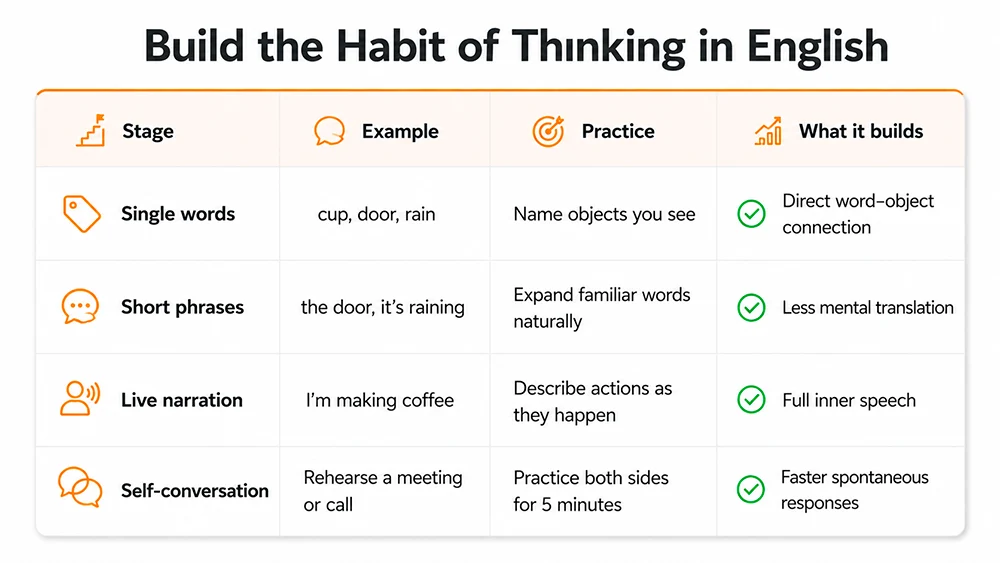
Full sentences ask too much too soon. A single noun - "cup," "door," "rain" - takes almost no cognitive effort to produce silently, which makes it the right starting point before attempting to think in English in complete thoughts.
Naming objects first builds a direct link between the object and the English word, skipping the native-language middleman entirely. That link strengthens with repetition until the English word arrives first, automatically, without the translation step ever activating.
Once single words stop requiring effort, short phrases follow naturally - "the door," "it's raining." Full sentences come last, built on a foundation that's already stopped relying on translation for the basics.

Three specific English immersion techniques move someone from single-word naming into full inner speech, each building on the skill before it rather than replacing it.
Silently naming objects in view - while walking, cooking, riding a bus - trains automatic word retrieval without demanding full sentences yet. A few categories cover most of daily life:
household objects - chair, window, keys, lamp;
food and kitchen items - plate, spoon, fridge, stove;
things seen commuting - car, bus stop, traffic light, sidewalk;
people and actions - neighbor, walking, waiting, talking.
Ten minutes of this, spread across a few short bursts rather than one long session, builds the habit faster than a single twenty-minute block once a day.
Narrating current actions in the present tense - "I'm making coffee," "I'm looking for my keys" - pushes past single nouns into full sentences tied to something actually happening in real time.
This works because inner speech runs on the same neural circuitry as spoken language production - a connection well established in cognitive research on language processing. Silent narration in English trains that exact circuitry, the same one that fires when the words actually leave someone's mouth.
Rehearsing an upcoming exchange - a work meeting, a phone call, an awkward question - silently in English builds readiness for a moment that hasn't happened yet. The rehearsal surfaces vocabulary gaps and awkward phrasing before the real conversation exposes them under pressure, when there's no time left to fix anything.
Five minutes before a specific interaction, running through both sides of the exchange in your head, catches hesitations early enough to smooth them out calmly - instead of live, in front of the person they're talking to.
A few concrete English fluency tips point to genuine progress rather than effort logged for its own sake. The clearest one: the pause before responding shrinks, even on an unfamiliar topic - inching closer to that 200-millisecond window native conversation actually runs on.
A second sign arrives uninvited - an English word beating the native-language equivalent to mind, with no conscious decision to think that way first. It happens, then gets noticed only after the fact, never the other way around.
Progress here rarely moves in a straight line. Someone might think fluently in English about work topics for weeks, then catch themselves translating again the moment an unfamiliar subject - car repairs, medical terms, family slang - comes up. That's not regression. It's the brain building new pathways one topic area at a time, not all at once across the whole language.
Progress runs from single words to short phrases to full sentences, and eventually to spontaneous inner speech that never touches the native language on its way out. Each stage builds directly on the one before it - skipping ahead usually means falling back on translation out of necessity, since the shortcut simply isn't there yet.
None of this requires guessing where the gaps sit. Taking an English proficiency test shows exactly which skills need the most attention right now, rather than spreading practice evenly across areas that may already be solid. Checking in periodically - not just once - keeps practice pointed at whatever's actually holding fluency back at that stage.
Beginners can start immediately, just at the word level rather than full sentences. Naming objects in English while going about a normal day works from day one - the technique scales with ability, it doesn't require a minimum level to begin.
Ten to fifteen minutes, split across short bursts throughout the day, tends to work better than one long session. Consistency matters more than duration - five minutes daily for a month beats one hour once a week.
Thinking in English is the internal process - forming ideas directly in the language without a translation step. Fluent speaking is the external result. The internal habit usually has to come first, since the same neural pathways handle both, and speech tends to lag slightly behind whatever's already happening internally.
Completely normal, and not a sign of doing something wrong. Bilingual thinking rarely arrives as a clean switch - vocabulary gaps get filled with the native language mid-thought all the time, even in people who've been fluent for years.