

Wondering how to track language learning progress in a way that actually shows results? Three methods make it concrete: measuring study consistency, recording output over time, and using periodic structured tests as external benchmarks. Without at least one of these in place, progress becomes invisible – and invisible progress is hard to sustain.
Language improvement is slower and less linear than most learners expect. A system makes the change visible before motivation runs out.
Consistency matters more than total hours. A learner who studies 20 minutes daily for three months builds more durable retention than one who studies three hours twice a month – because spaced, regular exposure reinforces patterns before they fade. Tracking consistency reveals whether the study habit is actually sustainable, not just intensive.
The simplest approach is a log: date, duration, activity type. That data shows patterns – which days get skipped, which formats get avoided, whether the pace is realistic. Without it, effort feels continuous even when it has gaps.
A journal entry from month one and a journal entry from month four contain the same kind of evidence as a before-and-after recording – the gap between them is the language learning milestones that felt invisible while they were happening.
Voice recordings made at the start of each study cycle are particularly useful. They capture fluency, vocabulary range, and pronunciation in a format that is easy to revisit. Most learners are surprised by how much a three-month-old recording reveals when played back.
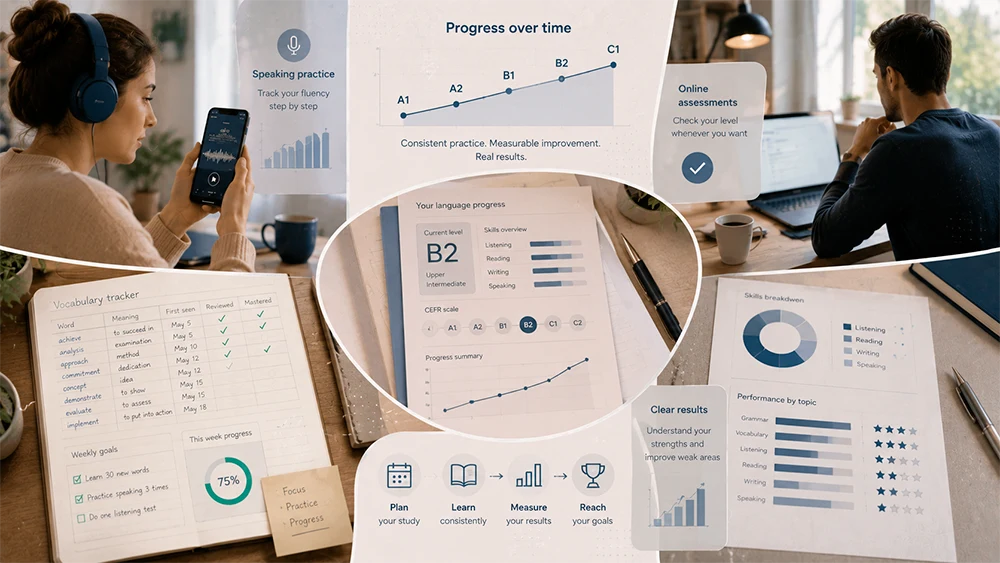
To measure language learning progress reliably, shift attention from study time to real output. The clearest signal is not how many hours went in – it is whether you can do something today that you could not do three months ago.
Concrete moments work better than abstract skill ratings. Understanding a podcast without rewinding, reading a news article without stopping at every unfamiliar word, holding a five-minute conversation on an unfamiliar topic – each of these is a milestone with a date attached. When the learner can name the first time they did something, progress stops being a feeling and becomes a record.
CEFR progress tracking works because the scale describes real tasks at each level, not abstract ability. A learner at B1 can check what B2 looks like – following extended speech, writing clear detailed text, handling most situations while traveling – and use that description as a practical checklist rather than a vague goal.
Language proficiency self-assessment against CEFR also makes ability communicable. Telling an employer or university "I am at B2" carries more shared meaning than "I am intermediate." The framework turns a personal estimate into a reference point others can interpret.
Self-assessment has limits. A structured test at regular intervals gives an objective external benchmark – and the language learning results it produces are usable beyond personal tracking. A certificate attached to a CV or application turns a progress milestone into formal proof.
Testizer offers free language level tests across several languages, with CEFR-aligned results delivered by email and an optional verifiable certificate available after completion. Taking a test every three to four months gives a clear picture of whether the current study method is producing measurable movement.
Take a free language test on Testizer to get an objective benchmark of where you stand right now.
Every three to four months is a practical interval for most learners. That gap is long enough for real improvement to accumulate and short enough to catch problems early. Testing more frequently than once a month rarely shows meaningful change and can create false signals based on test familiarity rather than actual progress.
Combining input tracking with periodic structured tests gives the clearest picture. Logs show whether study is consistent; tests show whether that consistency is producing results. Neither method alone is sufficient – effort without measurable output is hard to interpret, and a test result without context tells you where you are but not why.
Yes, when used at regular intervals. A certificate from a structured test gives a dated, verifiable snapshot of your level at a specific point. Two certificates taken six months apart show movement in concrete terms – not just a feeling of improvement, but a documented shift from one CEFR level to another.
The most practical signal is task performance, not study hours. Check the official descriptors for the next level and assess whether you can handle those tasks comfortably – not perfectly, but without significant effort. A structured test confirms whether that self-assessment is accurate before you commit to a formal exam or application.