

A project debrief ends with half the room holding different takeaways. A safety instruction gets followed incorrectly – not because the employee was careless, but because the phrasing assumed a proficiency level they did not have. These are not isolated incidents. Language barriers in the workplace tend to be invisible until something goes wrong, and by then the cost is already real – in time, errors, and people who stopped participating rather than risk getting it wrong again.
A language barrier at work is any communication gap created by differences in language proficiency, vocabulary range, or communication style. That definition is broader than it sounds. Barriers are not limited to teams where people speak different first languages – they also appear between native speakers when technical jargon, organizational acronyms, or differences in register create misalignment.
A senior engineer writing documentation assumes a level of baseline knowledge that a new team member does not have. A manager from one country uses directness that reads as aggression to colleagues from another. These gaps are language barriers even when everyone involved speaks the same language fluently.
Language barriers at work rarely have a single cause – three patterns appear most consistently across organizations.
A team member operating at B1 English level receiving instructions written for a C1 audience will miss nuance, hesitate to ask for clarification, and produce output based on partial understanding. The gap is not visible until something goes wrong – which is what makes proficiency mismatches harder to manage than more obvious communication problems.
Internal acronyms and industry terminology create barriers even when everyone on the team shares a first language. Onboarding research consistently shows that new employees – particularly those from different industries or countries – spend significant early time decoding vocabulary rather than doing the actual job. That decoding time is invisible to managers but real in its cost.
Cultural barriers in the workplace extend beyond vocabulary. Different cultures have different norms around directness, hierarchy, disagreement, and silence. In some professional contexts, silence in a meeting signals agreement; in others, it signals confusion or reluctance. A manager who misreads that signal makes decisions based on assumed consensus that does not exist.
The effects of language barriers in the workplace are measurable across three areas: operational efficiency, physical safety, and team cohesion.
Language gaps slow every process that depends on accurate information transfer – briefings, handovers, written instructions, client communication. Repeated clarification requests, email chains asking for rephrasing, and meeting follow-ups caused by misunderstood instructions all add time that compounds across a team. A single miscommunication in a project brief can produce a week of misdirected work before anyone identifies the source.
In safety-sensitive environments, language barriers carry direct physical risk. Construction, manufacturing, and healthcare are the highest-risk sectors – a misunderstood safety instruction or a mislabeled hazard can produce an incident that a clearer communication system would have prevented. Written safety procedures that assume high English proficiency create the same risk as verbal instructions delivered too quickly to a mixed-proficiency team.
Employees who struggle to express themselves in the working language often disengage – not from lack of ability, but from the sustained effort required to participate. Team members who cannot contribute confidently in meetings tend to be underestimated by managers and peers, creating a visibility gap that affects career progression independently of actual performance. Over time, that dynamic produces turnover that looks like dissatisfaction but traces back to communication exclusion.
A night shift team takes over a production line after a verbal handover delivered in fast English by a supervisor who assumed the incoming team followed everything. They did not. Two hours later, equipment is down. The root cause is a proficiency gap, not a process failure – but the incident report will not say that.
In a customer service center, an agent at B1 level receives a complaint about a billing error that involves three account changes. The agent catches one of them. The customer is offered a partial fix, declines, and asks for a manager. The agent gets a performance flag. The actual problem was that the role's communication demands exceeded the agent's current English level – a mismatch that a pre-hire assessment would have caught.
On a remote international team, a project brief distributed in idiomatic English produces three different interpretations of the deadline. Deliverables arrive out of sync, the integration phase collapses, and a week of rework follows. The brief was technically clear to its author and opaque to half its recipients.
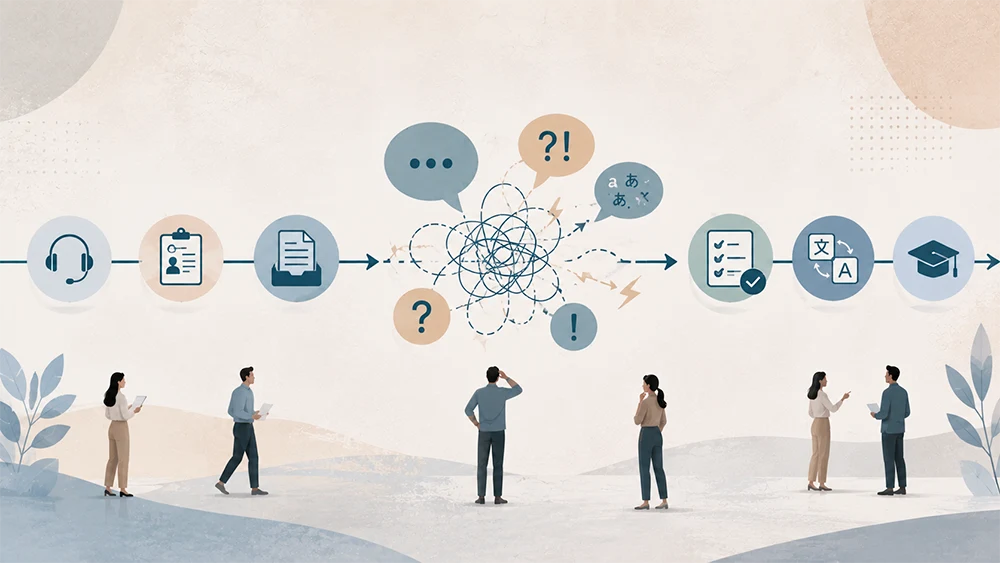
Most organizations address communication problems after they surface – in a failed project, a safety incident, or a client complaint. How to overcome language barriers in the workplace is a more useful question to ask before that point: identify where the gaps are, then address them systematically rather than reactively.
Plain language reduces misunderstanding without requiring anyone to improve their English first. Shorter sentences, active voice, and the removal of idioms and acronyms from cross-team communication lower the baseline proficiency required to understand routine messages. Written confirmation of verbal instructions adds a second channel that catches gaps the first missed.
Overcoming language barriers in the workplace at scale requires structured language development – not just goodwill and patience. Assessment before training identifies which employees need support and at what level, which prevents generic programs that miss actual gaps. Testizer's online English tests for companies allow organizations to benchmark employee proficiency across teams before deciding where training investment is most needed.
A process diagram communicates a six-step safety procedure to a mixed-proficiency team faster and more accurately than a paragraph of written instructions. That is not a technology argument – it is a comprehension argument. Illustrated onboarding checklists, structured email templates, and multilingual signage all reduce the proficiency threshold required to complete routine tasks correctly. The goal is not to replace language development but to stop making proficiency the bottleneck for tasks that do not require it.
Organizations where employees feel safe asking for clarification catch misunderstandings before they become errors. In high-pressure environments, employees often avoid admitting confusion because of perceived judgment from managers or peers. A norm of explicit confirmation – "I want to make sure I understood correctly" – removes that friction and produces more accurate execution without requiring anyone to improve their language level first.
Language barriers at work are a structural issue, not an individual failing. They require systematic responses across communication standards, language development, and team culture – not one-off training sessions or good intentions. Organizations that treat communication gaps as a measurable operational problem rather than a soft HR concern produce better outcomes across safety, productivity, and retention.
To assess your team's English proficiency and identify communication gaps before they affect performance, explore Testizer's online English tests for companies.
A team member who produces strong work independently but consistently misses the point in group settings is often managing a language gap, not a performance problem. The same applies to employees who over-rely on one bilingual colleague, avoid written communication, or respond to feedback with visible confusion rather than acknowledgment. These patterns show up weeks before a formal performance issue does – and a short proficiency assessment confirms or rules out language as the variable faster than observation alone.
Directly. A support agent whose proficiency does not match the communication demands of the role will misread requests, offer misaligned solutions, and struggle under time pressure. Customers experience this as poor service rather than a language issue – but the root cause and the solution are the same.
Yes. Employees who cannot participate fully in team communication tend to feel excluded, underestimated, and passed over for development opportunities. That experience drives turnover that appears in exit surveys as dissatisfaction with culture or management – but often traces back to unaddressed language gaps that made full participation impossible.
Translation tools and structured templates handle the immediate problem – a message gets understood, a task gets completed. They do not close the underlying gap. A team member who relies on machine translation for every client email is managing a workaround, not building a skill. Technology works best when it runs alongside language development rather than substituting for it – reducing friction in the short term while proficiency catches up.
Co-located teams have a layer of context that remote ones do not – body language, tone of voice, the ability to catch a colleague before a meeting to clarify something. Strip those away and a proficiency gap that was manageable in person becomes a recurring source of delays and misalignment. Async communication is particularly exposed: a misunderstood brief sent on Monday may not surface until Thursday's deliverable arrives wrong.