
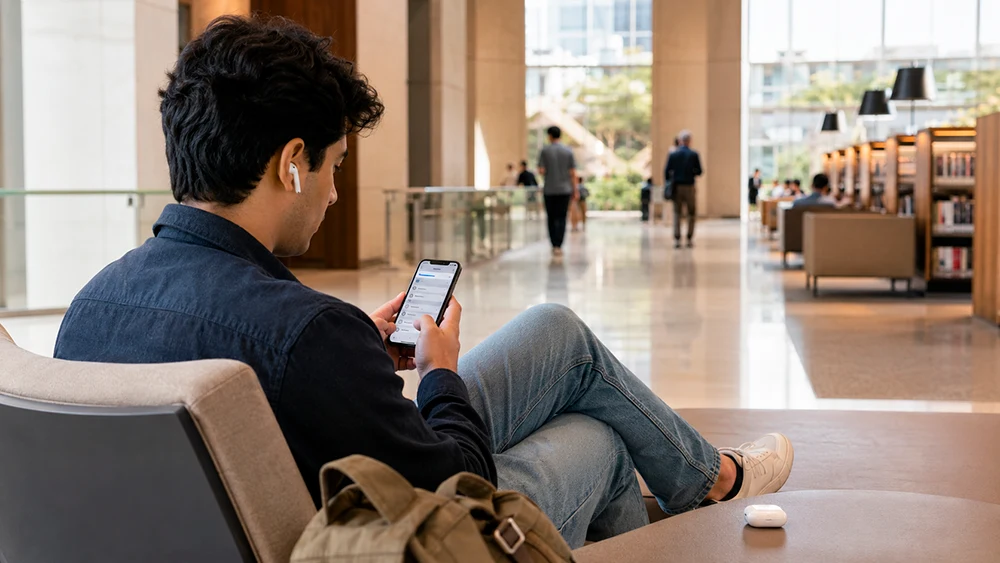
А language proficiency test on phone is entirely doable right now, no laptop required. What you actually get back depends on the type: browser-based tests run fine on mobile, while proctored certification exams almost always need a desktop.
Most app-based quizzes and informal score checks work without issue on a phone screen. Proctored certification exams are a different story - they typically require desktop-level camera setup, a full-size screen for reading passages, and proctoring software that mobile browsers can't run reliably.
Browser-based certification tests skip the proctoring layer entirely, which is exactly why they work on a phone. No camera monitoring, no software install, no minimum screen size - just a timed set of questions running right in the browser. Anyone who wants to take a language test on phone can start one the same way they'd check email.
A mobile test delivers a CEFR-aligned score, a result usable the same day, and - depending on the platform - a certificate available to download.
It won't produce an institutionally accredited result accepted for a visa application or university admission. Those specific processes require a proctored exam from an approved provider, full stop, regardless of how good a mobile score looks.
A score tells the test-taker where they stand. A certificate proves that same thing to someone else - a recruiter, an HR system, a client. Plenty of people finish a free mobile quiz and assume the number alone will satisfy an employer asking for proof.
It won't. A verifiable certificate carries a unique ID and a QR code that lets anyone confirm it's real in seconds, without a phone call or an email chain. That verification layer is the entire difference between a private data point and something someone else can act on.
Opening Safari or Chrome and loading a test directly, with nothing to download first, is the whole appeal for someone who needs a result today. The format stays consistent across providers that build this way: no installation, immediate start, questions on a timer, and a result sent by email once it's done.
That structure matters more than it sounds. A language test on mobile built this way removes every friction point that normally delays a result by hours or days - no account setup screen standing between someone and their score, no app store detour.
Testizer's test opens directly in any mobile browser - no app, no download. It runs 25 minutes, covering grammar and vocabulary, and produces a CEFR-mapped result sent by email as soon as it's finished. If the result looks worth keeping, a $10 payment unlocks a downloadable language certificate on phone - complete with a unique ID and QR code, verifiable by anyone who checks it.
Fourteen options cover most common needs: English, German, French, Spanish, Italian, Czech, Chinese, Russian, Korean, Arabic, Japanese, Portuguese, Dutch, and Polish. Business English and a kids' version round out the English options specifically.
Yes, the questions and scoring work identically regardless of screen size. Nothing about taking the test on a phone changes how the CEFR level gets calculated.
Each language runs as its own separate test, so nothing blocks taking two or three back to back and getting a certificate for each one.
It's valid for exactly what it's built for - professional contexts, CV use, quick proof of level. It doesn't substitute for a proctored exam anywhere one is specifically required, like a visa office or a university admissions portal.