
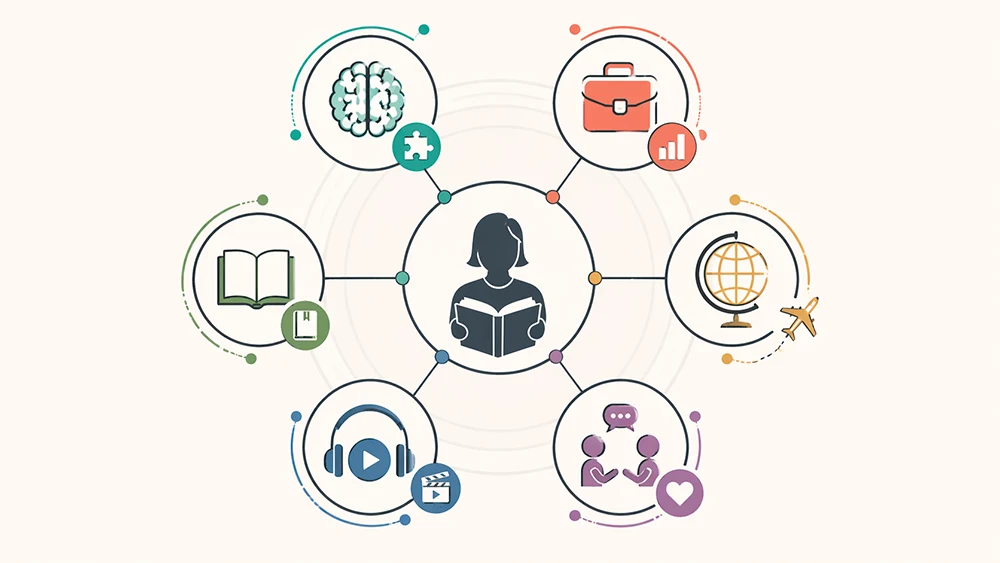
Most people who consider learning a language already sense there are good reasons to learn a new language – but the specific benefits are often less clear than the general idea. Brain function, career access, cultural range, and communication quality all shift with a second language, and the effects are practical rather than theoretical.
This article breaks down the real reasons to learn a new language across cognitive, professional, and everyday contexts – so the decision to start is based on something concrete.
Over 75% of the world's population does not speak English – which means a monolingual English speaker interacts with a filtered version of the world by default. That is one direct answer to why is it important to learn another language: the gap is practical, not philosophical.
It affects which jobs are accessible, which relationships are possible, and which information is reachable. A second language shifts the range of what a person can do and where – not as a side effect, but as a direct consequence of expanded communication range.
The benefits of learning a second language start inside the brain before they show up in any practical context.
Managing two language systems – switching between them, suppressing one while using the other – strengthens working memory and executive function over time. Research from York University found that bilingual individuals show delayed onset of Alzheimer's symptoms by an average of 4-5 years compared to monolinguals. The cognitive load of maintaining two languages appears to build a form of mental resilience that outlasts the learning process itself.
Bilingual individuals consistently outperform monolinguals on tasks requiring selective attention and mental flexibility. The likely mechanism is practice: every time a bilingual person speaks, the brain suppresses one language while activating another. That suppression-and-selection process, repeated thousands of times, builds cognitive habits that carry over into non-linguistic problem solving – faster option evaluation, better focus under competing demands.
The benefits of learning a new language show up earliest and most measurably in the job market.
In the US labor market, bilingual employees earn between 5% and 20% more per hour than monolingual peers in equivalent roles. That premium exists because supply is limited – fewer candidates qualify for positions with a language requirement, which reduces competition and strengthens the applicant's position. A verified language skill can separate two otherwise identical profiles at the screening stage.
In multinational teams, a shared working language reduces friction in day-to-day coordination. A candidate who speaks the client's or partner's native language creates a different quality of interaction – one that translation tools do not replicate. Trust builds faster when communication does not depend on a third layer of interpretation.
Benefits of knowing a second language extend beyond work into how people access and interpret the world around them.
Portuguese has "saudade." Danish has "hygge." Japanese has "ma." Each word describes something real – a feeling, a state, a quality of experience – that has no clean equivalent in other languages. Translation produces an approximation at best.
That gap is one of the practical benefits of knowing a second language that dictionary study alone cannot close. The cultural logic embedded in a language becomes accessible only through the language itself – not through a gloss or a footnote.
Even partial language knowledge – around B1 level – shifts the traveler from tourist-facing interactions to more direct access. Locals respond differently to someone attempting the language versus defaulting to English immediately. That shift changes the quality of interaction, the places that become accessible, and the information that gets offered without prompting.
Language learning changes how people communicate – including in their first language.
The process of learning a language requires repeated exposure to uncertainty and error in public – a pattern that builds tolerance for ambiguity in communication generally. Learners who push through early discomfort in a second language often report noticeably more confidence in professional and social interactions in their native one. The skill transfers because the underlying habit is the same: communicating despite imperfect conditions.
Grammar concepts that remained invisible in a first language often become clear only after encountering them in a second. Categories like grammatical aspect, case, or mood are difficult to notice in a language acquired from birth – they become visible through contrast. Many learners report that their writing and precision in their native language improved as a direct result of studying another.
Approximately 50% of internet content is in English – which means the other 50% is distributed across dozens of languages and largely inaccessible to monolingual readers. A second language opens a different segment of that content entirely: research published only in its original language, journalism written for a local audience, literature that loses tone and precision in translation.
Film, music, and podcasts follow the same logic. Watching a Spanish series in the original or reading a French novel without a translated intermediary gives access to the material as it was intended – not a version of it.
Language learning benefits show up in small recurring situations – reading a sign, following directions, understanding a nearby conversation. These micro-uses accumulate into a different relationship with the surrounding environment, particularly for people who live in multilingual cities or work in international settings.
At a practical level, even a working knowledge of a second language reduces daily friction: navigating a foreign system, reading a product label, or handling a basic transaction without relying on someone else. Those small moments of independence compound over time into a noticeably broader range of autonomous action.

Translation tools handle surface meaning – but not tone, register, or cultural implication. That is the practical answer to why learn another language when automated options exist. The parts of communication that affect trust, credibility, and relationship are exactly the parts that machine translation flattens or loses entirely.
In a global context, that gap matters most in high-stakes interactions: a job interview, a client negotiation, a first meeting with a partner in their own language. Those moments are not well-served by a translation layer between people.
The reasons to learn a language are practical across every area covered here – cognitive resilience, career access, cultural range, and communication quality all shift with a second language. None of these effects require fluency to start appearing. They build from the first stages of consistent study.
The clearest next step is to find out where you currently stand. Testizer offers free language level tests across several languages – results by email, with an optional certificate available if proof of level is needed.
That depends on the target language and the learner's native tongue. For English speakers, FSI estimates 600-750 hours to professional proficiency in Category I languages like Spanish or French. Conversational ability arrives earlier – typically at 150-300 hours with consistent daily study.
The most practical choice is the one closest to your native language or most relevant to your work and travel context. For English speakers, Spanish combines the shortest learning curve with the widest real-world reach. Proximity to your existing language reduces early friction significantly.
Yes. Adults typically progress faster in vocabulary and structured grammar than children because of stronger analytical skills. Pronunciation acquisition is harder after adolescence, but reading, writing, and professional communication can reach high levels at any age with consistent practice.
The benefits of learning a new language for brain health are well-documented. Managing two language systems strengthens working memory and executive function. Research suggests bilingual individuals show delayed onset of cognitive decline by several years compared to monolinguals – an effect attributed to the sustained mental activity of language switching.