
A German speaker visiting Amsterdam for the first time often catches fragments of meaning in shop signs and overheard conversation, then assumes actual conversation will follow the same pattern – and gets lost within a sentence or two once someone speaks at normal pace. That gap between written recognition and spoken comprehension sits at the center of Dutch vs German: two languages close enough on paper to blur together, distinct enough in practice that neither speaker can simply switch over without study.
Common ancestry explains most of the overlap – both trace back to the same West Germanic branch, which is why so much vocabulary and sentence structure look alike on paper. A Dutch reader can usually guess the topic of a German headline; the reverse works about as well. Speech breaks that illusion fast. Speech unravels the illusion – pronunciation shifts, rhythm changes, grammar pulls in different directions, and neither side follows a live conversation without having actually studied the other language.
The 50-60% lexical similarity figure – about the same gap separating Spanish from Portuguese – holds up mostly on paper. Dutch "water" sits next to German "wasser," "maken" next to "machen," "huis" next to "haus," almost unchanged. Put those same words into a full sentence, though, and word order and grammar start pulling the two apart fast.
French shaped Dutch vocabulary more heavily than it ever touched German – centuries of political entanglement with France and the Spanish Netherlands left a visible mark. German took a different route, leaning on Latin and building new words through internal compounding instead of borrowing from neighbors. The result: two languages built on the same Germanic frame, filled in with noticeably different material.
Core everyday vocabulary – body parts, common verbs, basic nouns – overlaps substantially between the two. Push into professional, abstract, or technical territory, though, and the gap widens faster than most learners expect going in.
False friends cause more trouble here than the overlap helps: Dutch "slim" means clever, while German "schlimm" means bad. Dutch "winkel" is a shop; German "winkel" is an angle. Dutch "brief" and German "brief" both mean letter – one of the rare cases where the match holds. Dutch "zee" means sea, while German "see" can mean sea or lake depending on grammatical gender.
The trouble tends to show up hardest around intermediate level – comfortable enough to stop double-checking familiar-looking words, not yet experienced enough to catch the ones that quietly mean something else. A Dutch speaker learning German, or the reverse, moves faster than a total beginner would, but that same head start makes false friends easier to trust and harder to notice.
Directness runs through Dutch workplace culture in a way that catches newcomers off guard. A colleague pointing out a flawed assumption mid-meeting isn't being harsh – that's just how disagreement gets voiced. Hierarchy stays relatively flat, first names get used almost immediately in new professional relationships, and "jij" or "je" – the informal you – shows up in business settings without anyone treating it as a breach of respect. Formal titles get reserved for narrow institutional contexts: academia, law, a handful of settings where tradition still holds.
The default runs the opposite way in German workplaces. "Sie" – the formal you – stays standard through first meetings and most client correspondence, and moving to "du" waits for an invitation from whoever's senior in the relationship. Titles matter here too: dropping the "Doktor" and calling someone just "Herr Schmidt" isn't shorthand, it's a small breach of what's expected in a formal setting. Younger companies and startups have been chipping away at this – flatter, more direct communication is spreading – but the older default still catches people off guard the first time they move between the two professional cultures.
Trace the Dutch vs Deutsch confusion back far enough and it comes down to one shared root. Both words descend from the Old High German "diutisc" – roughly "of the people" or "vernacular," a term once used to mark ordinary spoken language apart from Latin. For a long stretch of history, English speakers used "Dutch" loosely, covering Germanic-speaking peoples across a swath of the continent that included both modern Germany and the Netherlands.
As political borders hardened during the early modern period, the term narrowed. "Dutch" settled specifically onto the people and language of the Netherlands, while German speakers kept "Deutsch" as their own name for themselves. English ended up with two separate words from one shared root – a split that's the entire source of confusion for anyone running into both terms for the first time.
"Pennsylvania Dutch" preserves the older, broader usage almost by accident. The communities carrying that name descend from German-speaking immigrants – Lutherans and Anabaptists from regions that are now Germany and Switzerland – with no connection to the Netherlands at all. The name stuck around long after "Dutch" narrowed everywhere else in English, a linguistic fossil sitting inside a community name.
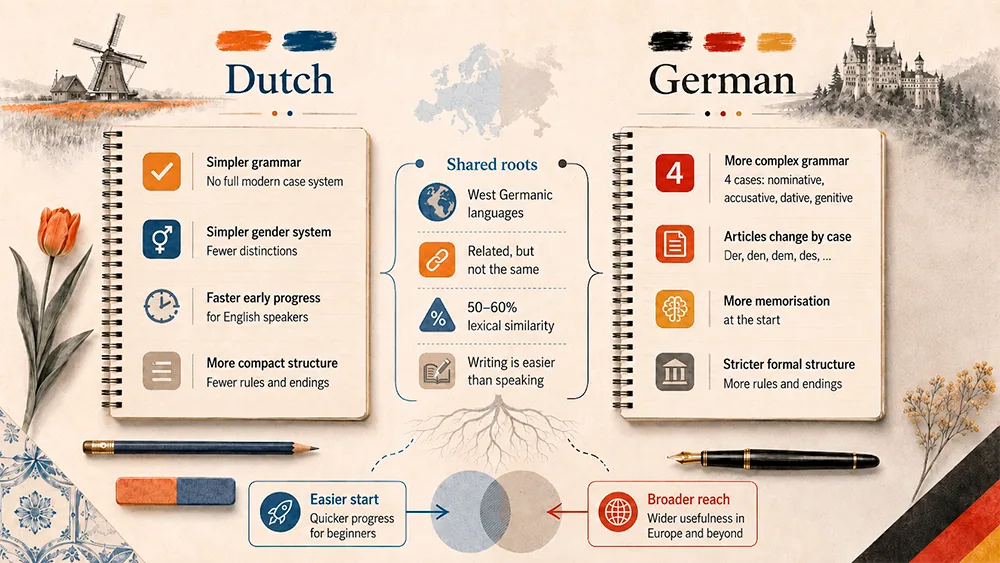
Both languages sit in FSI Category I for English speakers – roughly 600 hours to reach professional proficiency, on paper equally accessible. In practice, Dutch tends to produce faster visible progress early on, and the reason is structural rather than anything to do with motivation.
German's case system slows learners down hard in the first few months – dative article changes, genitive constructions to memorize, a three-way gender system that rarely maps onto intuition. Dutch drops most of that complexity, which means a Dutch learner typically reaches functional sentence construction sooner than a German learner working through the same number of study hours. That lower grammar ceiling helps early on, even if it trades away some expressive precision further down the line.
Word-level closeness to English tilts things further toward Dutch. Words like "hand," "arm," "over," "under," "land," and "water" show up nearly unchanged between English and Dutch, and a complete beginner can typically recognize somewhere around 30-40% of written Dutch without ever having studied it – a head start German doesn't offer nearly as generously, despite sharing the same Germanic roots with English.
German still has its own case to make. A larger global speaker base, stronger institutional footing across European business and academia, and real career relevance in fields like engineering, finance, and manufacturing all weigh in its favor. For anyone aiming at professional use somewhere in Central Europe specifically, German's steeper learning curve tends to pay off in ways Dutch simply can't match in those same markets.
Dutch vs German language comes down to a family resemblance without actual sameness – related enough to read into each other sometimes, distinct enough in grammar, vocabulary, and cultural norms that neither substitutes for the other. Dutch gets someone to basic communication faster; German carries more institutional weight and a larger speaker base once someone gets there.
Geography and career goals end up mattering more than any inherent "easier" or "harder" label. Anyone targeting German specifically can check their current level with a free proficiency check on Testizer – results by email, with an optional certificate available afterward.
Somewhere in between, structurally – grammar and core vocabulary lean German, while some word recognition and phonetic patterns lean English. Frisian usually gets named the closest living language to English overall, with Dutch and Scots not far behind, though the exact order shifts depending on which measure someone's using.
Partially, and mostly in writing. Reading a German text, a Dutch speaker can often pull the general meaning from shared vocabulary alone. Spoken conversation is a different story – pronunciation diverges enough, and grammar differences shift sentence structure enough that real-time listening stays difficult without prior exposure to the other language.
One root, "diutisc" – Old High German for "of the people" – split into two words. English speakers once used "Dutch" for Germanic-speaking peoples across the whole continent. Borders hardened, the term narrowed to the Netherlands specifically, and German speakers kept "Deutsch" for themselves. Same origin, different destinations.
Considerably, yes. German runs four grammatical cases with article changes for each one; Dutch shed most of that system in modern usage and gets by with far simpler article behavior. Anyone who's studied both tends to report German demanding noticeably more memorization in the early stages – one of the clearest points of difference between Dutch and German for a beginner to notice early on.
Dutch wins on speed – simpler grammar, heavier vocabulary overlap, progress that shows up faster for an English speaker. German wins on reach – better payoff long-term if the goal is professional use in Central Europe or a bigger pool of speakers to talk to. Pick based on which one actually matters more.