

There is no single answer to what is the easiest language to learn. The same question asked by a Spanish speaker and a Japanese speaker points to two completely different answers. Native language, prior exposure, and learning goals all shift the calculation.
That said, some languages are objectively faster to acquire than others – and the reasons are structural. The US Foreign Service Institute classifies languages into four difficulty categories based on learning hours. Category I languages, the easiest, take English speakers roughly 600-750 hours to reach professional proficiency. Category IV languages – Arabic, Japanese, Mandarin – require 2200+ hours. The easiest language to learn sits at the short end of that range, but which one depends on who is asking.
This guide breaks down the key factors, compares specific languages for different learner backgrounds, and helps match the right choice to a real goal.
Four factors determine how quickly a learner can acquire a new language: grammar structure, vocabulary overlap, pronunciation consistency, and access to input. Each one affects a different part of the process – and a language can be easy on one dimension while being difficult on another.
Grammar complexity is often the first barrier a learner hits. Languages with no grammatical gender, minimal case systems, and regular verb conjugation tend to move faster in the early stages – there are fewer rules to internalize before basic communication becomes possible.
Indonesian is a strong example. It has no verb tenses, no plurals, and no grammatical gender. Mandarin takes a different approach: verbs do not conjugate at all, and tense is expressed through context or time words rather than verb forms. Both languages remove entire layers of grammar that slow down acquisition in most European languages.
Linguists often cite Indonesian as having one of the simplest grammar systems of any major world language – yet it rarely appears in popular "easy language" lists because learners tend to conflate grammar simplicity with script familiarity.
Shared vocabulary cuts acquisition time more than almost any other factor. When a learner already recognizes a large portion of written words on first exposure, reading comprehension builds fast – and that early progress sustains motivation through harder stages.
Spanish and English share over 10,000 cognates – words like "animal," "hospital," and "natural" are identical or near-identical across both languages. French has left an even deeper mark on English: roughly 29% of English vocabulary traces back to French, a direct result of the Norman Conquest in 1066. A learner who reads English fluently already has a significant passive French vocabulary before opening a textbook.
At the far end of the scale, Spanish and Italian share approximately 82% lexical similarity. A Portuguese speaker learning Spanish can often read a newspaper on the first day – not because they studied, but because the two languages are structurally that close.
A language with consistent spelling-to-sound rules is faster to speak from the start. When every letter maps to one sound reliably, a learner can pronounce new words correctly without memorizing exceptions – and that reduces one source of early frustration significantly.
Spanish is nearly perfectly phonetic. Every letter has one sound, and that sound does not change depending on position or neighboring letters. Norwegian follows similar logic with predictable stress patterns. Both languages allow a beginner to read aloud accurately within days of starting.
French sits at the opposite end. Despite sharing large amounts of vocabulary with English, its spoken form diverges sharply from its written form – silent letters, liaisons, and nasal vowels create a gap that takes considerably longer to close. Finnish presents a different kind of contrast: pronunciation is completely regular, but the grammar carries 15 grammatical cases. Phonetic simplicity and overall ease are not the same thing.
Access to native input outside the classroom accelerates acquisition in ways that structured study alone cannot replicate. A learner surrounded by a language – through media, travel, work, or daily interaction – builds listening comprehension and vocabulary retention faster than someone who only encounters the language during lessons.
Spanish has roughly 500 million native speakers across more than 20 countries. That scale means passive exposure is available almost everywhere: streaming platforms, music, podcasts, colleagues, and travel destinations all become learning environments without extra effort. Dutch or Norwegian offer fewer of those opportunities by default, which means learners have to construct exposure deliberately.
Research in second language acquisition consistently shows that comprehensible input volume – hours spent hearing or reading the language at an appropriate level – is one of the strongest predictors of fluency speed, independent of formal instruction hours.
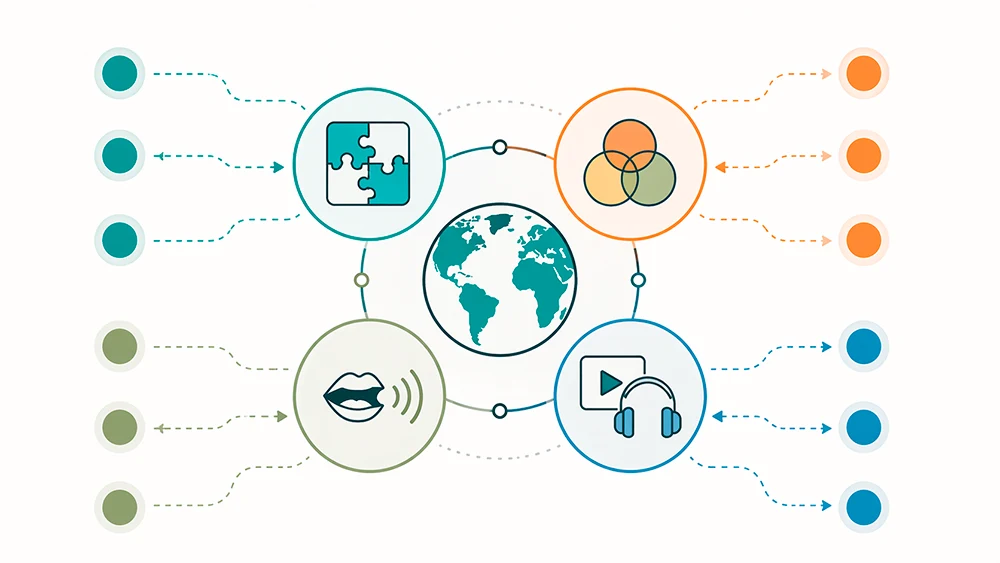
The easiest language to learn for English speakers is largely determined by shared Germanic or Romance roots. The closer the linguistic ancestry, the faster vocabulary builds and the more familiar the sentence structure feels from the start.
Norwegian is frequently ranked the easiest foreign language to learn for English speakers by the FSI – Category I, around 600 hours to professional proficiency. Germanic roots, flexible word order, and minimal inflection all contribute. Swedish shares the same advantages and follows a nearly identical learning curve.
Both use the Latin script, which removes the barrier of learning a new writing system entirely. English and Norwegian share enough vocabulary that a beginner can recognize roughly 30-40% of written Norwegian without any prior study – words like "arm," "land," "over," and "under" are identical across both languages.
Norwegian has two official written forms, but most learners pick one and build from there without significant difficulty.
Spanish is the most studied second language in the world – partly because it is genuinely accessible, partly because of its reach. FSI places it in Category I at roughly 600-750 hours to professional proficiency for English speakers.
Consistent phonetics, a large cognate base, and 500 million native speakers make it one of the most supported languages to learn. Content is available across every format – streaming, podcasts, news, music – which means building daily exposure requires almost no effort.
One practical detail: Castilian and Latin American Spanish differ in pronunciation, but grammar and written form are mutually intelligible across all Spanish-speaking countries. A learner of one variant can read and be understood everywhere.
Dutch sits grammatically between English and German – closer to English in many ways, with familiar vocabulary and sentence structures that feel less foreign than German from the start. FSI rates it at around 600 hours for English speakers.
Afrikaans is faster still. It evolved from Dutch and shed most grammatical gender and case complexity in the process. More unusually, Afrikaans has no verb conjugation for person or number – the same verb form is used for I, you, he, she, we, and they. That removes an entire layer of grammar that slows down acquisition in most other European languages.
For English speakers who want fast early progress, Afrikaans offers one of the shortest paths to basic communication available.
French is harder than Spanish for English speakers despite a large shared vocabulary – the gap comes mainly from pronunciation. Around 29% of English vocabulary traces back to French, so reading comprehension builds quickly. Spoken French is a different challenge: silent letters, liaisons, and nasal vowels create a production barrier that takes considerably longer to close than in Spanish or Norwegian.
French grammar also carries 17 verb tenses in formal form, though everyday spoken French typically uses only 4-5 regularly. That gap between textbook French and real spoken French catches many learners off guard early in the process.
FSI still places French in Category I, making it one of the easy languages to learn relative to the full range – but among Category I options, it sits closer to the harder end.
The easiest language to learn for non-English speakers depends entirely on the learner's first language. Romance language speakers, Slavic speakers, and East Asian speakers all start from different positions – and the same target language can be trivial for one group and genuinely difficult for another.
For speakers of any Romance language – French, Portuguese, Romanian – Spanish and Italian are the fastest options available. Shared grammar logic, overlapping vocabulary, and similar phonetic systems mean that a French speaker learning Spanish can often reach conversational level within 3-4 months of focused study.
Spanish and Italian share approximately 82% lexical similarity. A speaker of one can often understand the other's written text on first exposure, even without formal study. That starting advantage is significant – it effectively compresses the early acquisition stage that takes most learners the longest.
Esperanto was designed from the ground up to be the easiest foreign language to learn – it has no irregular verbs, no grammatical gender, and a fully phonetic spelling system. Every grammar rule applies without exception, which removes the pattern-memorization load that slows acquisition in natural languages.
Learners typically reach a functional level in roughly 150-200 hours – compared to 600+ for most Category I natural languages. A 1998 study found that students who learned Esperanto for one year before starting French outperformed students who had studied French for three years directly. The effect has a name in language research: the Esperanto propaedeutic.
Haitian Creole draws most of its vocabulary from French but has significantly simpler grammar – no grammatical gender, no verb conjugation for person, and a more regular structure overall. For learners with any French background, the entry barrier is low.
Swahili operates differently. Its noun class system is unfamiliar to most European language speakers, but the underlying structure is consistent and logical – once the pattern is understood, it applies without exceptions. Vocabulary borrowing from Arabic and English also helps many learners recognize words earlier than expected.
Swahili is spoken by an estimated 200 million people across East and Central Africa as a first or second language. That reach makes the learning investment practically transferable across Tanzania, Kenya, Uganda, and the DRC.
Linguistic distance – how structurally different two languages are – is the single strongest predictor of learning time. A Japanese speaker learning Korean faces a much shorter path than a Japanese speaker learning Arabic, despite both being equally "foreign" in the everyday sense. Korean and Japanese share similar grammar logic: SOV word order, postpositions, and honorific systems all transfer directly.
FSI learning hour estimates assume a native English speaker as the baseline. For speakers of other languages, the same figures can shift dramatically. A Spanish speaker learning Italian may need around 200 hours where an English speaker needs 600. The language is not easier – the learner's starting point is closer.
Linguistic distance – how structurally different two languages are – is the single strongest predictor of learning time. A Japanese speaker learning Korean faces a much shorter path than a Japanese speaker learning Arabic, despite both being equally "foreign" in the everyday sense. Korean and Japanese share similar grammar logic: SOV word order, postpositions, and honorific systems all transfer directly.
FSI learning hour estimates assume a native English speaker as the baseline. For speakers of other languages, the same figures can shift dramatically. A Spanish speaker learning Italian may need around 200 hours where an English speaker needs 600. The language is not easier – the learner's starting point is closer.
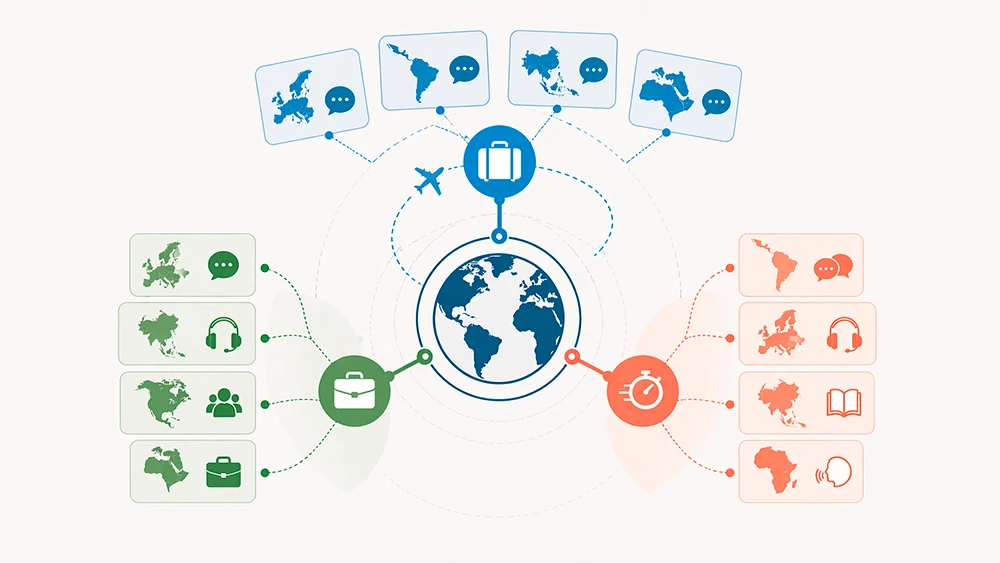
Choosing among easy languages to learn is not only about grammar or vocabulary overlap. The right language also depends on what the learner needs it for – travel, work, or fast visible progress each point toward different options.
Spanish covers the most ground geographically – official in 21 countries across Europe, Latin America, and parts of Africa. For a learner who wants one language that works across the widest range of destinations, it is the most practical choice.
French extends that logic into different regions: West Africa, North Africa, and parts of Southeast Asia all have significant French-speaking populations. For travel specifically across sub-Saharan Africa, French often reaches further than English.
For Southeast Asia, Malay and Indonesian cover a large connected region with mutually intelligible written forms and one of the simplest grammar systems available.
Mandarin, German, and Spanish lead in professional demand – but ease and demand rarely align perfectly. Spanish combines accessibility with strong labor market relevance across the Americas, the US, and parts of Europe, making it the most balanced option for most learners.
German is harder than Spanish grammatically – FSI places it in Category II at around 750 hours – but it carries strong pull in European job markets, particularly in engineering, finance, and manufacturing sectors.
Mandarin sits at Category IV difficulty for English speakers, requiring 2200+ hours to professional proficiency. The career upside is significant for certain industries and regions, but the time investment is in a different category entirely compared to Romance or Germanic options.
If speed of visible progress is the primary goal, three options stand out. Afrikaans offers the fastest path to basic communication among natural languages – simplified grammar, no verb conjugation for person, and close Germanic roots make early milestones arrive quickly.
Esperanto reaches functional communication faster than any natural language, typically within 150-200 hours. The limitation is practical reach – it has no native-speaking country and limited everyday use outside specific communities.
Spanish sits between the two. It takes longer than Afrikaans or Esperanto to reach basic fluency, but the result connects immediately to 500 million speakers, a large content library, and real-world use across dozens of countries.
FSI estimates for Category I languages – Norwegian, Spanish, Dutch, French, Italian – range from 600 to 750 hours for professional working proficiency, assuming a native English speaker studying consistently. At one hour per day, that translates to roughly 1.5 to 2 years.
Conversational level arrives earlier. Most learners reach basic spoken fluency in Category I languages at around 150-300 hours – roughly 6 to 12 months at moderate daily study. The gap between "can hold a conversation" and "can work professionally" is significant and often underestimated at the start.
These estimates assume structured study. Passive exposure – music, television, podcasts, social media – adds to acquisition but is not counted in FSI figures. Learners who combine structured sessions with daily passive input consistently move faster than the FSI baseline suggests. The variable that matters most is not hours per day but consistency over weeks and months.

Speed of acquisition improves when practice resembles real use rather than isolated exercises. A learner who reads graded texts, listens to native audio, and produces output in context will move faster than one who studies grammar rules without applying them.
Four habits that make a measurable difference:
Self-assessment is unreliable as a sole measure of progress. Learners consistently over- or underestimate their level depending on which skills they practice most – someone who reads well may assume their overall level is higher than it is, while a strong speaker may not realize how much written accuracy is still missing.
A structured language level test gives a clearer signal. It removes the subjectivity of self-evaluation and produces a result that can be used to adjust study materials, set a realistic next target, or document current proficiency for practical purposes.
Testizer offers free language level tests across several languages – results are delivered by email, with an optional certificate available if proof of level is needed.
The easiest language to learn is not a fixed answer – it shifts depending on where the learner starts. For English speakers, Norwegian, Spanish, and Afrikaans offer the shortest paths. For Romance language speakers, Spanish or Italian compress the early stages significantly. For anyone prioritizing speed of result over real-world reach, Esperanto remains the most efficient option by hours invested.
The more useful question is not which language is easiest in the abstract, but which one fits the learner's native language, available time, and actual goal. Those three factors narrow the choice faster than any ranking list.
Pick the language that connects to a real use case, set a measurable checkpoint at 4-6 weeks, and adjust from there.
Take a free language level test on Testizer to find out where you stand before you start – or to check progress after your first study cycle.
For most beginners, Spanish is the most practical starting point. It has consistent pronunciation, a large English cognate base, and more learning resources than almost any other language. Norwegian and Afrikaans are structurally simpler, but Spanish combines accessibility with real-world reach across 21 countries and 500 million speakers.
For speakers of Germanic or Romance languages, English is relatively accessible – familiar vocabulary and no grammatical gender help early progress. For speakers of Japanese, Arabic, or Mandarin, English is considerably harder. Ease depends entirely on the learner's native language, and English is no exception to that rule.
Basic conversational ability in an easy language to learn – Spanish, Norwegian, Afrikaans – is realistic in 3 months with consistent daily study of 1-2 hours. Professional proficiency is not. Three months at moderate intensity covers roughly 90-180 hours, which is enough for functional communication but well short of the 600+ hours FSI estimates for full working proficiency.
Younger learners acquire pronunciation and intuitive grammar more naturally, particularly before adolescence. Adult learners typically progress faster in vocabulary and structured study because of stronger analytical skills and prior language knowledge. Age affects the process more than the outcome – adults can reach high proficiency, but the path relies more on deliberate practice than on passive absorption.