
French has a reputation for difficulty that is partly deserved and partly overstated. Pronunciation takes time, spelling and sound diverge in ways that surprise most beginners, and the grammar carries enough complexity to slow early progress. But FSI places it in Category I – the same bracket as Spanish and Italian – at 600-750 hours to professional proficiency for English speakers.
The methods that produce results are consistent across learners who want to learn French effectively: high input volume, early speaking practice, and daily contact with the language. This guide covers how to learn French across each of those areas with specific techniques and realistic timelines – so the decision to start has a concrete basis rather than a vague plan.
French sits in FSI Category I – the same difficulty bracket as Spanish and Italian – but is French hard to learn in the same way across all skills? No. The challenge is unevenly distributed: reading comes faster than speaking, and grammar is more manageable than pronunciation suggests on paper.

Is French easy to learn for English speakers compared to most other languages? Easier than most, harder than Spanish. Roughly 29% of English vocabulary traces back to French – a direct result of the Norman Conquest of 1066 – which means reading comprehension builds faster than most beginners expect. A learner who knows "animal," "nation," or "silence" already has thousands of French words within reach.
How hard it is to learn French becomes a more practical question when spoken French enters the picture. Silent letters, liaisons between words, and nasal vowels create a gap between written and spoken French that takes considerably longer to close. "Vous avez" looks like two distinct words on the page; in natural speech it collapses into something closer to "voozavay." That gap is the main reason French feels harder than its FSI category suggests in the early months.
Three elements consistently produce faster results regardless of starting level: high input volume, early speaking practice, and daily contact with the language. Grammar study supports that process but works better as a reference tool than a starting point.
Comprehensible input research shows that acquisition accelerates when learners spend the majority of study time reading and listening at or just above their current level – not drilling grammar tables. A learner who reads and listens for 80% of study time and consults grammar for the remaining 20% will typically outpace one who reverses that ratio. The best way to learn French in practice is to build vocabulary and listening comprehension first, then use grammar to clarify patterns that have already appeared in context.

Speed comes from method, not effort. Distributing practice correctly from day one matters more than the total hours invested.
20 minutes daily outperforms a 3-hour session once a week. The brain consolidates language during rest periods between exposures – which means frequency matters more than volume. Habit attachment makes consistency easier: linking French practice to an existing routine removes the daily decision of when to start. A commute, a lunch break, or the first ten minutes of a morning routine are enough to maintain daily contact with the language.
The 1,000 most frequent French words cover approximately 85% of everyday conversation. Learners who start with frequency lists rather than textbook chapter vocabulary reach functional communication faster – every word learned is immediately useful rather than waiting for the right chapter context to appear.
Spaced repetition tools like Anki make that process more efficient. Vocabulary reviewed through spaced repetition is retained roughly 2-3 times longer than words studied in linear lists, which means less time re-learning and more time building on what already sticks.
For anyone trying to figure out how to learn French fast, listening volume is usually the first variable to increase. 30 minutes of daily comprehensible input adds roughly 180 hours per year – the equivalent of a full university semester, built from existing free time. French Netflix with French subtitles, InnerFrench podcast, and Coffee Break French all work well at different levels.
Listening builds the foundation, but spoken fluency develops only through speaking. Output practice is what separates learners who understand French from those who can actually use it.
Waiting until grammar feels complete before speaking delays the feedback loop that accelerates accuracy. Production errors are the fastest diagnostic tool available – they show exactly which structures need more input and which vocabulary gaps cause the most disruption to communication.
Even short daily speaking attempts make a measurable difference. Five to ten minutes of spoken output per day – describing surroundings, summarizing something just watched, or responding to a prompt – builds production habits that passive study alone does not develop.

Shadowing – repeating audio in real time, matching the speaker's rhythm and intonation – addresses one of the most specific problems French creates for English speakers: the gap between passive comprehension and active production. A learner can understand a podcast episode clearly and still freeze when trying to produce the same language in conversation. Shadowing closes that gap by training the mouth and ear simultaneously rather than separately.
The research backing is substantial. A systematic review covering 44 studies found that shadowing consistently improves comprehensibility, intelligibility, and pronunciation accuracy across learner groups. A separate classroom study on French learners specifically showed statistically significant pronunciation gains after regular shadowing sessions with subtitled French video. The technique works partly by stimulating the phonological loop in working memory – repetition and imitation strengthen the neural pathways that connect hearing a sound to producing it automatically.
For French specifically, shadowing is useful for training the sounds English speakers struggle with most: nasal vowels, liaisons between words, and the rhythm of connected speech. These features do not exist in English, and reading about them produces far less improvement than repeatedly mimicking them in real audio. Once the mouth movements become more automatic, cognitive load drops and attention shifts from pronunciation to meaning – which is where conversation actually happens.
A practical daily routine does not need to be long. Ten to fifteen minutes of shadowing a short audio clip, combined with one weekly conversation session on italki or Tandem, covers both the phonetic and interactive dimensions of spoken French. Platforms like italki connect learners with native speakers for paid tutoring or language exchange – even one 30-minute session per week accelerates spoken production faster than an equivalent amount of solo study.
For anyone trying to learn to speak French more quickly, the most common obstacle is not grammar gaps – it is avoidance. Several patterns consistently slow progress:
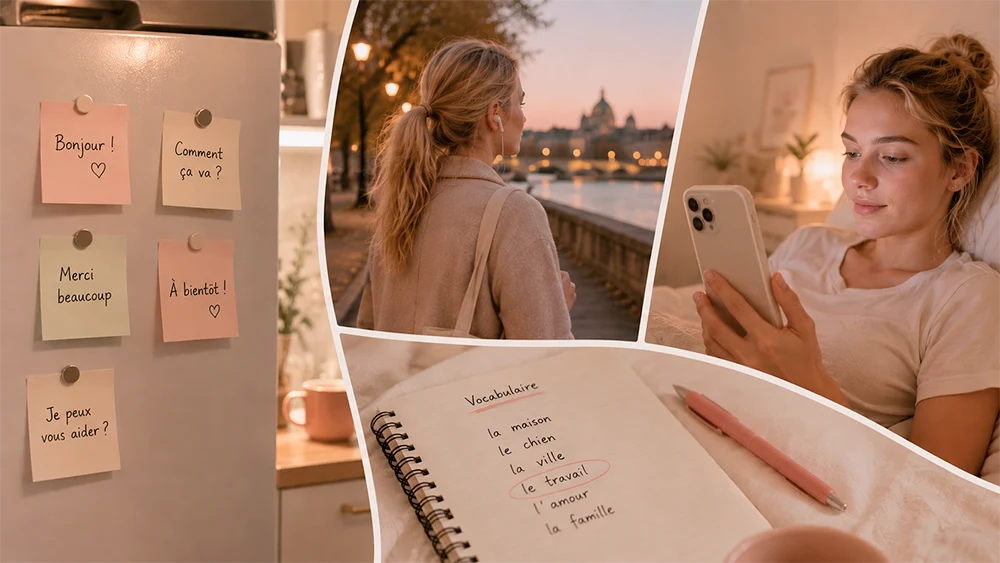
The easiest way to learn French at home is to replace passive English-language free time with French content rather than adding study hours on top of an existing schedule.
No single app covers the full range of what French acquisition requires. Duolingo builds a daily habit but stalls at beginner level without additional input. A more effective combination:
Each tool serves a different function. Vocabulary, habit, speaking, and immersive input each need a different format – one platform cannot replace the others.
Changing device and app languages to French creates passive daily exposure with zero additional time cost. A phone set to French means every notification, menu item, and system message becomes a micro-reading task – small individually, but consistent across hundreds of daily interactions. Research on incidental vocabulary acquisition shows that as few as two to three exposures to a word in context can trigger initial learning, and that repeated low-level exposure across multiple daily situations accelerates retention more than single concentrated study sessions.
The mechanism behind this is well-documented in second language acquisition research. Krashen's Input Hypothesis – one of the most cited frameworks in applied linguistics – argues that language is acquired most efficiently through exposure to comprehensible input rather than direct instruction. Changing the environment to French does not replace structured study, but it increases the total volume of comprehensible input without requiring additional scheduled time.
Practical adjustments compound quickly. Following French-language social media accounts shifts the default reading environment. Adding sticky labels with French names to household objects creates repeated visual exposure to concrete vocabulary – the category of words that tends to stick fastest because it is encountered in physical context rather than on a flashcard. Switching music playlists to French artists adds passive listening during commutes, exercise, or household tasks – time that would otherwise produce no acquisition at all.
One detail worth noting: passive exposure works best when the content is mostly comprehensible. Background French audio that is entirely beyond current level produces little acquisition – the brain filters it out rather than processing it. Content that is 70-80% understandable generates the most incidental learning per hour. That is why intermediate learners benefit more from environmental immersion than complete beginners – they already have enough vocabulary for partial comprehension to occur naturally.
It depends on starting level, daily hours, and what "learned" means in practice – survival communication, conversational fluency, or professional proficiency are very different targets.
Prior language knowledge is the strongest variable. A Spanish or Italian speaker learning French reaches conversational level in roughly 150-200 hours – an English speaker with no Romance language background typically needs closer to 600. Daily input volume, speaking practice frequency, and immersion level all shift that timeline significantly in either direction.
Consistency matters more than intensity. A learner who studies 30 minutes daily for a year accumulates more durable progress than one who studies 3 hours a week irregularly – because spaced exposure consolidates retention in ways that concentrated sessions cannot replicate.
A practical breakdown for English speakers starting from zero:
At one hour per day, B1 is reachable in roughly 9-12 months. That estimate assumes consistent daily practice with a mix of input, vocabulary work, and speaking – not passive exposure alone.
Grammar study too early is the most common trap. Conjugation tables feel productive, but a learner who spends the first weeks on verb endings instead of vocabulary reaches functional communication significantly later.
App-only learning stalls at A2. Duolingo builds habit but was never designed to carry a learner past beginner level – without additional listening, reading, and speaking, progress plateaus regardless of daily streak length.
Avoiding French media because it feels hard removes the input that drives acquisition fastest. Content at or just above current level is uncomfortable by design – that discomfort is where learning happens.
Studying without spoken output delays the feedback loop that shows which structures are actually internalized. And inconsistent practice – sessions followed by long gaps – forces re-learning of material that was already partly consolidated.
Self-assessment alone is unreliable – a structured benchmark gives a clearer signal than intuition about whether the current study method is working.
Progress tracking works best when it is periodic and structured rather than continuous and informal. A short test at 4-6 week intervals shows whether vocabulary is growing, listening comprehension is improving, and the overall level is moving in the right direction – or whether the current approach needs adjustment.
Testizer offers a free French proficiency test that covers core language skills, delivers CEFR-aligned results by email, and produces an optional verifiable certificate if proof of level is needed. Taking the test at regular intervals gives a dated record of progress – not just a feeling of improvement, but a documented shift from one level to the next.
Take a free French test online on Testizer to get a CEFR-aligned result by email – and an optional certificate if you need proof of your level.
Consistent daily input, early speaking practice, and periodic level checks are the three variables that determine how fast French progresses. Grammar supports that process but rarely leads it – learners who prioritize comprehensible input and regular output practice consistently outpace those who start with rules and work toward use.
The most practical next step is to find out where you currently stand. Take a free French test online on Testizer, get a CEFR-aligned result by email, and use it to set a realistic target for the next study stage.
One focused hour daily is enough for most learners to reach conversational level within 9-12 months. Shorter sessions work if they happen consistently – 20-30 minutes daily produces more durable retention than a 3-hour block once a week. Frequency matters more than session length for language acquisition.
For English speakers, pronunciation is typically the harder barrier. French grammar is complex but learnable through structured study. Pronunciation – silent letters, liaisons, nasal vowels, and the gap between written and spoken French – takes longer to internalize because it requires ear training that grammar study alone cannot provide.
Neither exclusively. High-frequency vocabulary and comprehensible listening input should come first – they build the mental model of the language. Grammar study is most useful once patterns have already appeared in context. Speaking practice should start early, even imperfectly, because production errors are the fastest diagnostic tool available.
B1 covers most travel and daily communication situations – following conversations, handling transactions, reading signs and menus, and managing unexpected situations without constant support. That level is reachable at roughly 200-300 hours of consistent study for English speakers starting from zero.
Yes. Adults typically progress faster in vocabulary and structured grammar than children because of stronger analytical skills. Pronunciation acquisition is harder after adolescence, but reading, writing, and professional communication can reach high levels at any age with consistent practice and sufficient input volume.
Daily comprehensible input at or just above current level – podcasts like InnerFrench, French Netflix with French subtitles, and graded audio content. Thirty minutes daily adds roughly 180 hours per year. The key is choosing material that is mostly understandable – if more than 30% is unclear, it is too difficult to drive acquisition efficiently.