
Spanish and French both sit a full FSI category easier than German for English speakers – a full six months of extra structured study, roughly, before reaching the same working proficiency. Grammar accounts for nearly the entire gap; German vocabulary, by contrast, gives English speakers a real head start most learners don't expect going in. Figuring out how to learn German fast starts with recognizing that early, since it points study time toward where it actually pays off instead of getting spread evenly across everything.
Most of what makes German hard for an English speaker traces back to one part of the language rather than the whole thing at once – grammar carries the weight, while everything else tends to cooperate more than expected.
Four grammatical cases – nominative, accusative, dative, genitive – mean a noun's article changes depending on its role in the sentence, so "the dog" shifts between der, den, dem, and des depending on whether it's the subject, direct object, indirect object, or showing possession. Three grammatical genders compound this, since every noun carries one arbitrarily and the article has to match. Word order adds a third layer: in subordinate clauses, the verb often gets pushed all the way to the end, which means holding the sentence's structure in mind before the action even shows up. Answering how hard is it to learn German honestly means naming these three mechanics directly, since they're what actually slows learners down.
Grammar gets all the attention, but vocabulary quietly works in the opposite direction. German and English share deep Germanic roots, so Haus, Wasser, and Freund land close enough to their English cousins to recognize on sight. Spelling behaves too – German words sound the way they're written, almost without exception, unlike English. Even the long compound words that look alarming at first glance turn out to be smaller, familiar pieces stuck together, once that habit of splitting them clicks.
Is German easy to learn? Parts of it come together fast enough to genuinely offset the grammar's early cost – the vocabulary side of the ledger balances out more than most learners expect walking in.
Timelines below follow CEFR-based hour estimates, broken into three stages so the number that matters depends on which actual goal – casual conversation, independent daily use, or professional fluency – is being planned for.
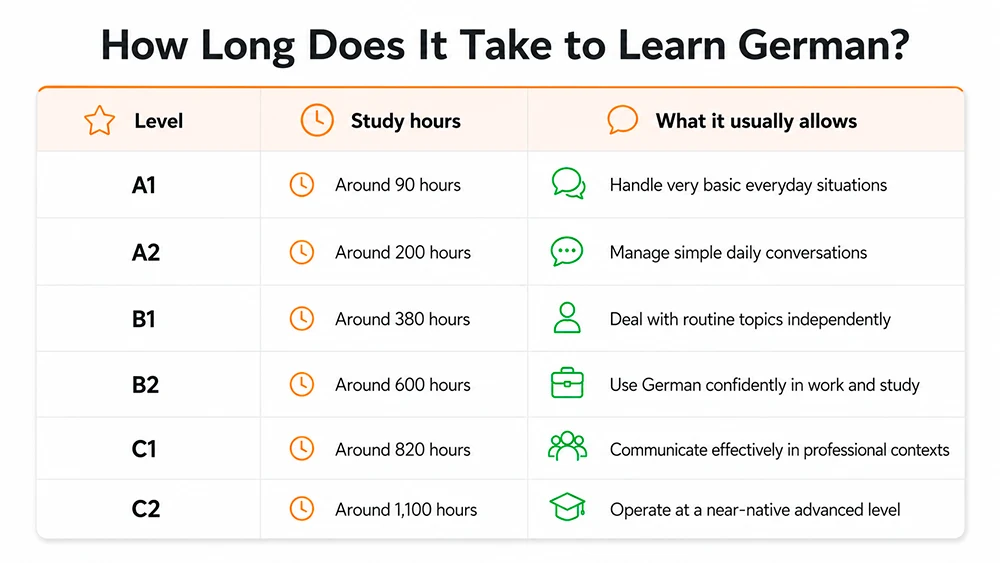
Anyone asking how long does it take to learn German usually starts here: A1 typically takes around 90 hours of study, with A2 following at roughly 200 cumulative hours, based on standard CEFR benchmarks. At an hour a day, that puts A2 within reach in about six to seven months – enough to handle simple daily exchanges, order food, and get through basic small talk, though not enough to follow a fast conversation between native speakers.
B1 sits around 380 cumulative hours, with B2 climbing to roughly 600. That upper figure lines up closely with the lower end of the FSI's own estimate for German – 750 to 900 hours to reach professional working proficiency, which typically corresponds to strong B2 or C1. At an hour a day, B2 usually falls somewhere between 20 months and two years out.
C1 lands around 820 hours, C2 near 1,100, using the same CEFR-based estimate. Those figures assume structured study backed by regular feedback – a classroom or guided self-study track, casual exposure alone won't get there on the same schedule. Full immersion changes the math considerably: living in a German-speaking environment can cut the C1 estimate in half or more, with the size of that cut tracking closely to how much active speaking happens daily, not just how much German surrounds someone passively.
Three methods carry most of the actual weight here, each aimed at a distinct part of the language instead of one blanket "study more" approach.
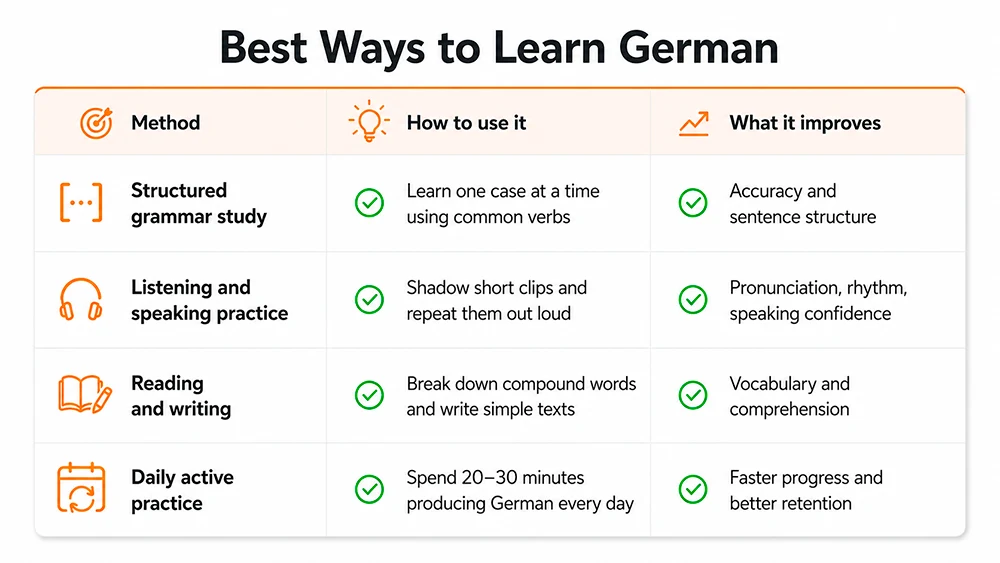
Lock in one case at a time, using verbs that actually show up daily, and only move to the next once that pattern feels automatic. Trying to hold all four cases in one giant mental table from day one tends to backfire fast. A workable order: nominative and accusative first, since they cover most basic statements and direct objects. Dative comes next, tied to everyday verbs like ‘helfen’ and ‘geben’ that demand it every time. Genitive lands last – it simply shows up far less in real speech than the other three. That's really the best way to learn German grammar without drowning in it early on.
Shadowing a short German podcast or video clip – repeating it out loud in real time – trains rhythm and intonation in a way no amount of vocabulary drilling ever will. Pronunciation stays steady once the rules click, sure, but the pacing of live speech still throws people. Textbook audio moves carefully and even; real German doesn't wait around like that.
Starting with texts full of compound words actually works in a learner's favor once the pattern becomes visible – Krankenhaus breaks down into krank (sick) and Haus (house), making "hospital" guessable rather than something to memorize cold. Reading for these breakdowns, rather than reaching for a dictionary at every unfamiliar-looking word, turns German's long compound nouns from an obstacle into a built-in vocabulary hint.
Once grammar and vocabulary have a real foundation, the question stops being what to study and turns into how well that study time actually gets spent. Tightening the daily routine matters more here than piling on new material – that's what learning German fast looks like once the basics are locked in.
Twenty to thirty minutes of active practice daily – speaking or writing, not just listening or reading – tends to move the needle faster than an hour of passive exposure. Someone trying to figure out how to learn German fast specifically benefits from matching input time with output time roughly one-to-one at the start, since production is what actually surfaces which grammar rules haven't stuck yet. It also matters which twenty minutes those are – time spent producing the language moves things forward faster than the same stretch spent passively absorbing it.
Learning a noun without its article – memorizing just "Tisch" instead of "der Tisch" – creates a gap that has to get filled in later, usually the hard way, once gender starts mattering for adjective endings and pronoun agreement. Building the article into the word from the very first encounter costs almost nothing extra and prevents a correction that otherwise has to happen months down the line.
A structured course works best for anyone with limited weekly time, since a set curriculum removes the daily decision of what to study next – typically two to four hours a week, spread across a few sessions. Self-directed immersion suits someone with more flexible time and enough discipline to build their own routine, since nothing forces consistency without a scheduled class. A tutor earns its cost specifically for speaking practice and real-time correction, areas where self-study alone tends to let small mistakes calcify unnoticed. The easiest way to learn German for most working adults ends up being a structured course covering grammar fundamentals, paired with independent listening and speaking practice on the side – few people have the discipline to build both halves from scratch alone.

Flip a phone's system language to German and vocabulary starts showing up everywhere – settings, notifications, app names – for free, with zero dedicated study time. Try narrating ordinary tasks silently in German while doing them: making coffee, getting dressed, locking the door. That habit trains thinking directly in German instead of translating each phrase from English first. A short list of five phrases actually used that week beats a long vocabulary dump nobody revisits.
Recording a two-minute spoken answer to a familiar prompt once a month, then comparing it against the previous month's recording, reveals progress that a general sense of "getting better" can't confirm on its own. Mapping that recording loosely against CEFR descriptors – can this response handle a simple opinion? A minor complaint? A more abstract topic? – gives a concrete reference point instead of a vague feeling of improvement.
German runs somewhere between 600 and 900 hours before it feels genuinely independent – grammar eats most of that time, while vocabulary comes cheaper than expected. Case-by-case grammar work, daily speaking matched to input, and a monthly self-recording habit cover most of what actually drives progress. Before locking in a study plan, a German language level test gives a real starting point and points straight at which skill – vocabulary, grammar accuracy, listening speed – needs attention first.
The four cases stick around permanently, but picking the right one turns into reflex instead of a conscious calculation somewhere past that point. Adjective endings, stacked on top of case and gender together, tend to be the part still catching people off guard well beyond B1.
Comes down heavily to the specific employer and city. Plenty of large international companies in Germany operate entirely in English, though smaller local firms, public-sector jobs, and daily life outside the office almost never offer that shortcut.
Hochdeutsch runs the show as the written and broadcast standard across all three. Austria mostly shifts vocabulary and pronunciation – someone who learned standard German follows it without much trouble. Switzerland is a different story spoken aloud: native speakers from Germany regularly lose the thread in a live Swiss German conversation, even though the written Swiss Standard German stays close to Hochdeutsch.
Depends heavily on where you are. Plenty of everyday interactions end with a quick switch to English the second someone senses hesitation – not a judgment, just practical habit. Smaller towns and older generations tend to go the other way, genuinely appreciating the effort, mistakes and all.