

Two candidates both write "Intermediate French" on their resumes. One handles routine client emails without much trouble; the other freezes the moment a call moves past small talk. The label alone can't tell a recruiter which one they're looking at – which is exactly the problem worth solving before figuring out how to list languages on a resume in a way that actually holds up. Getting this right comes down to three decisions: where the language block sits, which format signals the level clearly, and when a claim needs something to back it up.
Some roles list a language as a hard requirement – no French, no interview, full stop. Others treat it as a tiebreaker: two candidates with comparable technical skills, and the one with a verified B2 in German gets the callback over the one who only wrote "conversational."
A customer support role handling accounts across three countries needs a working language listed prominently, since it directly affects who can take which tickets. A backend engineering role at a domestic company, by contrast, might never touch a second language at all – listing one there adds little unless it's genuinely part of the day-to-day work. Resume language skills carry real weight only where the job actually calls for them.
Three placements come up most often: a dedicated Languages section, a line inside Skills, or mentioned inline within Education or Experience. Which one fits depends on how many languages there are, how central they are to the role, and where in the resume a recruiter would naturally look first.
A language section in resume format works best once two or more languages are listed with different proficiency levels – grouping them gives a recruiter a single place to scan rather than hunting through the document. For a role built around bilingual support, for instance, this section might sit right under the summary, immediately after the candidate's name and title.
One additional language, relevant but not central to the job, fits comfortably as a single line inside Skills instead of earning its own section. Something like "German – B1, used for email correspondence" keeps the resume compact without burying a language that occasionally matters.
A language picked up through a degree program, a study-abroad term, or a specific job can live inside that entry instead of a separate list. “Led weekly status calls with the Berlin office in German” tells a recruiter more than the same language sitting alone in a skills line – this is where language skills in CV entries actually earn their keep, tied to something the candidate has done rather than just claimed.
Three things make a language entry actually work: the language, a level, and something to back it up. A name on its own tells a recruiter nothing about what someone can actually do in that language.
A few workable formats:
Spanish – C1 (CEFR) | Advanced
French – B2 (CEFR) | Upper-Intermediate
German – conversational, used for internal team chats
None of these is the one correct way to do it – figuring out how to put language proficiency on a resume mostly comes down to which scale the employer already uses and how much detail the role calls for.
Two systems cover most of what shows up on resumes: general descriptive labels and CEFR. Neither one wins outright – which fits better depends on where the employer is based and how international the role actually is.
Native, Fluent, Advanced, Intermediate, and Basic show up constantly, but they're a convention, not an official scale anyone regulates. Fluent causes the most friction in practice – interviewers frequently ask candidates to define exactly what they mean by it, since the word covers everything from confident daily use to genuine professional command. Intermediate is nearly as slippery: it can mean someone who reads well but stumbles in conversation, or the reverse. Basic tends to be the one label people actually trust at face value, mostly because nobody overstates it.
CEFR runs six bands, A1 through C2, published by the Council of Europe as a scale that isn't tied to any single language or exam. Several major tests align with it directly: IELTS carries an official concordance published jointly by Cambridge Assessment and the British Council, and DELF/DALF are built around CEFR bands from the ground up, using the same letter-number labels as their exam names. Not every test works this way, though – some proficiency exams run on entirely separate scoring systems with no confirmed official CEFR equivalence, so it's worth checking directly with the issuing body before assuming a conversion exists.
One CEFR label also rarely means identical strength across all four skills – someone might sit comfortably at B2 for reading and listening while their spoken output lags closer to B1.
A few phrases tend to raise more questions than they answer: "Conversational" doesn't specify a range, "Basic knowledge" gives no real benchmark, "Intermediate-Advanced" reads as a range rather than a level, and "Some experience" barely qualifies as a proficiency claim at all. None of these need cutting entirely – they just need sharpening. "Conversational Spanish" becomes clearer as "Spanish – B1, comfortable with routine conversations," which gives a recruiter something concrete instead of a vague impression.
Good language skills in resume entries follow one of a few reliable patterns – here's what that looks like in practice:
Languages
English – Native
Spanish – C1 (CEFR) | Advanced
French – B2, comfortable in client meetings
German – A2 (CEFR)
Mixing formats slightly, as above, still reads cleanly – not every line needs both a CEFR level and a descriptive label if one alone already carries enough information. Repeating both on every line adds length without adding clarity.
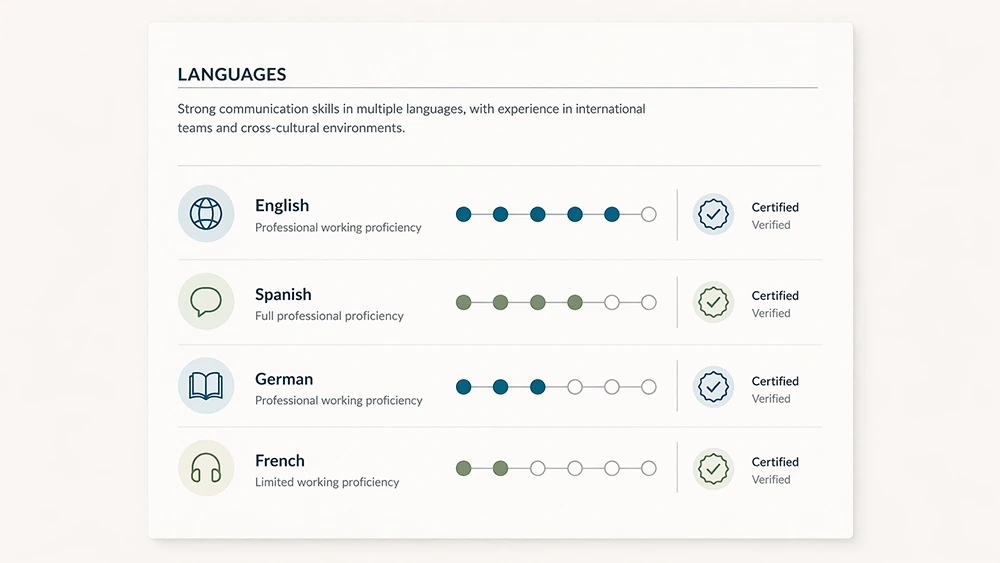
Not every language a candidate has ever studied earns a spot on the resume. Languages on a resume work best when the level is strong enough to matter in a work context, or when the job description names that language directly.
A1 and A2 don't automatically disqualify a language from appearing – someone relocating to a new country, or already taking lessons ahead of a move, might reasonably list a beginner level to signal that intent, even without a job requirement forcing the issue. What doesn't help is a long list of weak languages padded out for volume; that tends to dilute the stronger entries sitting above them.
A few questions worth running through: Does the role or job posting actually reference this language? Has it been used in any real professional or academic setting? Would leaving it off change how a recruiter reads the rest of the resume? If most of the answers land on "no," it's probably safe to leave off.
A level on its own is a claim. A certificate, a score report, coursework taught in the language, or a task actually completed in it – any of these turns that claim into something checkable. For roles where language is a genuine requirement, that difference tends to matter more than most other resume details combined.
Some interviewers test this directly: switching languages mid-conversation, asking for a short written sample, or requesting a quick task in the target language. A certificate with a unique ID and QR code lets a recruiter confirm a result in seconds without chasing down additional paperwork. Testizer runs one version of this – a free online language check covering several languages, with results delivered by email and an optional verifiable certificate afterward. It's one additional way to back up a claim, not a replacement for whatever official exam a specific role might require.
A language entry works when it's specific and honest: a real level, placed where it fits the resume's structure, backed by evidence when the role actually calls for it. None of that requires perfection – just enough precision that a recruiter isn't left guessing what "conversational" or "advanced" is supposed to mean in practice.
Before finalizing anything, it's worth pulling up the actual job posting and checking whether the language block on the resume matches what's being asked for – not what feels impressive in isolation.
Usually yes, as long as the level is stated honestly rather than rounded up – something like "Spanish – A2, currently studying" reads better than an inflated label that falls apart in an interview.
Absolutely, and it's common enough that splitting them out makes sense when the gap is significant – "German – B2 spoken, B1 written" gives a recruiter more accurate information than a single blended level would.
Not always. It matters most when the resume is being read in a country where that language isn't the default assumption, or when a role specifically needs a native-level speaker for one language among several required.
It's still worth including, though pairing it with a note about recent use helps – "B2 certified (2021), used regularly in current role" reassures a recruiter more than a bare date that might suggest the skill has faded.
Often, particularly when the language is listed as a requirement rather than a bonus. A switch to that language mid-conversation, or a short task performed in it, is common enough that an inflated level tends to get caught quickly.