

A grammatically flawless email can still fail on arrival — purpose buried three paragraphs deep, no clear action, tone that misses the reader entirely. Fixing how to write professional emails usually means fixing those three things specifically. Grammar was probably fine to start with.
Three habits split the emails that get answered fast from the ones sitting unread in an inbox for days.
"Question" tells the recipient nothing. "Budget approval needed by Friday" tells them exactly what to expect and when it matters. That's the entire difference - specificity over vagueness, every time.
Generic subjects like "Hello," "Important," or "Question" force the reader to open the email just to find out what it's about, which delays responses from anyone triaging a full inbox. A subject line naming the actual topic - and a deadline, where one exists - lets the recipient prioritize without opening anything. This is one of the more overlooked professional email writing tips, mostly because it takes ten extra seconds to fix and almost nobody bothers.
Reading an email line by line is rare. Scanning it is the default, and MIT's professional communication guidance leans on exactly that habit when it recommends leading with purpose. Three paragraphs of context before the actual point almost guarantees it gets skipped on the first pass.
Before: "I wanted to follow up on our conversation last week about the marketing budget. As you know, we discussed several options during the meeting, and after thinking it over, I believe we should move forward with option B, but I wanted to check with you first before proceeding."
After: "Can we move forward with option B for the marketing budget? Happy to walk through the reasoning if useful — just wanted your sign-off first."
"Let me know your thoughts" rarely gets a useful reply, mainly because it never asks for one. "Please confirm by Thursday whether option A works for you" does — one decision, one date, nothing left to guess.
The same thing happens when unrelated issues get crammed into a single email. A recipient answers the easy question and skips the harder one sitting three sentences down. One topic per email, or a numbered list when several related questions genuinely need separate answers, keeps every point visible on its own.
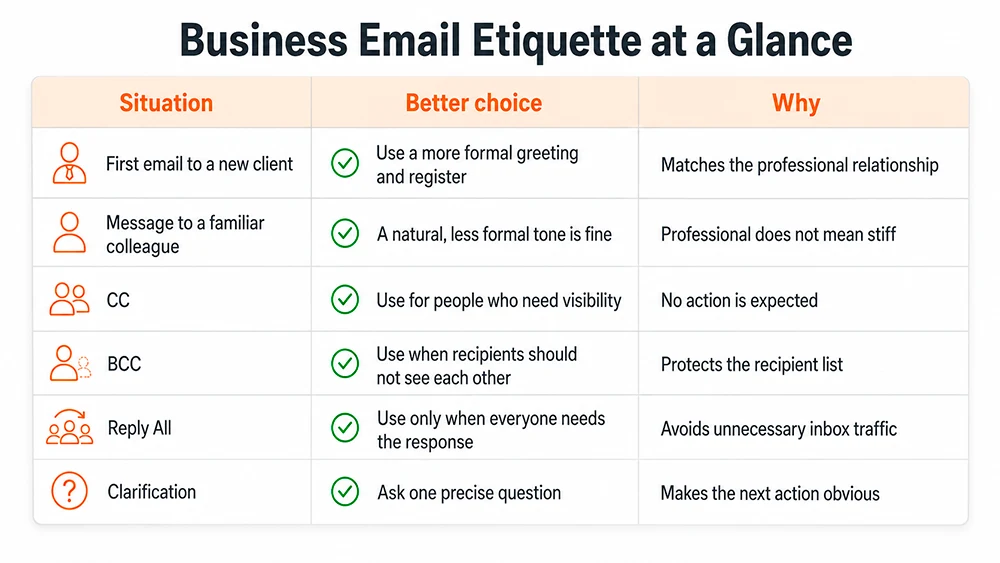
Tone changes outcomes, not just impressions. A Grammarly Business and Harris Poll survey of over 1,000 knowledge workers found that 62% respond faster to a request written in a positive tone, and 48% say they actually deliver higher-quality work in response to it. Who's reading matters just as much — the identical message, sent to two different people, can land two completely different ways.
"Hey, can you send over the Q3 numbers when you get a chance?" works fine for a familiar colleague. "Good morning, could you please share the Q3 figures at your earliest convenience?" fits a first email to a new client better. Both count as professional — formality shifts here, not professionalism itself.
Grammarly's own guidance on workplace tone draws a similar line: messages to managers or clients typically call for a more formal, respectful register, while messages to close teammates can loosen up considerably. Business email etiquette tips rarely boil down to "always be formal" as the actual rule — matching tone to the relationship gets closer to the real standard than defaulting to stiff every time.
CC keeps someone informed without asking them to act - a manager who needs visibility but not a response, for instance. BCC hides the recipient list from each other, useful when addressees shouldn't see who else got the message.
Reply All misfires constantly: a question meant for one person on a ten-person thread answered publicly, flooding nine inboxes with something irrelevant to them. Before hitting Reply All, one quick check - does everyone on this thread actually need to see my response - saves everyone else's time.
"Sorry to bother you, I was just wondering if maybe you could possibly clarify..." piles six qualifiers onto one simple question. Compare that to: "Could you clarify what you meant by 'final version' — the draft from Tuesday, or the one with your comments?" Same question. Half the words. Still polite.
Isolated tips rarely stick the way a full example does, side by side.
Before: "Hi team, I hope everyone is doing well. I wanted to reach out regarding the client presentation coming up next week. I know everyone is busy, but if possible, could someone take a look at the slides sometime before Friday?"
After: "Hi team — could someone review the client presentation slides by Thursday? Link attached. Two things to check specifically: the pricing slide and the timeline graphic."
Deadline, specific action, exact scope of the review — the second version nails all three. The first never quite gets there.
"Status: on track, launching Tuesday as planned. QA finished this morning with no blockers. Marketing assets are in final review, expected done by end of day." Status first, details after - a recipient scanning quickly gets the headline in three words before deciding whether to read further.
Timing depends on urgency more than any fixed rule. MIT's guidance suggests roughly 5 to 10 business days for a non-urgent academic follow-up, versus 2 to 3 days when something's actually time-sensitive - useful as an illustrative range, not a universal workplace standard, since urgency and context shift the right window considerably.
A short, low-pressure follow-up works better than a guilt-laden one: "Following up on my note from last week about the budget approval - happy to send more detail if that's helpful." No apology, no accusation, just a clear nudge.
Most of what actually goes wrong in workplace email has little to do with grammar - figuring out how to write better emails at work usually means fixing a handful of practical details instead.
Before sending, run through the same checklist Indeed recommends professionals use:
"See attached" with no attachment is the single most common failure on that list, and it's also the easiest one to catch - a five-second glance before hitting send prevents the awkward follow-up email that inevitably has to explain the mistake.
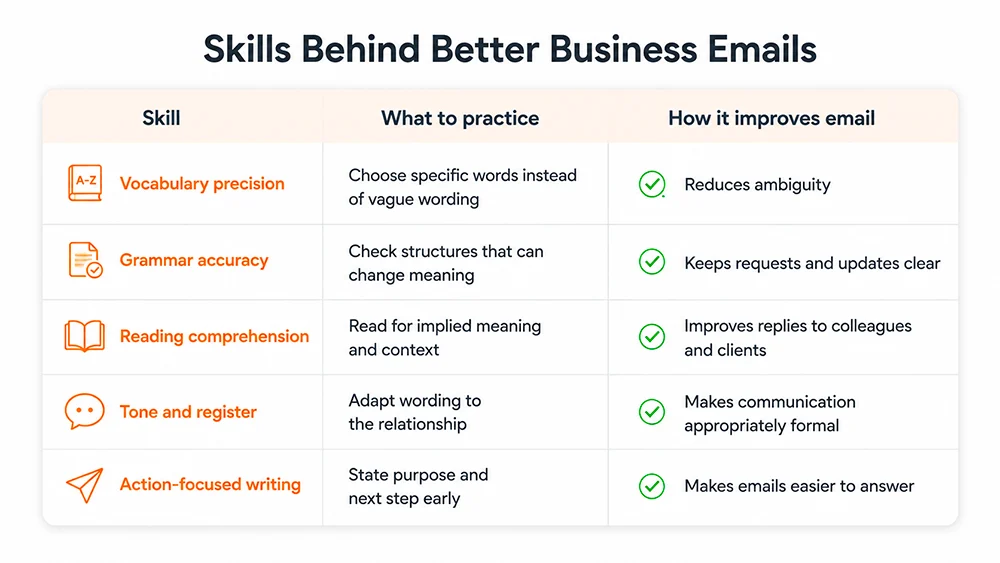
Structure and tone can only carry an email so far. Underneath sits something bigger — Business English ability broadly: vocabulary precise enough that nothing reads ambiguous, grammar solid enough that meaning survives, reading skills sharp enough to catch what a colleague actually meant between the lines.
Someone struggling specifically with vague requests or awkward tone often has a gap in general Business English rather than email technique alone. Testizer currently runs a free online Business English assessment with CEFR-based results - a practical way to check exactly where that gap sits before deciding what to work on. Taking a Business English proficiency test shows whether the issue is vocabulary, grammar, reading comprehension, or something else entirely, rather than guessing.
Good email writing and broader business email writing skills aren't separate things - one feeds directly into the other. A clear subject line, a purpose stated early, a request with an actual deadline: these habits fix most of what goes wrong, but they work better on top of solid general English than as a substitute for it.
Checking a current Business English level on Testizer turns "I think my emails are fine" into an actual answer, rather than a guess based on how confident a familiar exchange happened to feel.
Short enough to scan in ten seconds for routine messages - three to five sentences usually covers a request or update. Complex topics genuinely need more space, but even then, the first two sentences should carry the actual point - a rule that holds across most professional email examples worth following.
Not inherently. "I'll," "we're," and "don't" read naturally in most workplace contexts and rarely cause offense. Highly formal situations - a first email to a senior external stakeholder, say - sometimes call for spelling them out, but that's about register, not a fixed rule against contractions themselves.
No. "Dear [Name]" fits formal or first-contact situations well, but "Hi [Name]" works fine for colleagues and familiar contacts. Matching the greeting to the actual relationship matters more than defaulting to the most formal option every time.
As far as workplace email etiquette goes, yes - frequently, especially with multiple related questions or steps that each need a separate answer. A single simple request rarely benefits from bullets; save the format for genuine complexity, not routine one-line asks.
Within 24 hours for most routine workplace messages, sooner for anything flagged urgent. If a real answer needs more time, a quick acknowledgement - "Got this, will have a full response by Thursday" - beats silence every time.