
A student walks away from an HSK exam with a level, then runs straight into a university application asking for something else entirely – a CEFR band, B2 or C1. No lookup table bridges the two cleanly; there's no official formula for that. One thing worth settling before anything else: this HSK to CEFR comparison runs on HSK 3.0 – the nine-level system, three stages (Elementary, Intermediate, Advanced), which fully took over from the old six-level exam in July 2026. Anyone still leaning on HSK 2.0 materials or an older chart is measuring against a system test centers stopped using.
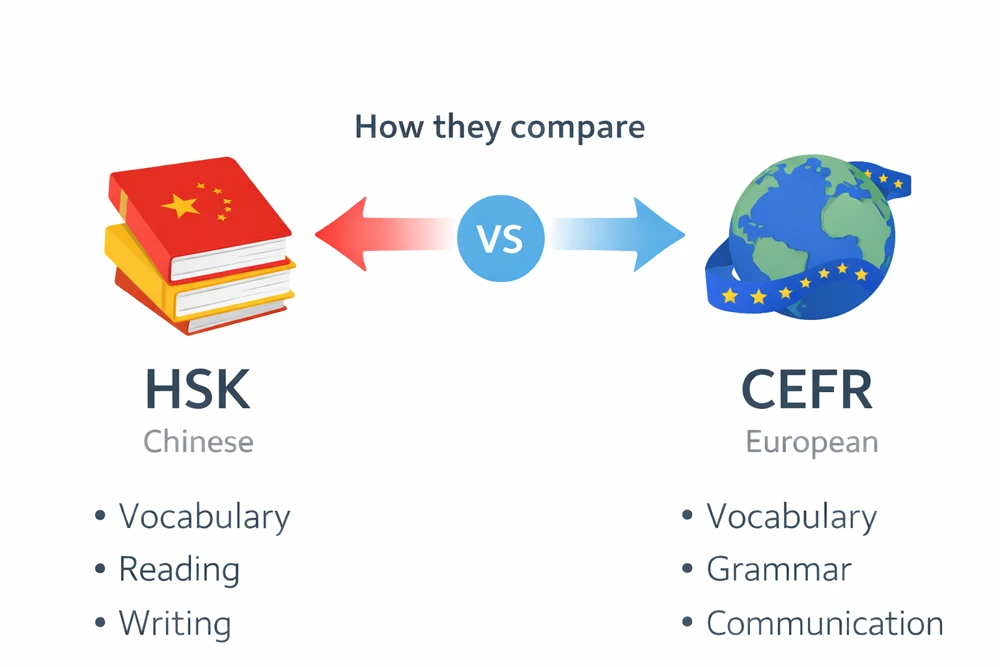
HSK tests Chinese specifically, through a fixed set of levels and task types built around that one language. CEFR does something different – it describes what a learner can do across any language, at any level from A1 to C2, without being tied to one particular exam.
Under HSK 3.0, nine levels group into three stages: Elementary (1-3), Intermediate (4-6), and Advanced (7-9). One structural change matters for comparison purposes – speaking is now assessed starting at Level 3, whereas the older six-level exam kept speaking as a separate, often optional test (HSKK) rather than folding it into the main level. That shift means an HSK 3.0 result at Level 3 and above already reflects some spoken ability, which affects how the score should be read against a CEFR band that always covers all four skills.
HSK levels compared to CEFR work best read stage by stage rather than level by level, since the official syllabus groups outcomes at the stage level rather than certifying identical ability across, say, Level 4 versus Level 5 alone. A result at any given level shows tested performance within that stage's format – it doesn't guarantee equally strong reading, listening, speaking, and writing, since a learner can pass comfortably on vocabulary and structured tasks while still finding spontaneous conversation much harder.
CEFR skips the exam-and-language format entirely. Six bands, can-do statements, used by universities and employers no matter what language sits behind the score. Three things keep it useful in practice: descriptors tied to real tasks rather than grammar points, applicability across dozens of languages instead of one exam family, and a habit of showing up wherever admissions, course placement, or curriculum design need a shared reference point.
Mapping HSK levels to CEFR works as a range, the two systems weren't designed to line up level for level. What follows draws on the official HSK 3.0 stage descriptions, general CEFR can-do statements, and the split between receptive skills (reading, listening) and productive ones (speaking, writing), rather than counting vocabulary alone as proof of a given level.
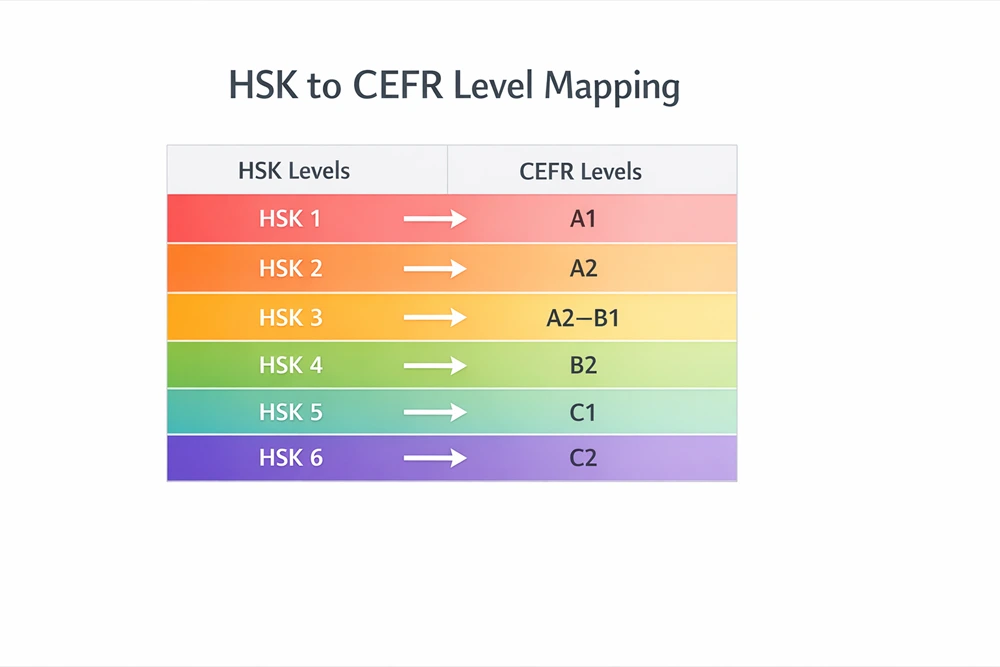
Level 1 through Level 3 make up HSK 3.0's Elementary stage, and most HSK levels CEFR equivalence charts place this range around A1-A2. The overlap makes sense on paper: both systems describe short, predictable exchanges built around everyday topics rather than anything abstract, so a learner who's solid at this stage in one system tends to look similarly solid in the other.
That clean-looking overlap has a simple explanation: early tasks in both frameworks lean heavily on memorized patterns and familiar situations, which leaves little room yet for the kind of skill imbalance – strong reading, weaker speaking, say – that starts showing up once learners move past the basics.
Once a learner reaches the Intermediate stage of HSK 3.0 (Levels 4-6), roughly mapping to CEFR B1-B2, the comparison gets noticeably less stable. Picture someone who reads news articles reasonably well and follows fast conversation between native speakers, but still hesitates constructing an unscripted response of their own – that gap between recognition and production is exactly where a single CEFR label starts to mislead.
Sources disagree at this stage for a few concrete reasons: some weigh vocabulary size more heavily than task performance, others rely on different tested skills depending on which HSK level or CEFR exam gets compared, and interpretations of what a B1 versus B2 descriptor actually requires vary between institutions.
Levels 7 through 9 make up HSK 3.0's Advanced stage, roughly corresponding to CEFR C1-C2 – though HSK CEFR alignment at this end of the scale gets far less dependable than it does lower down. A strong Level 8 or 9 result reflects real tested performance, but it doesn't automatically mean someone functions like a stable C1 or C2 user in every situation.
What complicates this stage most: reading speed and tolerance for dense, unfamiliar text; vocabulary depth extending into formal and abstract subject matter; and the ability to produce speech and writing under genuine time pressure instead of a controlled testing environment. A polished exam-day result can mask a gap that only surfaces once someone has to hold a conversation on an unfamiliar topic for several minutes straight, rather than respond to a fixed set of prepared questions.
Three things drive the gap between the two systems. HSK is a specific exam tied to one language; CEFR is a reference framework used across dozens of them. The two also distribute attention across skills differently – HSK 3.0's mandatory speaking component from Level 3 onward doesn't map neatly onto how CEFR weighs speaking against the other three skills. And a raw HSK score describes exam performance, while a CEFR descriptor describes what someone can generally do – two different kinds of information wearing similar-looking labels.
HSK measures Chinese specifically, through one testing body's fixed structure. CEFR describes ability across any language, without being tied to a single exam at all.
The gap shows up practically, too. A student might pass HSK 3.0 Level 5 comfortably on vocabulary and reading tasks, yet a CEFR-aligned interviewer assessing spontaneous speech could rate that same person's spoken ability closer to B1 than the B2 the level notionally suggests – the exam score and the descriptor are answering different questions about the same person.
The framework itself also works differently from an exam score in a more basic sense: HSK certifies performance on one specific test administered on one specific day, while a CEFR level describes a general capability that a teacher, employer, or admissions officer infers from whatever evidence they happen to have – an interview, a writing sample, a course record.
Different comparison charts lean on different kinds of evidence, which is exactly why one source's mapping can look stricter than another's. A vocabulary-based chart answers a narrow question – how many words does this level require – and says little about whether someone can actually hold a conversation. A curriculum-based chart instead tracks where a learner sits relative to a standard teaching syllabus, regardless of raw word count. Observed-ability mapping asks something closer to real use: can this person actually complete the task in front of them, independent of what a syllabus says they should know by now.
HSK levels CEFR correspondence shifts depending on which of these three approaches a given source relies on – a chart weighted toward vocabulary size can look more generous than one built around observed task performance, and that difference says more about the method than about any error in either chart.
A comparison earns its keep in a handful of specific situations: an application form asks for a CEFR band while all the applicant has is an HSK score, a learner already fluent in CEFR terms from studying English or French wants a rough read on where their Chinese stands, or a teacher planning a course needs a general reference point rather than an exact number.
Exchange programs, degree applications, and scholarship committees are where this comparison shows up most often – a student holding an HSK certificate needs to translate it for an institution that thinks in CEFR terms instead. Framed that way, HSK vs CEFR functions as a rough translation tool, not a guarantee.
It has real limits, though. Some universities ask specifically for an HSK certificate and nothing else; others accept a range of proof and weigh it differently depending on the program. An informal comparison chart doesn't override whatever the institution's own admissions page actually states – checking that page directly, before assuming a chart's estimate will satisfy a specific requirement, saves a lot of wasted effort later.
Someone who already thinks in CEFR terms from studying English or French has a built-in reference point for sizing up their Chinese progress – placing an HSK 3.0 stage against A1 through C2 turns an unfamiliar number into something that fits a scale they already understand.
Used this way, the comparison answers a few practical questions: whether a learner is still working through the basics, moving into independent use of the language, or approaching the kind of reading and writing that shows up at the advanced stage. It works better as a planning signal than as a certificate – useful for deciding what to study next, not for proving anything to an outside institution.
A level number matters less on its own than what it actually lets someone do: read a short article without stopping every few words, follow a classroom explanation in real time, write a coherent message, hold a basic conversation, or work through a formal document. Matching a score against tasks that actually come up in study, work, or daily life gives a far more useful picture than the number by itself.
A practical way to read what a score actually tells you:
what the score supports; a tested level of recognition and task performance within that specific exam format;
what it may not capture; comfort with spontaneous speech, especially on topics outside familiar exam material;
what to check next; whether the language actually holds up in situations that matter outside the test itself.
Here's what most HSK compared to CEFR conversations overlook: a learner can ace the reading and listening sections while still freezing on an unscripted question a native speaker would ask without thinking twice. Strong performance on one skill says very little about the others.

No chart hands over an exact CEFR number – the closest thing to a real answer comes from testing the guess against something concrete. Four tasks worth trying: following a normal-speed conversation on a familiar topic without asking for repeats, writing a short paragraph on an opinion, holding a few minutes of spoken conversation without constant restarts, reading an everyday text without translating line by line. None of it needs a formal setting. An honest run through these four often says more than any chart.
HSK and CEFR can only be compared in broad terms, never as a precise conversion – the accuracy of any estimate depends on which HSK stage is involved, which skills actually get tested, and which mapping method produced the chart in the first place. A single result rarely reflects the same strength across reading, listening, speaking, and writing all at once, and for anything formal – an application, a job requirement – the receiving institution's own stated requirement is what actually counts, not an informal comparison chart.
For an additional data point, Testizer runs a short online language check that can offer a second read on where someone stands, alongside whatever HSK result they're working from.
It depends entirely on the institution and program – some require HSK specifically, others accept a wider range of documentation. Checking the university's own admissions page directly beats relying on general advice, since policies vary too much to generalize safely.
Under the current HSK 3.0 structure, less so than before, since speaking now factors in from Level 3 onward rather than sitting in a separate optional test. That said, reading and listening can still develop faster than spontaneous speech, so a passing score doesn't guarantee equally strong performance across every skill.
Vocabulary load grows sharply at the upper levels, and progress stops being linear – moving from one advanced stage to the next typically demands far more exposure than moving through the earlier stages did. Consistent volume of reading and listening starts mattering more than any single study technique.
Some employers treat an HSK score as a real screening signal, especially when the role demands Chinese from day one. Others barely glance at it, leaning instead on a live conversation or a task tied directly to the job – the certificate ends up as one data point among several, not the deciding one.