

Someone can interview flawlessly and still open a spreadsheet on day one, staring blankly at the first formula the job actually requires. Interviews and application forms show how a person describes their skills – they say almost nothing about whether those skills hold up once real work starts. Building pre-employment testing into the hiring process catches that gap before an offer goes out, while it's still cheap to fix.
Pre-employment screening covers everything that happens between a candidate submitting an application and an employer extending an offer – resume review, interviews, testing, and background checks, each filtering candidates on a different basis. Testing sits inside that broader process as one specific tool – the part of the process that actually answers what is a screening test for a job, as opposed to the stages built around resumes and conversation alone.
Four stages typically run in sequence, each narrowing the candidate pool using different criteria before the next stage even begins.
This first filter checks for baseline fit – required experience, education, location, and availability – before anyone spends time on a conversation. For high-volume roles like retail or customer support, this stage alone commonly eliminates 60 to 70 percent of applicants who don't meet the stated minimums, well before a recruiter picks up the phone.
A short call, often 15 to 20 minutes, confirms the basics that a resume can't: salary expectations, availability to start, and whether the role actually matches what the candidate is looking for. Skipping this stage tends to waste far more time later – a full interview scheduled around a mismatch that a quick call would have caught in minutes.
At this stage, a candidate demonstrates a skill directly instead of describing it – an administrative applicant builds a working spreadsheet, a sales candidate walks through a mock objection, a customer-facing hire drafts a short email in the language the role requires. What the interviews and resume review couldn't confirm gets confirmed here, in a controlled setting where the task itself does the talking.
The final stage verifies what a candidate has already claimed and demonstrated, using a source outside the candidate's own account – a former manager confirming dates and responsibilities, or an official record check where the role requires one. Handling this data comes with real obligations: candidate information gathered during a pre-employment background check needs to be collected, stored, and used in line with whatever data protection and employment laws apply locally, which vary enough between jurisdictions that no single blanket approach covers every case.
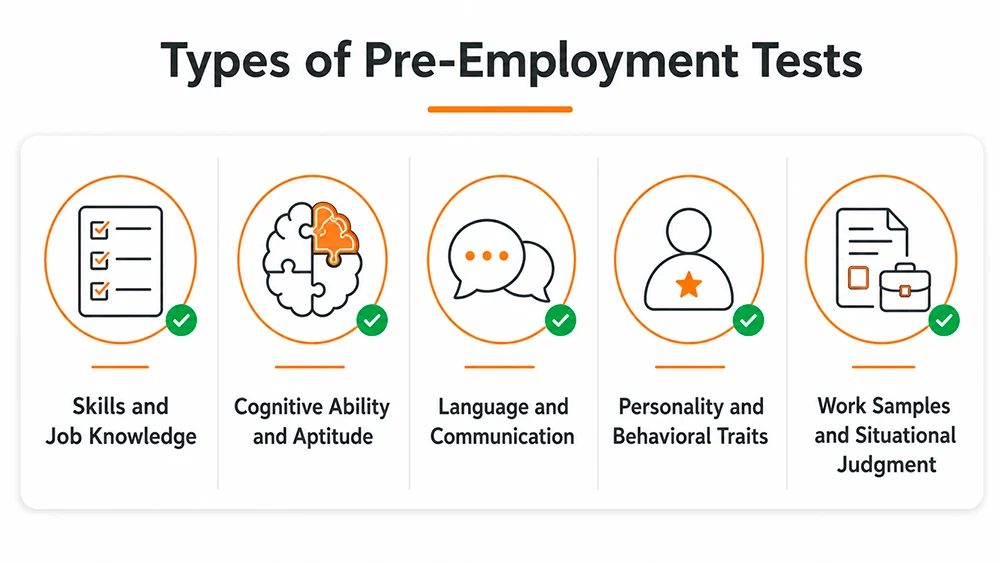
Five broad categories cover most of what employers assess before hiring, each measuring a different kind of readiness for the role:
These measure whether a candidate can execute a specific, job-relevant task rather than describe familiarity with it in general terms. An administrative role might include a spreadsheet test covering sorting, formulas, and pivot tables – skills that show up daily in the actual job, not abstract competencies pulled from a job description template.
These tests skip the fixed skill entirely and go after something harder to fake: how someone reasons through an unfamiliar problem under a ticking clock. Roles that shift shape often, or throw new hires into unfamiliar systems fast, get the most value here – the score predicts how well someone adapts, not how well they've already mastered today's specific task.
A customer-facing role that involves email or phone contact with clients abroad needs more than a passing grade on a general grammar quiz – it needs evidence that someone can write a clear response under time pressure and hold a conversation without losing the thread. A written task built around a realistic complaint, evaluated for clarity and whether it actually resolves the issue, tells an employer more than a multiple-choice vocabulary test ever could.
Comfort with ambiguity, appetite for risk, how someone reacts once a conflict actually flares up – that's the real target here, working style rather than any single skill. High-autonomy roles and heavy client contact reward this lens the most. A glowing personality profile still says nothing about whether someone can execute the technical side of the job, which is exactly why it earns a seat alongside other evidence instead of deciding anything on its own.
This category sits closest to the actual job, out of all five. Picture a sales candidate handed a scripted objection – a prospect balking at the price – and asked to pick the sharpest response from a set of realistic options, or write one cold. That closeness to the real task is exactly why performance here tends to predict on-the-job behavior better than anything the other four categories manage.
Grabbing whatever test a competitor happens to use, without checking it against what the role actually demands, hands you data nobody bothers looking at twice. Pre-employment testing pulls its weight only when each assessment ties back to a real task the job genuinely involves.
Start from the actual daily tasks of the position, not a generic list of desirable traits pulled from a template. A bookkeeping role, for instance, needs evidence of accuracy entering recurring transactions and reconciling discrepancies – a far more specific target than "attention to detail," which says nothing about which specific failure mode the test should catch.
Once the actual skill gap is clear, the next step is matching it to a screening test for the job rather than picking whatever assessment happens to be popular or already licensed. Testizer's online skills tests cover specific roles and competencies directly, which makes it easier to select something tied to the task at hand instead of a generic aptitude battery that measures something adjacent to what the job actually needs.
Testing early, before the first interview, filters out mismatches fast when application volume is high – useful for roles that draw dozens or hundreds of applicants per opening. Testing later, after a promising interview, works better as confirmation of an impression already forming, since fewer candidates reach that stage and the stakes of getting the placement right go up. Neither timing is universally correct; it depends on how many candidates are in the pipeline and how expensive an interview slot is to schedule.
A strong test score paired with weak or inconsistent references should raise a question first. The test measures a task in isolation; the reference speaks to how someone actually behaved over time in a real job. Treating any single data point as decisive, whether that's a great interview or an impressive test result, tends to produce hires that look good on paper and struggle once the actual working conditions hit.

Testing brings real advantages to a hiring process:
It also comes with real limits worth naming directly:
One source rarely gives the full hiring picture. Someone who scores well on a pre-employment test but has no verifiable work history sits in the same risk category as someone who interviews beautifully yet can't finish the actual task the role demands – both stories rest on a single piece of evidence when several were available all along.
Pair test results with interviews, real experience, and a pre-employment background check, and the picture gets noticeably fuller than any one method delivers alone. Read the whole process as one connected story about a candidate, not a checklist to clear, and the hires tend to hold up once the job actually starts. Testing and background checks alike should follow whatever legal requirements apply wherever the hiring happens.
Somewhere between a few days and several weeks, depending on how many stages are involved and how fast references get back to you. One interview plus one test can wrap up inside a week; a role demanding a thorough background check often runs well past that.
Failing usually means falling short of a threshold set for that specific role, rather than hitting some universal pass or fail line – a result that misses the bar for one position can still be perfectly adequate for another.
No, and treating all roles as interchangeable is one of the more common mistakes employers make with testing. A screening test for a job in sales measures something entirely different from one built for a bookkeeping role, and applying either test outside its intended context produces data that doesn't actually predict performance.
Fifteen to thirty minutes handles most skills and knowledge assessments without eating too much of a candidate's time before any offer is even on the table. Push closer to an hour for senior roles, where a bad hire costs enough that asking for a bigger upfront commitment makes sense.
Often yes, especially when the check turns up something that flatly contradicts what the candidate claimed earlier. The fine print – notice requirements, a candidate's right to respond, which reasons actually qualify – shifts enough by location that it's worth checking local employment law directly instead of guessing at a universal rule.