

Hiring decisions rarely come down to one thing. A candidate may know the tools, pass the technical screen, and still lose the offer to someone who communicates better under pressure. That tension sits at the center of the soft skills vs hard skills debate – and understanding it is more useful than picking a side.
Both matter. The difference is in how they are acquired, how they show up on a resume, and how employers check them. This article explains what each type covers, how soft skills vs hard skills compare in practice, and what that means for building a stronger profile.
You will learn:
Recruiters and hiring managers use the term constantly, but what is a hard skill exactly? It is a specific, teachable ability that can be measured and verified. A person either knows how to run a pivot table, write a SQL query, or read a balance sheet – or they do not. That measurability is what makes hard skills straightforward to screen.
Hard skills examples vary widely by profession, but the logic stays the same – the skill is concrete and provable.
|
Field |
Examples |
|
Technology |
Python, SQL, cloud infrastructure, cybersecurity basics |
|
Marketing |
Google Ads, SEO, Google Analytics, data reporting |
|
Finance |
Financial modeling, Excel, accounting software, tax compliance |
|
Design |
Adobe Photoshop, Figma, video editing, typography |
|
Languages |
English B2/C1, CEFR-certified proficiency, business writing |
Entry-level job postings tend to list software and tool requirements most explicitly – partly because those skills are the easiest to screen for quickly.
What is a soft skill in a workplace context? It is a behavioral pattern – the way someone approaches a task, handles disagreement, or keeps a project moving when conditions change. Unlike hard skills, soft skills are not tied to one profession. A person who communicates clearly and manages time well carries those abilities from one role to the next.
Abstract categories like "communication" or "adaptability" become clearer when they are tied to a real situation. Here are a few soft skills examples from ordinary work:
The distinction between hard and soft skills is not about which type matters more. It is about how each one is built, demonstrated, and evaluated. That difference affects how you study, how you write a resume, and how an employer decides whether to trust a candidate's profile.
|
Hard Skills |
Soft Skills |
|
|
How acquired |
Training, courses, practice, certification |
Experience, feedback, observation over time |
|
How measured |
Tests, portfolios, verified results |
Behavioral interviews, references, work samples |
|
How they age |
Can become outdated as tools change |
Remain relevant across roles and industries |
|
On a resume |
Listed with specific names and levels |
Shown through examples, not just labels |
|
How verified |
Certificates, assessments, task results |
Patterns of behavior over time |
One detail worth noting: hard skills tied to specific software or platforms can lose relevance within a few years as tools evolve. Soft skills – structured thinking, clear communication, reliable follow-through – tend to hold their value across a full career.
A candidate with strong hard and soft skills is easier to place, easier to retain, and less likely to create friction inside a team. That is the practical reason hiring managers look for both – not as a philosophical balance, but as a risk reduction decision.
Two common hiring scenarios show why neither type alone is enough.
A developer who writes clean code but cannot explain decisions to non-technical colleagues creates a bottleneck. Every handoff slows down because the team cannot interpret the work without mediation. The hard skill is strong; the communication gap is costly.
The reverse is equally limiting. A project coordinator who builds relationships well but cannot use the reporting tools, manage a budget, or read a timeline creates a different kind of problem. Soft skills keep the room comfortable; missing hard skills mean the work does not get done correctly.
HR managers rely on behavioral interview questions – «Tell me about a time when...» – specifically because soft skills are harder to imitate under pressure than a practiced answer about tool experience.
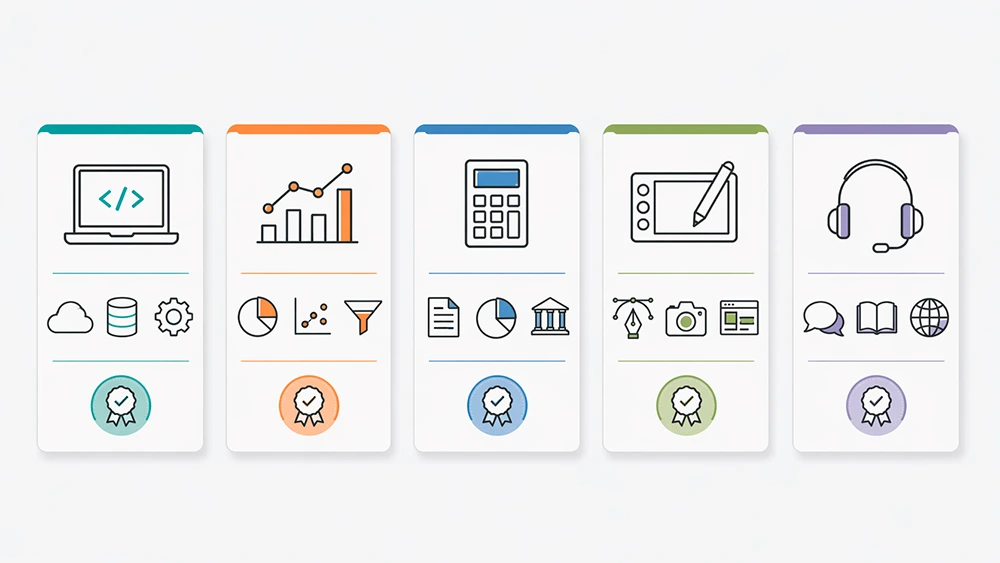
On a resume, hard skills for resume sections work best when they are specific and matched to the job description. A generic list of tools adds less signal than a focused selection of skills that directly address what the role requires.
A practical hard skills list by category:
Technology & Data
Marketing & Analytics
Finance & Operations
Languages & Communication
Adding a proficiency level next to each skill – beginner, intermediate, or advanced – gives recruiters a more accurate signal than a name alone. A list of fifteen tools with no context is harder to trust than eight skills with clear levels attached.
Soft skills for resume sections are where most candidates lose credibility without realizing it. "Team player" and "good communicator" appear on nearly every CV – and carry almost no weight as a result. A soft skills list for a resume works only when each entry is specific enough to mean something.
A useful starting list:
The list itself is less important than how it is used. Each soft skill on a resume becomes more convincing when it is paired with a short example in the work experience section – a situation where that behavior produced a visible result. Without that grounding, even a strong soft skills list reads like a template.
The right skills depend on the role, the industry, and the gap between where a candidate currently is and what the next position actually requires. There is no universal list that works across every situation. Three practical questions help narrow the choice.
What does the job description ask for directly? Hard skills listed in requirements are the clearest signal. If a role mentions SQL, Google Analytics, or a specific platform, those belong on the list – assuming the candidate actually has them.
What is missing from the current profile? Junior roles are screened more heavily on hard skills because employers cannot yet rely on a track record. Senior roles shift the weight toward soft skills – leadership, communication, and judgment – because technical ability is assumed.
What skills appear across multiple roles in the target field? When the same competency shows up in five different job postings, it is worth prioritizing. That pattern is more reliable than optimizing for one specific listing.
Listing skills on a resume is the starting point, not the proof. The difference between a claim and evidence matters most at the screening stage, when a recruiter has limited time and multiple profiles to compare.
Hard skills are easier to verify. A portfolio, a completed project, a test result, or a verifiable certificate gives the recruiter something concrete to check. For language and professional skills, structured online skill tests can produce a shareable result with a unique ID and QR code – the kind of signal that takes seconds to validate rather than minutes to interpret.
Soft skills require a different approach. They cannot be certified in the same way, but they can be evidenced. A short behavioral example in the work experience section – a situation, an action, a result – does more than a label. Reference contacts who can speak to specific patterns add another layer. Consistency across multiple roles is the strongest signal of all.
A practical approach for both:
If you want to add verifiable proof to your resume, Testizer's online skill tests cover professional and language skills – free to take, with a certificate available after.
Soft skills vs hard skills is not a competition. Both types appear in hiring decisions, both belong on a resume, and both affect how a career develops over time. The practical difference is in how they are built and how they are proved – hard skills through measurable results and verified credentials, soft skills through behavioral patterns and consistent performance.
The most useful next step is audit, not addition. Check the job descriptions in your target field, identify the skills that appear most often, and compare them against your current profile. Where hard skills are missing, a structured test or certification is often the fastest way to close the gap and make the evidence visible.
Take one skill test, attach the result, and give recruiters something concrete to check.
Most soft skills develop through experience rather than fixed personality. Communication, time management, and conflict resolution all improve with deliberate practice and feedback. Some people start with stronger instincts in certain areas, but consistent exposure to real work situations is usually what builds reliable behavioral patterns over time.
It depends on the level. Junior roles are screened more heavily on hard and soft skills combined, but hard skills carry more weight at the first filter – recruiters need to confirm baseline competence quickly. At senior level, soft skills become proportionally more important because technical ability is largely assumed from the track record.
Common methods include technical assessments, task-based exercises, portfolio reviews, and verified certificates. Some roles use structured tests before the interview stage. Hard skills examples like coding, data analysis, or language proficiency are often checked through standardized tools that produce a result the hiring team can compare across candidates.
Yes, and most strong resumes do. Hard skills for resume sections typically appear as a dedicated list with tool names and levels. Soft skills work better when embedded in the work experience section as short behavioral examples rather than listed separately. That structure gives both types the right context.
Quick improvement is less realistic than consistent improvement. The most effective approach is to pick one specific area – clarity in written communication, for example – and practice it in real work tasks every week. Feedback from a manager or peer accelerates progress faster than self-study alone. A short benchmark test can also help identify which area needs attention first.