Many parents look for an English test for kids when they need a clearer answer before choosing classes, a tutor, or the next study step. A child may already know some English, but that still leaves an open question: what level is that in practice? A quick English level test for kids helps turn guesswork into a more practical starting point.
This page presents a simple online solution. The test starts free, takes only a short time, and gives a result that can support placement, progress tracking, or course decisions. It is designed to be accessible, low-pressure, and easy to use when a fast level check is more helpful than a long evaluation.
This English level test for kids is useful for more than one type of user. It works well for parents who want a quick level check, but it can also support tutors, schools, and educational centers that need a simple placement signal before lessons begin.
It is suitable for children who are already learning English and for those who are only starting structured study. The value depends on the situation: before classes, before tutoring, or when a parent wants a clearer picture of the child’s current level. The goal is guidance, not pressure.
Level 1 — Young learners can understand simple instructions and very short stories. They can name familiar people, animals and objects. They can use short, simple phrases to express agreement or disagreement, ask basic questions and recount simple stories, often with the aid of pictures.
They can read short factual texts, signs, notices and simple stories that use narrative tenses. They can copy words, phrases and short sentences; spell very simple words; write basic descriptions; and produce short, simple stories and sentences.
Level 2 — Young learners can understand and use simple, everyday English phrases and expressions. They can introduce themselves, share simple personal information and answer basic questions about who they are, where they come from and what they do.
They can understand simple written English, such as short messages, signs or basic texts. They can also interact with English speakers at a basic level by taking part in short, straightforward conversations in familiar situations.
Level 3 — Young learners can read simple textbooks, articles and other everyday materials in English and understand them well. They can write letters and emails about familiar, everyday topics such as personal experiences, daily life or shared interests.
They can grasp factual information clearly and begin to recognise opinions, tone and mood in both spoken and written English. This enables them to go beyond basic facts and sense the feelings or viewpoints behind the language.
Level 4 — Young learners can communicate effectively in face-to-face conversations, expressing their opinions confidently and presenting clear arguments. They can follow the news and understand current affairs relatively easily.
In writing, they produce clear and detailed English in a variety of formats. They can write emails, letters, articles, reviews and other types of text while thoughtfully discussing the pros and cons of different ideas and expressing their own viewpoints.
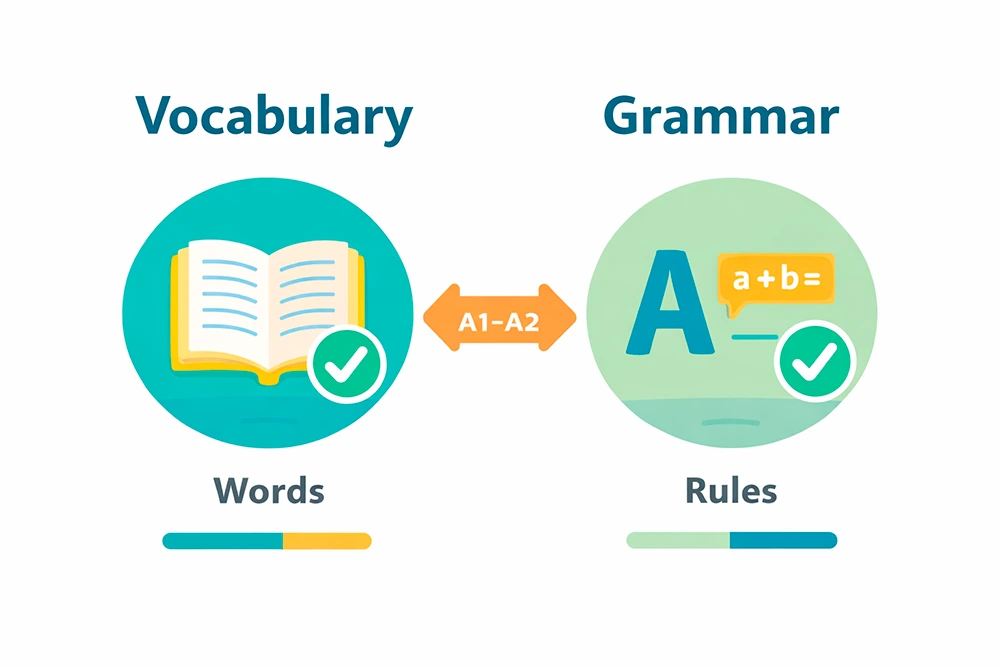
Before parents trust the result, they need to know what kind of English the test actually checks. This test is built around the language young learners are most likely to use at their stage. That makes the result easier to understand and more useful for class choice, tutoring, or general level orientation.
The test focuses on the core areas that matter first: vocabulary recognition, simple grammar patterns, and basic language use. It is meant to show whether a child can handle foundation-level tasks, not advanced academic English. That is why it works well as a basic English test for kids and as a first benchmark before more formal study.
The format supports that goal. Children respond to clear multiple-choice questions, short tasks, and manageable prompts, which keeps the focus on real understanding rather than on test stress.
The tasks are designed for young learners, so the format stays clear, short, and level-based. The purpose is to place the child on a broad learning path, not to overload them with adult-style testing. A result is more useful when the task type matches the child’s stage and attention span.
That is also why the test stays practical. Clear answer choices, short task length, and a quick overall format make the result easier to trust. In that sense, this English exam for kids works best as a child-friendly placement tool rather than a heavy formal assessment.
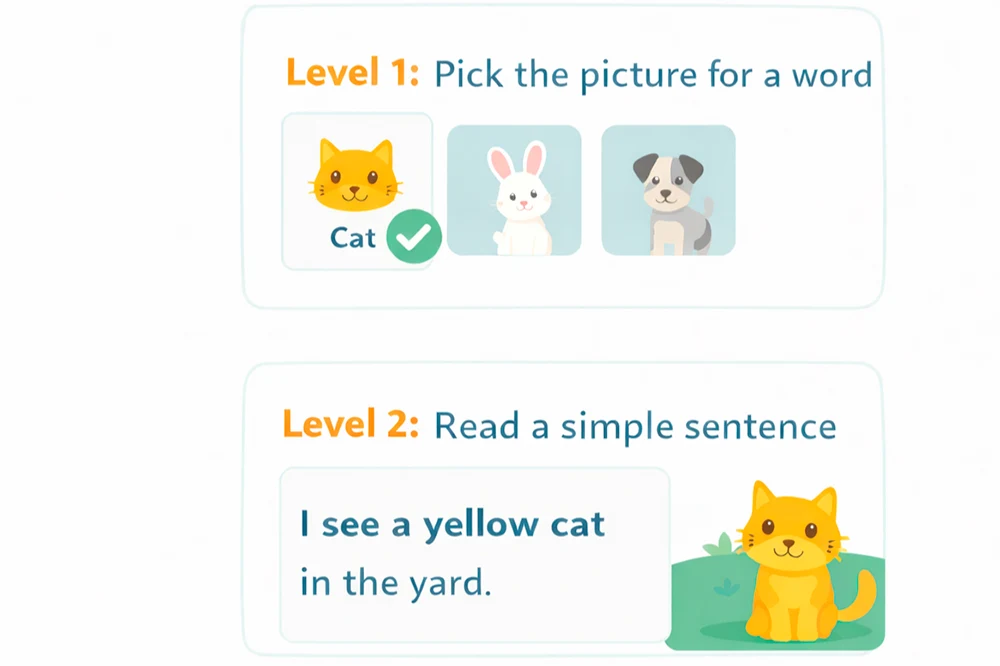
Parents usually want the process to feel simple before they click start. That is why this English test online for kids is built around a short, clear flow. There are no complicated steps, no heavy setup, and no need to decide everything in advance. The idea is straightforward: check the child’s level first, then decide what to do with the result.
The test starts online and does not require upfront payment. That makes it easier for families who first want a level check and only later decide whether they need a certificate. The format is also short enough to feel manageable for young learners.
In practical terms, this is a free English test for kids with a quick browser-based process. Testizer positions most public tests around 25 questions and about 25 minutes, with results available quickly after completion. Parents can start with the test itself, see the outcome, and only then decide whether the certificate is necessary.
Once the test is finished, the result gives a fast picture of the child’s approximate level. That is often enough for placement, course choice, or progress tracking. For families who need something more formal, the certificate is available as an optional second step rather than a required purchase.
This part matters because it gives parents a real choice. Testizer delivers results by email and positions the certificate as a separate add-on with fast digital delivery. Seeing the result first makes the process easier to trust, because the value appears before any payment decision.

Parents usually want more than a score. A useful English proficiency test for kids should help them decide what to do next: choose a class, start tutoring, confirm progress, or check whether the current level matches the child’s real ability. That is where Testizer becomes practical. The result is not just a number on the screen. It is a tool for making the next learning step clearer and easier.
Many parents use the test before enrolling a child in a course or speaking with a tutor. A quick level check can prevent mismatched placement and reduce the chance of paying for support that starts too high or too low. It also saves time because the first conversation begins with a clearer view of the child’s current level.
The fast format matters here. When completion is quick and the result comes soon after, the test works well as a first placement signal rather than a long evaluation process.
A clearer result makes it easier to set practical goals. Instead of guessing what the child should study next, parents can use the result to discuss level, pace, and next steps with a tutor, school, or course provider. It also creates a baseline that can be checked again later.
Testizer supports that process with quick results, email delivery, and an optional certificate when documented proof is useful. That makes it a practical benchmark before classes, tutoring, or progress review.
A placement English test for kids is most useful when a real decision depends on knowing the child’s approximate level. That usually happens before classes, before tutoring, after a long break in learning, or when parents want to check whether progress is actually happening. It is also a strong starting point for children who have learned informally through apps, videos, or private practice and now need a clearer level signal.
The timing matters. A level check becomes valuable when it helps choose the next step with more confidence instead of relying on guesswork.
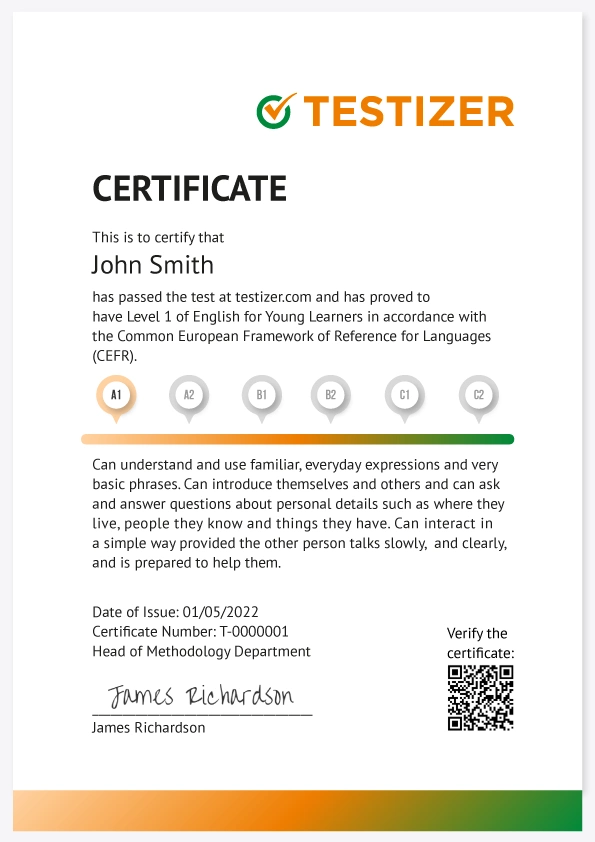
An English certificate for kids is useful when parents want a clear record of the result, not just a score on the screen. It works as an optional proof layer after the test and gives the result a format that is easier to save, share, and present when needed.
On Testizer, the certificate is delivered digitally as a PDF and includes verification features such as a QR code, a unique ID, and a public verification page. That makes the result easier for a tutor, school, or course provider to check if needed. The value here is practical: the certificate is simple to receive, simple to store, and simple to verify.
This is a quick, practical way to check a child’s current English level without turning it into a stressful exam event. The result can support placement, course choice, tutoring decisions, and progress tracking. When formal proof is useful, the certificate is available as an optional next step.
The next move is simple. Start the test, check your child’s level in a clear online format, and use the result to choose the next learning step with more confidence.
There is no single age that fits every child. What matters more is whether the child can read simple instructions and stay focused long enough to complete short tasks. If those basics are in place, the test can already be useful.
Yes, it can be useful for beginners too. A level check still helps when a child knows only a little English, because it shows where structured learning should begin. The result is often most helpful as a starting point, not as a final judgment.
It is designed to stay short and manageable for young learners. Testizer generally positions its public tests around 25 questions and about 25 minutes, which fits a quick child-friendly online format. Shorter tests are often more practical for attention span and result quality.
Parents can help with setup, login, and understanding the instructions. Helping with the answers is different. Once answers are suggested by an adult, the result stops reflecting the child’s real level, which makes the placement value weaker.
The result should be understood as a structured level estimate. That is usually enough for placement, planning, or deciding on the next class. It is useful because it gives direction. It does not define the child permanently or replace every other form of evaluation.
It can be useful as an extra document for tutors, language schools, or private courses that want a quick record of the child’s level. Its value depends on how the receiving teacher or center uses placement information, but it can make those first discussions easier and clearer.

Excited to share that I have successfully cleared the Basic Computer Knowledge and Related Software test by TESTIZER! This certification validates my understanding of fundamental computer concepts and software applications. Always eager to keep learning and enhancing my skills in the ever-evolving tech landscape. Thanks to TESTIZER for the opportunity!


Test Your Business English – Even for Fun! Improving your business English proficiency can open doors to better career opportunities, smoother communication, and greater confidence in professional settings. But learning doesn’t always have to be serious—why not make it fun? It takes you very little time to test your knowledge. In our busy lives, we often focus on learning new skills for work or study, but we rarely take a step back to assess what we already know. Testing your business English is a simple yet valuable way to measure your progress, identify areas for improvement, and boost your confidence. This is a made Self-certificate of mine for taking the quick quiz to challenge my business English.
I encourage everyone to dedicate a little free time to taking an English test, not as a chore, but as a fun and insightful challenge. Platforms like Testizer offer a quick and engaging way to check your level without pressure. Even if you’re not actively studying, testing yourself occasionally keeps your skills sharp and helps you recognize where you can grow.

I'm thrilled to have achieved the C2 level certification through TESTIZER! All my hard work and dedication have finally paid off, and it feels incredibly rewarding!

Thrilled to share a new achievement!
I’ve officially been certified as a C2 Proficient user of Business English by Testizer, in accordance with the Common European Framework of Reference for Languages (CEFR).
This means I can:
Understand virtually everything I read or hear with ease
Summarize and synthesize complex information from diverse sources
Communicate spontaneously and precisely—even in high-stakes business environments and international Fluent Communication
Language is power in today’s global workplace—and I’m proud to continue sharpening mine.
Big thanks to the Testizer team and James Richardson, Head of Methodology, for the recognition!

Thrilled to Announce a Key Milestone! I am pleased to share that I have attained the Proficient (C2) level of English, as certified by testizer.com, in alignment with the Common European Framework of Reference for Languages (CEFR).
This certification reflects my ability to:
Comprehend complex written and spoken material effortlessly.
Synthesize and articulate information from diverse sources with precision.
Communicate fluently and effectively, adapting to nuanced and intricate contexts.
Achieving this level underscores my commitment to continuous professional and academic development, particularly as I pursue my aspirations in mechanical engineering and hydrogen fuel cell research. Strong communication skills are a cornerstone for collaboration and innovation, and I am eager to leverage this proficiency to contribute meaningfully to my field.
I look forward to the opportunities ahead and to connecting with like-minded professionals.

I just took the test for both chinese HSK 4 Chinese and C1 advance business English. Using the website testizer it helps me up date my languages skill from time to time.

I’m happy to share that I’ve obtained a new certification: B2 German Language from TESTIZER! It's been a long journey in this learning experience. I remember myself 5 years ago trying to know how could I learn German for free, since I was paying my university fees and didn't have more money to pay for German courses. Plus pandemic times, where everything was closed and everything started to be on the internet. I discovered how accessible learning languages become in those times, because I started to discover free German courses. Guess what? Took all of those courses and grew up these knowledges step by step. But that was not easy, because my learning way was literally writing EVERYTHING placed on those courses, EVERY single word, phrase, expressions. You know, that takes a lot of time and that's why I spent so much time learning German. And now, seems like a lie, but 5 years later I have B2 level.
And now for what that B2 level? I still don't know, but I guess I can say that at least I speak german as well!