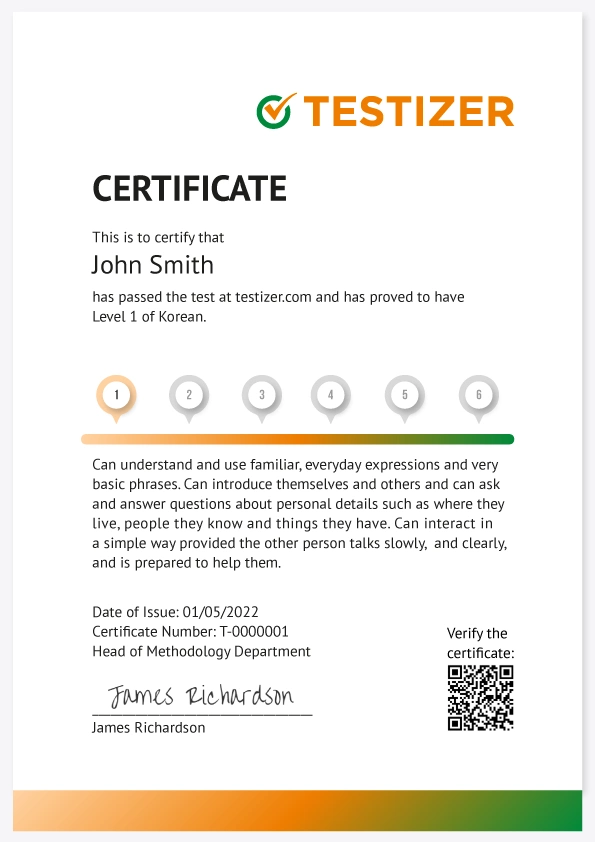
Level 1 – Your language skills at this level are limited to short, basic everyday interactions. You can read, write, and speak basic sentences in Korean, such as those required when introducing yourself or answering simple questions about what you do on a day to day basis.
Level 2 – You can participate in familiar day-to-day conversations. You don't just speak but can write as well. You're also able to ask simple questions, make requests, send and reply to messages, and follow short and clear instructions.
Level 3 – At this level, you can engage in lengthier discussions revolving around your own life or social affairs in general. For example, you can offer advice to a friend, whether via text or speech. You can exchange information with someone confidently, and even complain about an issue. However, your Korean vocabulary is still limited to familiar situations.
Level 4 – In this proficiency level, your Korean language skills have gone beyond purely personal or familiar social interactions and you can now manage abstract subjects such as engaging in philosophical debates and summarizing something you read, even though it wasn't all too familiar. In general, you can share your thoughts with relative ease.
Level 5 – This skill level proves you can engage in more complex conversations involving niche topics, such as details of your work, specialized disciplines, and philosophical discussions. Your vocabulary is broader; you can understand, read, and write detailed essays on subjects in virtually all aspects of society.
Level 6 – This is the highest proficiency level in Korean, which means you can use the language virtually like a native speaker. Words come naturally to you. You can read, write, and talk about social, professional, academic, and abstract issues. You are able to construct your thoughts into a clear structure and even persuade people with logical arguments.