
A university asks for proof of Korean before enrollment. A job posting lists a minimum language level. A scholarship application needs a documented score, not a self-assessment. TOPIK, in practical terms, comes down to answering that exact demand – a standardized result that an institution can check against its own requirements, rather than taking someone's word for their level. This TOPIK guide breaks down exactly what that result measures and how the six levels actually differ. What counts as sufficient varies by school, employer, and program, so the specific threshold always needs checking against that organization's own page rather than assumed from general advice.
An institution reviewing hundreds of applications can't interview every candidate about their Korean. What it can do is ask for one number that means the same thing regardless of who submits it – that's the entire function TOPIK serves. A self-reported "intermediate" from one applicant and another's identical claim mean nothing next to each other without a shared scale behind them; TOPIK gives schools, employers, and government programs exactly that shared scale.
None of this means a passing level guarantees acceptance anywhere specific. A program's minimum requirement – whether that's Level 3 for a language course or Level 5 for graduate admission – needs confirming directly on that institution's own page, since thresholds vary considerably between programs even at the same level of study.
Take a scholarship committee working through two hundred applications. A Level 4 TOPIK result tells them something a personal statement never could – exactly how someone performs against a fixed standard, not how confident they sound describing their own Korean. That's really what the exam is built to do: measure task performance at a given difficulty, translate it into one of six levels, and produce a certificate that means the same thing wherever it lands.
International students form one of the largest groups, mainly because Korean universities frequently require a specific level for admission into degree programs taught in Korean. Job seekers make up another sizable share – both those applying within Korea and those targeting roles abroad that specifically mention Korean proficiency.
Beyond these two groups, independent learners take it to get a formal marker of progress, government program participants submit it as required documentation, and Korean heritage speakers living abroad sometimes take it to confirm a level they've picked up informally rather than through structured study. Someone learning Korean purely as a hobby, with no application or job attached to the goal, generally has little reason to sit the exam at all – informal progress tracking works just as well without the cost and scheduling involved.
TOPIK splits into two separate tracks, each leading to its own range of levels, rather than running as one exam with six possible outcomes. Which one someone sits determines both the content they'll face and the ceiling on what score they can earn.
TOPIK I covers Levels 1 and 2, scored out of 200 points, and tests only Reading and Listening. TOPIK II covers Levels 3 through 6, scored out of 300, and adds a Writing section on top of the other two. The split isn't just about difficulty stacking higher – TOPIK I stays entirely receptive, asking a test-taker to recognize and interpret Korean rather than produce it, while TOPIK II requires generating language from scratch, which draws on a different set of skills than recognizing the right multiple-choice answer.
That distinction is worth sitting with before registering. Reading simple texts and following a conversation is one set of skills; producing several paragraphs of formal Korean under a clock is another. Someone who's never written more than a short message will find TOPIK II a different exam entirely once Writing enters the picture – not a harder version of TOPIK I, but something that tests a different capability altogether.
As a proficiency test in Korean, TOPIK I runs 100 minutes total – 40 minutes for 30 Listening questions, then 60 minutes for 40 Reading questions, all multiple-choice. A Listening question might play a short pharmacy exchange and ask what the customer ends up buying; a Reading question might show a posted notice and ask what residents are supposed to do about it.
TOPIK II takes longer: 180 minutes, 104 questions, three separate blocks. Listening covers 50 questions in 60 minutes, Writing brings 4 tasks in 50 minutes, and Reading closes things out with 50 questions in 70 minutes. Two of the writing tasks ask for short fill-in-the-blank responses; the other two are essays, the longer one usually running 600-700 characters. A test-taker might fill in a missing sentence within a short passage on one task, then build a full argument on a general topic from nothing on another.
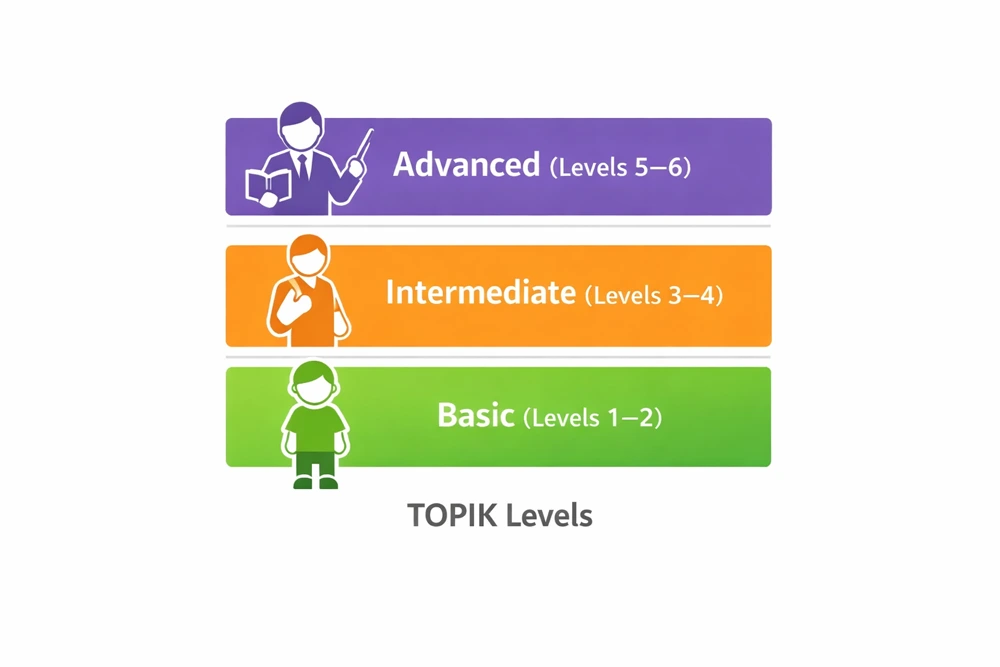
A level number by itself doesn't say much until it's tied to what someone can actually do with the language – what kind of conversation they can follow, what kind of text they can read unassisted, how they handle a situation that veers off-script. That's the lens worth applying to each of the six levels below, rather than treating them as an abstract ladder.
Level 1 corresponds to roughly 800 words of vocabulary – enough to greet someone, order food, or make a simple request, but not much beyond that. Someone at this stage can introduce themselves, ask for directions, and understand a short posted notice, though a conversation that shifts topic unexpectedly will likely leave them behind.
Level 2 pushes the vocabulary range to somewhere between 1,500 and 2,000 words, plus a working feel for formal versus informal speech – the difference between how you'd greet a stranger and how you'd talk to a friend. Writing a landlord about a repair, or confirming a reservation over the phone, sits comfortably within this range. What it doesn't cover is real independence: a native speaker talking at natural speed, with no script to follow, will still outpace what either beginner level prepares someone for.
Level 3 is where sustained conversation on familiar public topics starts happening without constant hesitation – asking a pharmacist about medication side effects, say, or working through a deposit dispute with a landlord. By Level 4, news and general-interest writing enter the picture: following a segment on a policy change, or getting through an opinion piece without needing every third sentence explained.
Levels 5 and 6 shift the challenge away from the language itself and toward precision – holding up in a graduate seminar, drafting a formal business proposal, catching the subtext buried in a nuanced argument. A single score at this range can hide more than it reveals, too: someone might read academic Korean with real ease while still hesitating through spontaneous formal speech, since the exam adds reading, listening, and writing into one number rather than certifying each skill on its own.
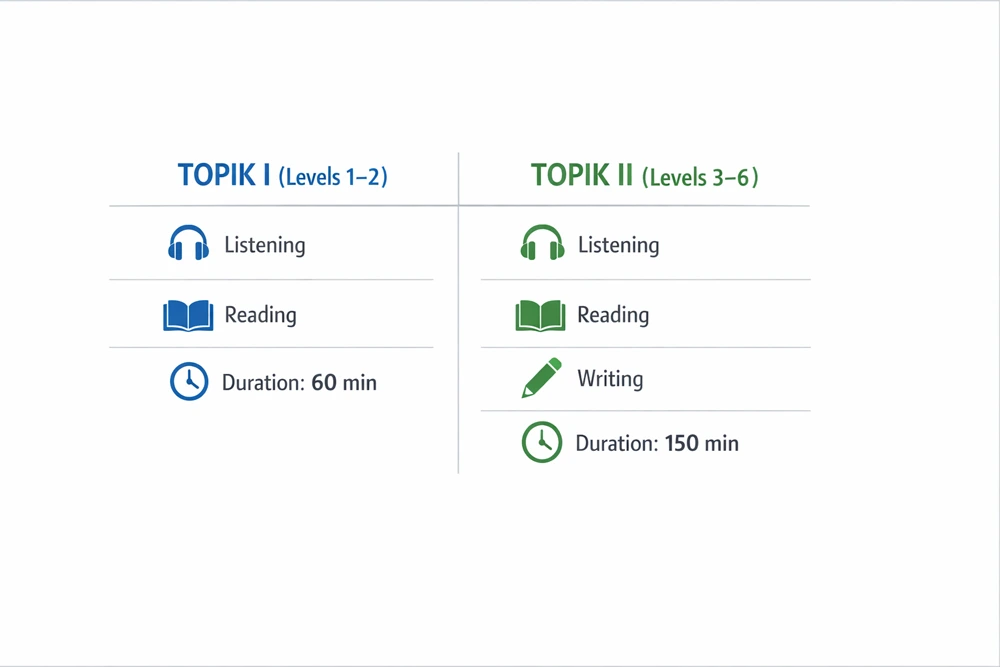
TOPIK I tests Reading and Listening exclusively, which means every point comes from recognizing correct Korean rather than producing it. TOPIK II keeps those same two sections but adds Writing, which changes the kind of preparation that actually helps – recognizing a correct sentence and constructing one from scratch draw on noticeably different skills.
Reading and Listening sections shift noticeably across the TOPIK test levels, but a Listening item at any stage might play a short phone call between two coworkers arranging a meeting time, then ask what time they settled on – straightforward once heard clearly, but unforgiving if attention lapses for even a few seconds, since the audio plays only once. A Reading item could present a public notice about a building's elevator maintenance and ask what residents are being asked to do.
What makes both sections harder than raw vocabulary size would suggest: the clock. Forty minutes for forty reading questions leaves little room to reread a passage twice, and the multiple-choice format means near-identical answer options are common by design, built specifically to catch anyone skimming rather than reading carefully. Longer passages at higher levels shift from concrete daily topics toward more abstract subject matter, which adds another layer of difficulty beyond simply knowing more words.
The Writing section's four tasks split into two shorter fill-in-the-blank responses and two essays, the longer of which typically runs 600-700 characters. The two task types test genuinely different things: the shorter responses check whether specific grammar patterns and vocabulary get used correctly in context, while the essay checks whether a test-taker can organize an argument, transition between points, and sustain formal register across several paragraphs.
Knowing the relevant grammar isn't enough on its own – plenty of test-takers who can produce individually correct sentences still lose points because they run out of time partway through the essay, or because their response wanders without a clear structure. Organizing an answer before writing, and budgeting minutes deliberately across the four tasks rather than spending too long polishing the first one, tends to matter as much as grammatical accuracy itself.
A university listing a minimum TOPIK level for degree admission is one of the most common reasons people sit the exam – without that number, an application often doesn't clear the first review stage. Government exchange program participants face a similar requirement, needing an official score report as part of their documentation rather than a language school's informal assessment. Job seekers targeting roles that specifically mention Korean proficiency attach a certificate to their application for the same reason employers ask for it: a number that means something without further explanation.
Results stay valid for two years from the announcement date, which matters more than it might seem – someone planning to apply for a program eighteen months out needs to time their exam so the certificate hasn't expired by submission deadline, not just by the interview date.

A study plan built entirely around vocabulary lists and grammar drills tends to miss where points actually get lost. Someone can know several thousand words and still run short on time in the Reading section because they're translating each sentence mentally instead of reading directly, or lose Writing points not from grammar mistakes but from running out of the fifty allotted minutes with the essay half-finished.
Knowing the shape of the exam in advance changes how someone allocates their limited time during it – a test-taker who knows Reading gives roughly ninety seconds per question can pace themselves, while someone encountering that constraint for the first time mid-exam tends to panic and lose time reconsidering already-answered questions. The two tracks also demand different preparation entirely: drilling essay-writing speed does nothing for someone registered for TOPIK I, since that track has no Writing section at all.
Past exam papers show what the questions actually look like and how difficulty builds within a section – good for picking up common phrasing and the trap answers that show up repeatedly. A timed mock exam does something a paper alone can't: it forces steady work once the clock starts running low, which has almost nothing to do with knowing the right answer under no pressure at all.
One way to use both together: sit a full past paper without timing it, mark which sections produced the most wrong answers, spend a few days on just those weak spots, then run a second attempt against a real clock and see if the gap actually closed.
Two tracks, six levels – the right one comes down to an honest read of current ability, not how high someone wants to aim. Whatever level ends up being the target, the actual minimum a university, employer, or program requires still needs confirming on that organization's own page. No general guide replaces a published requirement.
A quick check before committing to a full study plan can help narrow down which track fits. Testizer runs one of these online – a short, browser-based assessment with results by email, useful as an early orientation point rather than anything meant to replace the official exam.
No. Both tracks test Reading and Listening, with TOPIK II adding Writing – spoken production isn't assessed at any level of the exam.
Yes, authorized test centers run it in dozens of countries, not just inside Korea. Dates and formats differ by country, so it's worth checking a specific center's calendar directly rather than assuming it lines up with Korea's schedule.
There's no such requirement. Anyone confident their level already sits at 3 or above can go straight for TOPIK II, skipping TOPIK I entirely.
Each section gets its own score, and the total maps to one of six levels based on set thresholds. The final report shows both – the section-by-section breakdown and the overall level – once grading wraps up.
Photo ID and a passport-style photo cover most test centers, both submitted online during registration. Since exact rules shift slightly from country to country, a quick check with the local center avoids surprises closer to exam day.