
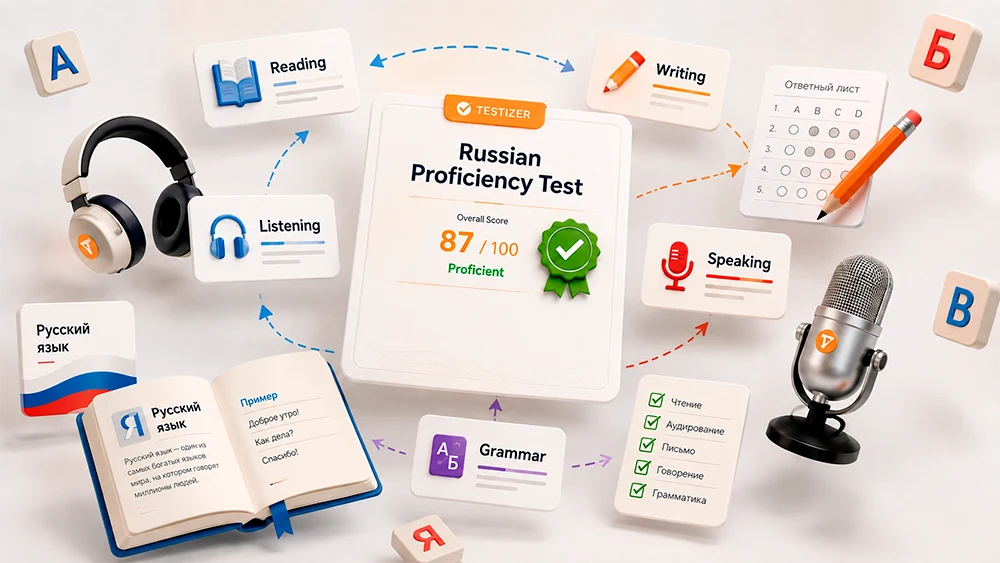
TORFL is the standardized system for testing Russian as a foreign language, built around six levels that run from A1 to C2. Anyone researching TORFL for the first time usually starts here - with the level names, since everything else about the exam builds on understanding where each one sits on the scale.
Leading Russian universities developed the exam, and the Russian government recognizes it as the official benchmark for non-native Russian ability. A Russian proficiency test built this way maps onto CEFR while still capturing features specific to Russian - the case system, verb aspect, stress patterns - that a generic CEFR framework alone wouldn't fully account for.
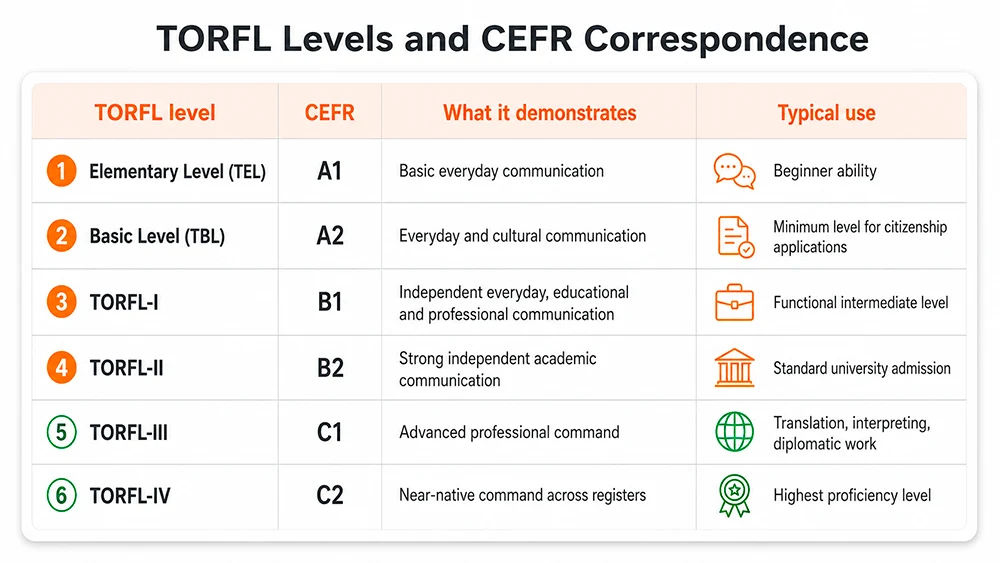
Six levels run from complete beginner to near-native command, each with its own name, minimum vocabulary target, and practical use.
Elementary Level (TEL/A1) requires roughly 780 to 800 words and demonstrates basic competence in limited, everyday situations - introductions, simple requests, short exchanges. Basic Level (TBL/A2) raises that to around 1,300 words and covers everyday and cultural communication more broadly.
TORFL levels CEFR correspondence gets practically important right here: TBL is the minimum level accepted for Russian citizenship applications, yet it falls short of what's needed for university admission, even at preparatory programs designed for foreign students.
TORFL-I (B1) covers main communicative needs across everyday, cultural, educational, and professional contexts - enough to function, not yet enough for demanding academic work. TORFL-II (B2) raises the bar substantially: understanding around 10,000 words, with active command of roughly 6,000 of them.
That B2 certificate carries real institutional weight. A Russian level test result at TORFL-II is the standard requirement for bachelor's, master's, and PhD admission at Russian universities, with philology-related programs as the main exception requiring something higher.
TORFL-III (C1) opens doors that B2 doesn't - professional work conducted in Russian, translation and interpretation, diplomatic service. TORFL-IV (C2) sits at the top of the scale, reserved for near-native command across every register the language uses.

Five sections make up the full exam, weighted roughly equally rather than letting one skill dominate the overall result.
A Russian language proficiency test at this level breaks down into five distinct sections:
vocabulary and grammar - case endings, verb aspect, syntax accuracy;
reading - comprehension of texts matched to the target level's complexity;
writing - producing a coherent text, sometimes based on audio material heard earlier in the exam;
listening - understanding spoken Russian at natural or near-natural speed;
speaking - direct interaction with an examiner on assigned topics.
Each section carries its own pass threshold. Falling short on one, even with strong results elsewhere, means the certificate for that level doesn't get issued.
The speaking section grows more demanding at higher levels specifically. At TORFL-III, candidates engage in something closer to a structured conversation than a simple Q&A - discussing current events or a given topic directly with the examiner, adjusting tone and vocabulary as the exchange develops rather than reciting prepared answers.
International students applying to Russian universities make up one of the largest groups, since TORFL-II is the standard admission requirement for most degree programs. People pursuing Russian citizenship take TORFL specifically for the TBL certificate, the minimum level the application process accepts.
A smaller but distinct group - translators, interpreters, and diplomatic staff - pursues TORFL exam certification at the TORFL-III level, where the certificate itself signals professional-grade competence rather than academic sufficiency.
Exam fees don't get refunded on a failed attempt, and registering for a level above actual ability is one of the more common ways candidates lose that money. Getting a rough estimate of current level before committing to a specific TORFL registration avoids that mistake entirely.
A structured Russian proficiency test on Testizer gives that kind of preliminary read - a CEFR-mapped estimate someone can use to test your Russian level before deciding which official TORFL tier actually matches where they stand today.
TORFL certification and an online level check serve different purposes entirely. The official TORFL certificate requires an in-person exam at an accredited center and carries legal weight for citizenship, university admission, or professional licensing. A TORFL test online - meaning a preliminary self-assessment, not the official exam itself - works best as a starting point, showing roughly where someone stands before they commit time and money to formal registration.
Total time varies by level, but higher levels run longer across all five sections combined - TORFL-III sessions commonly stretch past four hours once reading, writing, listening, vocabulary and grammar, and the oral portion are all included.
The official exam requires an accredited testing center, though some locations now offer supervised home-based sessions under specific conditions. A separate, informal Russian level check can be taken online anytime, but it doesn't substitute for the official certificate.
Several experienced teachers note that TORFL tends to feel roughly one CEFR level harder than its official equivalent suggests - a B1-level candidate, in practice, often needs closer to B2-level command to pass comfortably.
No official expiration date applies to the certificate itself, though some institutions and employers prefer results from within the past few years as a practical matter, even without a formal rule requiring it.