

Many learners want a quick sense of their level before signing up for a course, booking a test, or changing the way they study. That is why English proficiency self-assessment tools are so useful at the early stage. Without them, people often rely on intuition, and that can be uneven. One day their English feels strong, the next day it feels weaker. Good English proficiency self-assessment tools reduce some of that uncertainty.
They do not provide perfect measurement, and they are not meant to replace a formal exam. What they do offer is structure. A well-designed English self-assessment gives learners a clearer starting point, highlights likely weak areas, and makes the next decision easier.
English self-assessment tools are methods learners use to estimate their level on their own. They can take the form of short quizzes, skill checklists, guided tasks, or self-rating grids tied to real language use. The goal is not official certification. The goal is orientation.
A useful English self-assessment helps the learner answer practical questions: what feels easy, what breaks down under pressure, and which area needs attention first. That makes these tools more suitable for direction than for formal proof.
A reliable approach starts with structure. When thinking about how to assess English proficiency self-assessment, focus on real tasks rather than isolated knowledge. Try writing a short message, summarizing a text, or responding to a prompt under time limits. This reveals how language works in use, not just in theory.
The process matters more than the score itself. You should interpret the results as signals rather than as conclusions. You may compare your perception with real performance with the use of a practical benchmark, such as a brief test on Testizer. This helps decrease the amount of guessing involved.
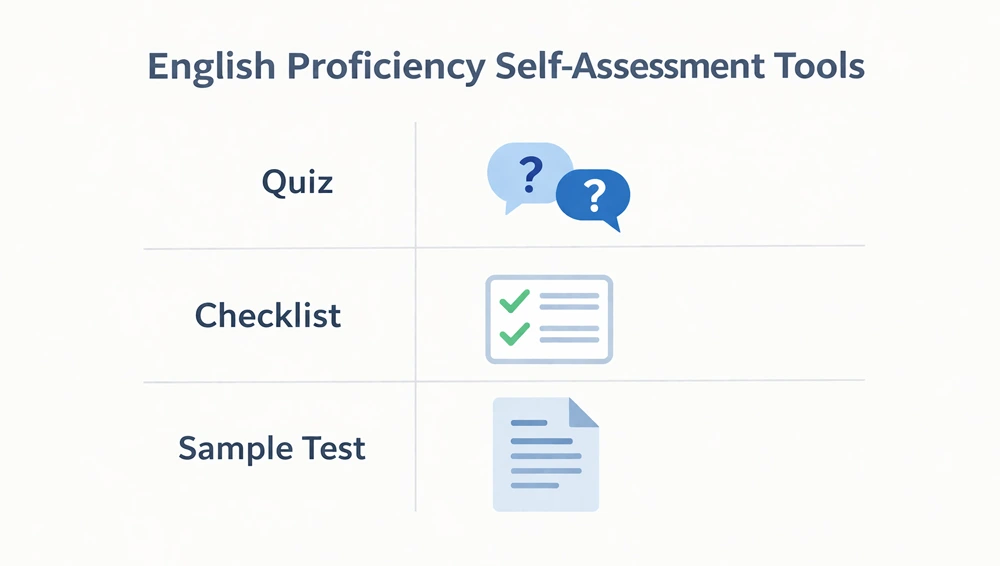
Different English proficiency self-assessment tools serve different purposes. Some rely on perception, while others measure performance more directly. Using more than one type gives a clearer picture.
Checklists help you reflect on what you can do. Quizzes check specific knowledge points. Full practice tests simulate real conditions and reveal how skills work together. Combining these formats reduces bias and makes the overall assessment more balanced.
Self-assessment is useful, but only up to a point. It tends to reveal patterns – for example, which skills hold steady and which ones start to fail when tasks become more complex. Gaps in vocabulary or structure usually show up quite quickly.
At the same time, it does not give a precise level. There is no controlled timing, no external evaluation, and no pressure similar to real test conditions. Because of that, perception plays a big role. Some learners rate themselves too highly, others are overly critical. In practice, these tools work better as signals than as final answers.
For self-assessment of English language learners, the main value is direction. A structured check makes it easier to see where effort should go. Instead of studying everything at once, learners can focus on the areas that limit progress.
This improves efficiency. Clear priorities reduce wasted time and make study sessions more targeted. Self-assessment also supports planning by turning a vague goal into specific actions. When learners understand their starting point, they can build a more consistent and realistic learning path.
Self-assessment works best as a way to set direction. It helps you see where you stand and what needs attention, but it does not replace formal testing. The value comes from clarity, not precision.
Use it as a starting point, then confirm your understanding with a structured test on Testizer before making decisions about courses or exams. Check your level with a structured test, identify gaps, and decide your next learning step.
You can get a general idea, but not an exact level. Self-assessment shows patterns in your skills, yet it depends on perception and context. For precise results, a standardized test is still the more reliable option.
Self-assessment is based on personal evaluation and informal tasks. A proficiency test follows fixed criteria, timing, and scoring rules. One helps estimate your level, the other provides validated and comparable results.
It is better to check periodically rather than constantly. Once every few weeks or after a study cycle is enough to track progress. Frequent checks without changes in practice do not add useful information.
Yes, if the tools are simple and focused on basic skills. Beginners benefit from clear checklists and short tasks. Complex tests may confuse them, so starting with straightforward formats makes the process more useful.
Combine self-reflection with structured methods. Use timed quizzes or full practice tests to balance your perception. This adds a more objective layer and helps confirm whether your self-evaluation matches actual performance.