

Many professionals use English at work every day, yet still hesitate when the task becomes more specific. A short update in a meeting, a follow-up email, a written explanation, or a report summary can feel harder than general conversation. That is usually the point where you can decide to improve your business English. The problem is not always basic knowledge. More often, it is the gap between knowing English and using it clearly under workplace pressure.
This is also why people search for how to improve business English and how to improve business English communication skills. They want practical solutions for real job situations. This article focuses on that need directly: clearer speaking, stronger writing, and better control in everyday professional communication.
Business English skills influence how smoothly work actually gets done. Many everyday tasks depend on clear wording, appropriate tone, and quick understanding. This applies not only to client communication, but also to internal coordination, where teams rely on shared clarity to move tasks forward. When language is weak, the result is often small but repeated delays: unclear requests, extra explanations, and hesitation in decision-making.
These issues rarely look dramatic, but they accumulate. Time is lost in follow-ups, corrections, and repeated clarification. Stronger Business English reduces that friction and makes routine communication more efficient and predictable.
The fastest progress usually comes from practice that looks like real work. That is the core of how to improve business English communication skills in a useful way. Listening passively can help with exposure, but spoken Business English improves more reliably when learners repeat the kinds of interactions they actually face on the job.
The best speaking practice is usually built around recurring work formats rather than general free conversation. Short, repeated exercises work well because they reflect the same patterns people use every week. Learners tend to improve faster when they rehearse communication they already need.
Useful formats include:
These tasks train fluency in a practical direction and make workplace speaking feel less unpredictable.
Confidence at work usually grows from control, not from complexity. People speak more steadily when they know how to explain simple points clearly and in the right order. In many business settings, clear structure matters more than advanced vocabulary.
That is why one effective way to improve your business English is to simplify first. Clear structure, shorter sentences, and predictable phrasing often work better in real conversations than complex language used under pressure.
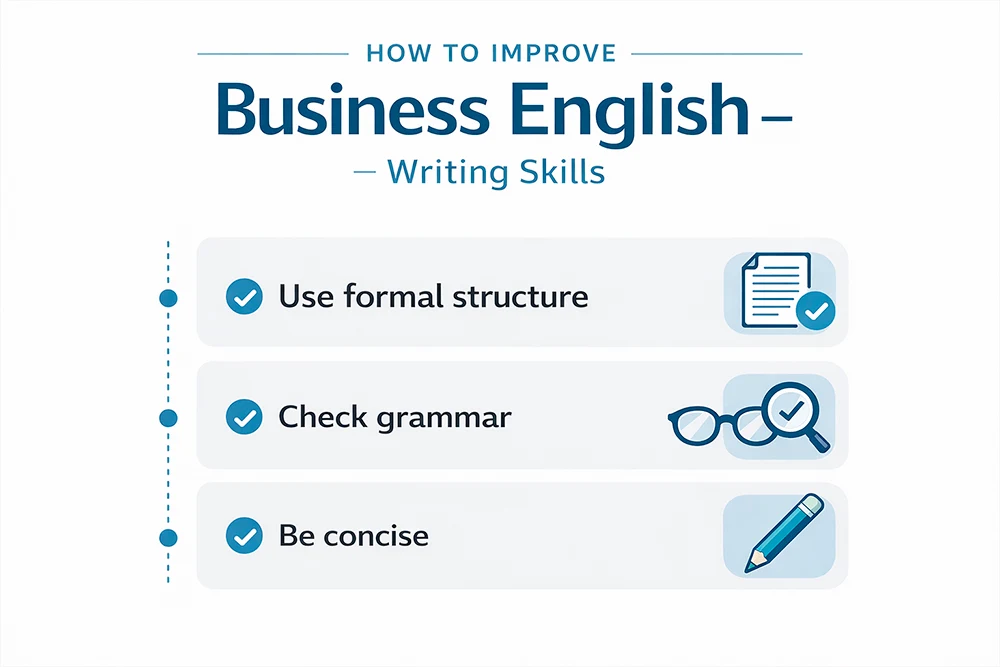
Writing is where professional English becomes visible in a lasting way. A spoken mistake may pass quickly, but written language stays in inboxes, reports, chats, and shared documents. That is why how to improve business English writing skills matters so much at work. Written communication is reviewed, forwarded, stored, and often judged more carefully than speech, so it has a strong effect on credibility.
Effective business writing depends more on structure, purpose, and tone than on advanced vocabulary. Most workplace writing becomes easier to follow when the writer makes the action, current status, and expected next step clear from the start. This saves time because the reader does not have to search for the main point.
A practical structure usually includes:
Common problems are usually repetitive rather than dramatic. Long sentences, vague requests, weak subject lines, and uneven tone appear often because many learners carry habits from general English into professional writing.
If you want to improve business English in written form, the useful place to start is precision. Stronger writing usually comes from cutting extra words, making requests specific, and checking whether the message sounds clear to the reader, not just correct to the writer.
The useful question is not only ”what resources help improve business English?” but which resource fits the problem you are trying to solve. Good materials are usually tied to real work tasks. Someone who struggles with meetings needs different input from someone who writes unclear emails. Progress is usually faster when learners combine exposure, correction, and a quick level check instead of relying on one resource type.
Useful options include:
A short business-focused test on Testizer can also work as a diagnostic step. It helps identify weak areas before the learner chooses what to practice next.
Managers usually get better results when language improvement is built into daily work instead of being treated like a separate school subject. That is the practical answer to “how do i improve my team's business English?” The most useful starting point is not broad training. It is identifying the communication tasks that create the most friction and improving those first.
A workable approach is:
When English practice is attached to recurring workflows, improvement becomes easier to sustain and easier to measure.
Business English improves most reliably through repeated use in real tasks, clearer writing habits, and focused speaking practice tied to work. Progress is usually stronger when the practice matches what the learner actually does: meetings, emails, updates, reports, or client communication. It also becomes easier to sustain once weak spots are visible.
A business-focused test on Testizer can help with that first step by giving you a quick benchmark and showing where to focus next.
You can still make solid progress by simulating real work tasks. Write short emails, summarize updates, practice meeting points, and use business-focused materials instead of general conversation alone. The key is realism. You do not need an English-speaking office if the practice already reflects workplace communication.
That depends on your current level, how often you practice, and whether the practice fits real work use. In most cases, steady short sessions over several weeks or months work better than occasional intensive study. Business English grows through repetition. Consistency usually matters more than volume.
Yes, but only the vocabulary connected to your actual tasks. Most professionals do not need a huge general business word list. They need the terms, phrases, and structures that appear in their own emails, meetings, reports, and updates. Targeted vocabulary is easier to retain and easier to use well.
The fastest route is to practice the exact formats you use most often. If meetings and emails are your main pressure points, focus on agenda language, clarification phrases, follow-up wording, and short written summaries. Improvement usually comes faster when practice follows weekly work patterns rather than broad general study.