

If you want to know how to improve listening skills, the first step is to understand why listening feels so difficult. Spoken language moves continuously. Sounds blend together, speakers shorten words, and sentences arrive before your brain has time to process each piece. Unlike reading, you cannot pause and recheck every line. That is why many learners search for how to get better at listening even when their grammar and vocabulary seem solid.
Good listening is not about understanding every single word. What matters more is stable comprehension in real situations: a work call, a video explanation, a short meeting, or a conversation while traveling. The goal is to catch the main meaning quickly and stay with the speaker as the message develops.
Progress usually starts when practice matches your real level. If the material is far too easy or far too difficult, improvement slows down. A simple way to avoid that problem is to begin with a quick baseline check. Services like Testizer provide a short online level test with results sent by email, and a certificate can be added if you need formal proof of your level.
In the sections below, you’ll learn how to improve listening comprehension through structured exercises, practical listening habits, and clear training routines that fit daily study.
If you’re not sure where you’re starting, take a quick level check before you set your weekly routine.
Listening is not a single skill. It is a chain of small processes that happen almost instantly: you hear sounds, identify where one word ends and another begins, connect those sounds to words you already know, interpret the meaning, and then keep that information in memory while the speaker continues. If any part of that chain breaks, comprehension drops.
One common surprise for learners is this: knowing a word does not guarantee recognizing it in speech. Words change shape when people talk naturally. Sounds blend, syllables disappear, and stress moves to different parts of the sentence. A word that looks familiar on paper can sound completely different in fast conversation.
Pressure also plays a role. When someone is waiting for your response, the brain often shifts from listening to planning an answer. That small shift reduces recall and makes it easier to miss key information.
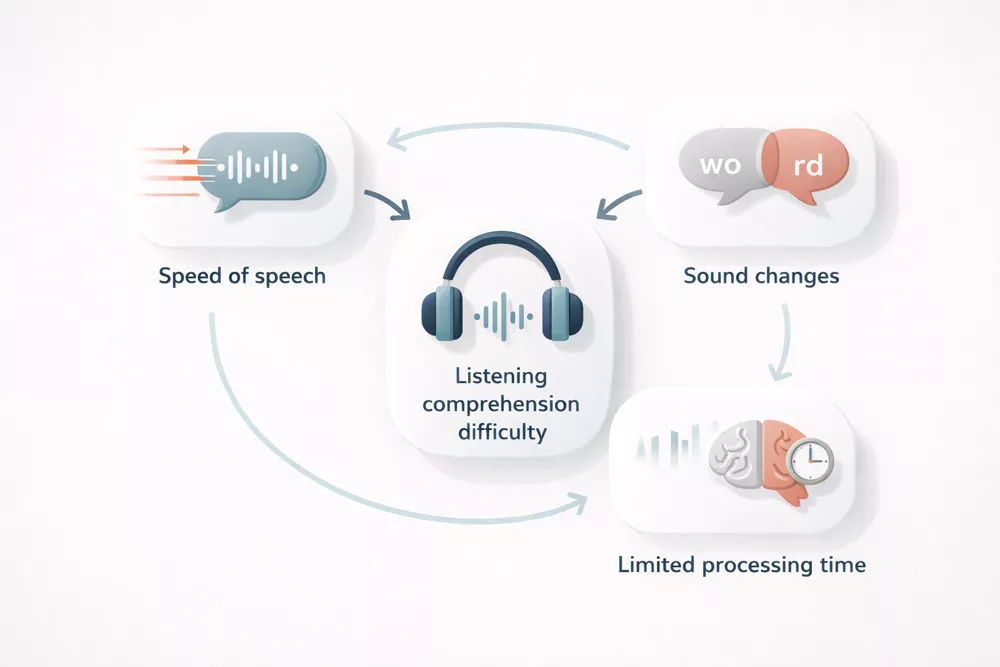
Several factors usually combine to make listening difficult:
Real conversations rarely sound like textbook recordings. When people speak naturally, words connect to each other and individual sounds often change. This phenomenon – often called connected speech – means that pronunciation becomes more fluid. Instead of carefully pronouncing every syllable, speakers focus on rhythm and stressed words, while smaller sounds fade or disappear.
Speed also plays a role, but not always in the way learners expect. The difficulty is not only that someone speaks quickly. Natural speech has a rhythm that may feel unfamiliar, and many syllables are reduced or shortened. As a result, even a moderate speaking pace can feel fast if your ear expects every word to sound “complete.”
For effective listening practice, the goal is not to catch every syllable. It is to recognize where words begin and end and to notice the stressed words that carry the main meaning of the sentence.
Three common sound patterns appear in everyday speech:
For example, “want to” is often heard as “wanna” in casual conversation.
Many learners can read a word, define it, and even use it in writing – then miss it completely when they hear it. That’s a recognition gap. Reading knowledge doesn’t automatically turn into listening access because your brain still lacks a clear “audio memory” of how the word sounds in real speech, with natural rhythm and reductions.
The fix is not more memorization. It’s repeated encounters in context, followed by quick recall when there’s no time to pause. You’re training your ear to link sound to meaning instantly, the same way it works in your first language.
A simple recognition practice routine works well:
Three signs you have a recognition gap:
If your materials are too hard, you’ll quit. If they’re too easy, you’ll stall. The sweet spot is content you can partly understand and return to without dreading the replay button.
A level-fit rule that works: choose audio that feels like a manageable struggle – enough unknowns to learn, not enough to drown. Rotate sources to hear different accents and speaking styles, but keep your task routine steady for a few weeks. That consistency is one of the most underrated strategies for listening comprehension, and it sets up the next section on what to do while you listen.
Use a simple filter: topic familiarity, short length, clear voices, and easy replay. Two to four minutes you can replay with focus beats 45 minutes you half-follow while multitasking. For beginners and intermediate learners, learner podcasts, graded videos, and slow news are practical because they’re built for clarity. For advanced learners, try interviews, panels, and workplace-style meetings where speakers overlap and phrasing is less predictable.
|
Level |
Best audio length |
Best formats |
|
Beginner |
1-2 minutes |
Graded videos, learner podcasts |
|
Intermediate |
2-4 minutes |
Slow news, short interviews |
|
Advanced |
3-6 minutes |
Meetings, debates, long-form interviews |
Subtitles are a tool, not permanent support. Use them in phases so your brain still has to work. A clean sequence:
Avoid bilingual subtitles for training – they pull you into translation instead of faster recognition.
When the audio is playing, you need real-time tactics – not more rewinding. The best strategies for listening comprehension start with accepting that listening has modes: a first pass for meaning, and a second pass for details. Strong listeners make quick predictions from context (topic, setting, speaker intent), then confirm them with a few key phrases. That’s how to get better at listening without chasing every unknown word and losing the thread.
The goal is controlled attention: you decide what matters in the moment – the main point, the change, the next step – and you let the rest go until review time.
On the first pass, aim for the backbone: who is speaking, where it happens, what changed, and why it matters now. Gist reduces panic and gives your memory something stable to hold, so the second listen becomes sharper instead of exhausting. Train this with timed summaries so your brain learns to compress meaning fast.
Tiny exercise:
Signal words act like road signs. They tell you whether the speaker is adding a reason, changing direction, or finishing a point – even if you miss some vocabulary. Once you catch structure, comprehension improves because you stop guessing randomly. Build a personal signal list from your own materials and reuse it.
Mini signal list:
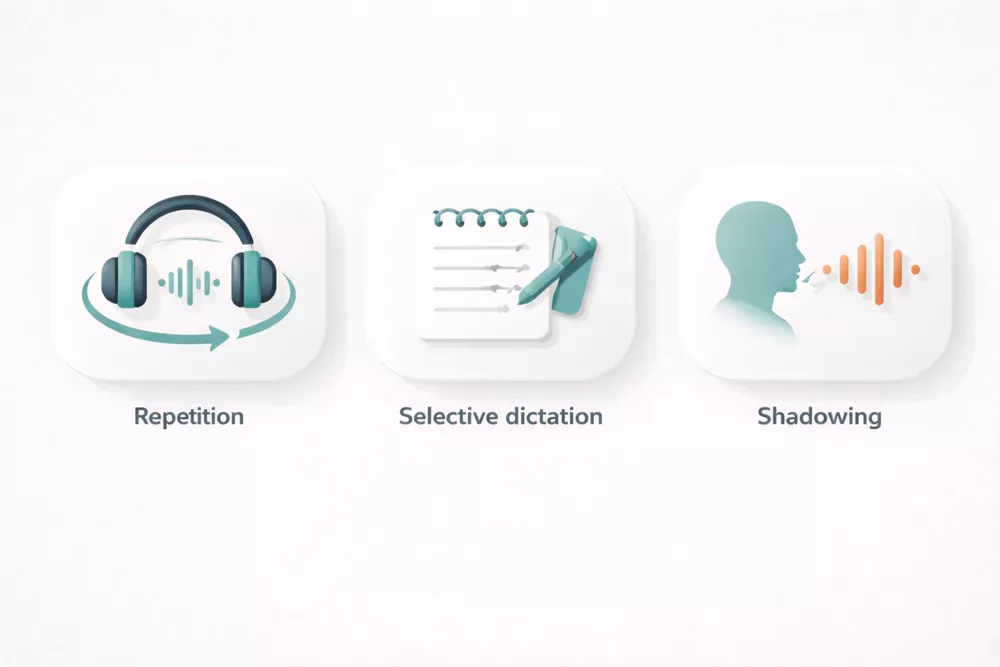
If you want to improve listening comprehension skills, practice has to be deliberate. Progress usually comes from short training loops where you listen, check what you missed, and repeat the same fragment again. This kind of focused work gives immediate feedback, which helps the brain recognize patterns faster.
Each drill below targets a specific weakness in listening: recognizing sounds, holding information in memory, or processing speech at natural speed.
Choose a short clip – about 10-20 seconds – and replay it several times until the words begin to separate clearly. At first you may slow the audio slightly to notice word boundaries, but always return to normal speed after a few repetitions.
Stop before you feel tired. Returning to the same clip the next day often makes it noticeably easier to understand.
Full dictation can take too much time. A lighter method is selective dictation: write down only the parts you cannot hear clearly, then verify them with a transcript.
A simple workflow looks like this:
Listen → mark the time → write the unclear phrase → check the transcript → replay once
The aim is accuracy on problem spots rather than perfect transcription of the whole passage.
Shadowing improves listening because it trains timing and chunking. Use echo shadowing: speak a beat behind the audio, aiming for rhythm rather than perfection – that’s how to improve listening comprehension without turning it into a pronunciation marathon. Keep it short: two minutes, same clip for a week. A good starter is a short customer support call opening where names, dates, and next steps appear naturally.
Real conversations are rarely clean. People interrupt each other, voices overlap, and background noise turns simple audio into a moving target. The main skill is recovery – how fast you regain the thread after you miss a phrase. Listening is also interactive: a brief clarification is a strategy, not a failure. If you’re wondering how to get better at listening, treat each conversation as practice in staying calm, tracking the topic, and asking for just enough repetition to move forward.
Accent exposure works best when it’s planned, not random. Keep one “comfort” accent in your routine and add one stretch accent each week, so your ear adapts without overload. Don’t try to collect accents; focus on recurring sound patterns and common vocabulary choices.
Missing a phrase is normal. The real problem is freezing, then losing the next part too. Use “hold your place” tactics: grab the next keyword, ask for one repeat, or confirm what you did catch.
Recovery script (3 lines):

The daily time can stay roughly the same across levels – what changes is the difficulty of the task and how strict your accuracy target is. If you want to improve language listening skills in a practical way, match your practice to your level: beginners build recognition, intermediate learners close gaps at speed, and advanced learners train nuance across different speakers. Each level needs one non-negotiable habit and one trap to avoid.
Use short, clear audio with transcript support and stick to everyday topics (introductions, directions, simple requests). Repeat the same 60-90 second clip across several days so common words become familiar in sound, not just on the page.
Must-do: replay once, then say 2-3 lines aloud to connect listening to output.
Avoid: using movies as your main tool too early – the speed and noise usually overwhelm more than they teach.
Shift toward first-pass understanding: listen for gist, then confirm with signal words that show structure.
Must-do: one weekly “pressure” task – a short call snippet, a meeting clip, or an interview answer – then review what you missed. Track recurring gaps (fast function words, linking, word endings) and target one pattern per week.
Avoid: leaving subtitles on all the time; they stop your ear from doing the work.
Train nuance: stance, tone, implied meaning, and polite disagreement. Add controlled difficulty with noisy environments and multi-speaker audio (panels, meetings, group calls).
Must-do: after listening, write one sentence answering: what changed, who agreed, and what happens next. That forces precision instead of vague understanding.
Avoid: chasing rare vocabulary at the expense of speed and clarity.
If you’re serious about how to improve listening comprehension, measure outcomes instead of counting hours. Time spent is easy to log, but it can hide a flat result. Use three simple signals: an estimate of how much you understood on the first listen, how many replays you needed, and what you missed (numbers, names, linking words, verb endings, key intent). This gives you a diagnosis, not just a streak.
Keep one weekly micro-metric and one consistent benchmark. Weekly tracking shows whether your training tasks work; a benchmark prevents the common illusion of progress that comes from listening to familiar content.
|
Metric |
How to measure |
Frequency |
What it tells you |
|
Replays per minute |
Count pauses/replays during a 2-4 minute clip |
Weekly |
Processing speed and confidence |
|
Summary accuracy |
Write a 3-5 sentence summary, then check against transcript |
Weekly |
Meaning retention and structure |
|
Comprehension on first listen |
Estimate % understood before any transcript/subtitles |
Weekly |
Real-time stability under normal pace |
|
Benchmark level check |
Use one consistent test format to compare results |
Every 2-4 weeks |
Direction of progress over time |
As a checkpoint, run a quick Testizer level check every 2-4 weeks to confirm movement. Results come by email, and a certificate is optional if you need proof for work or study.
Listening gets easier when your practice has three parts: material that matches your level, an active task that forces attention, and a short feedback loop that shows you what to fix next. Big jumps rarely come from bingeing podcasts or background TV. They come from repeated exposure to the same sound patterns until your brain stops treating them as noise and starts grouping them into meaning.
Keep the daily effort small but stable. Ten focused minutes done every day will usually beat a random two-hour session, because consistency trains recognition and recall under real pace.
For the next two weeks, run a simple cycle: choose one source you can replay, use two drills (for example, short repetition loops and selective write-down), and track one weekly metric plus a benchmark check. If you want to see how to improve listening skills without guessing, measure what changes first-listen, not how long you listened.
Start with a baseline, follow the plan for two weeks, then re-check. If you need proof of level for work or study, a Testizer certificate is optional and designed to be shareable and verifiable.
About 20-30 minutes of focused listening is usually enough to see steady improvement. The key factor is consistency. Short daily sessions train your ear to recognize patterns in real speech, while occasional long sessions often feel productive but don’t build stable comprehension. Active listening with a clear task works far better than passive background audio.
Practical step: Schedule one 20-minute focused session and add a short 10-minute replay loop later in the day.
Both can be useful if used in the right order. Subtitles should help diagnose what you missed, not replace listening. Starting with subtitles trains your eyes instead of your ears, but never checking a transcript can leave mistakes unnoticed. A short sequence helps balance both goals.
Practical step: Listen once without subtitles, check the transcript briefly, then listen again without subtitles.
Teachers often speak more clearly and control their pace, while natural conversations include faster rhythm, sound reductions, and unexpected topic changes. Native speakers also rely more on connected speech, where words blend together. Because of this, real listening requires adapting to natural rhythm rather than only recognizing individual words.
Practical step: Practice with short real-life clips and note reduced forms you hear in the transcript.
Listening can improve through focused listening exercises alone, but speaking usually accelerates the process. When you repeat phrases aloud, you reinforce the rhythm and sound patterns you just heard. This strengthens memory and makes similar phrases easier to recognize later in real conversations.
Practical step: After listening, repeat five key lines aloud or shadow the audio for two minutes.