

If you are wondering how to study for a language test, the problem is usually not effort but direction. Many learners spend time on grammar, vocabulary, and random exercises, yet still feel unprepared. Language test preparation often becomes overwhelming for this reason. There are too many materials, and without structure, it is difficult to understand what actually improves results.
The same question – how to study for a language test – often appears when general practice stops working. This guide focuses on a more structured approach. Instead of doing more tasks, it explains how to organize preparation, focus on the right skills, and use time in a way that leads to measurable progress before the exam.
General language learning and exam preparation are related, but they are not the same task. In language testing, knowledge has to work under pressure. The learner is expected to answer within a set time, follow a fixed format, and stay accurate while moving quickly. That changes the way the language is used.
This is why preparation for a test needs more than broad study. A person may understand the material well and still perform unevenly if timing, format, or task type feels unfamiliar. Success depends not only on what the learner knows, but on how well that knowledge holds up inside test conditions.
Preparation usually works better when it follows a sequence. Many learners work hard but move from one task to another without a clear order, which makes progress harder to measure. A more useful approach is to break the process into steps. That is the practical answer to how to prepare for a language exam without wasting effort.
The first step is to understand exactly how the test works. Format matters because it shapes strategy. Timing matters because it changes how quickly you need to read, decide, write, or respond. When the structure feels familiar, the brain spends less energy adjusting and more energy solving the actual task.
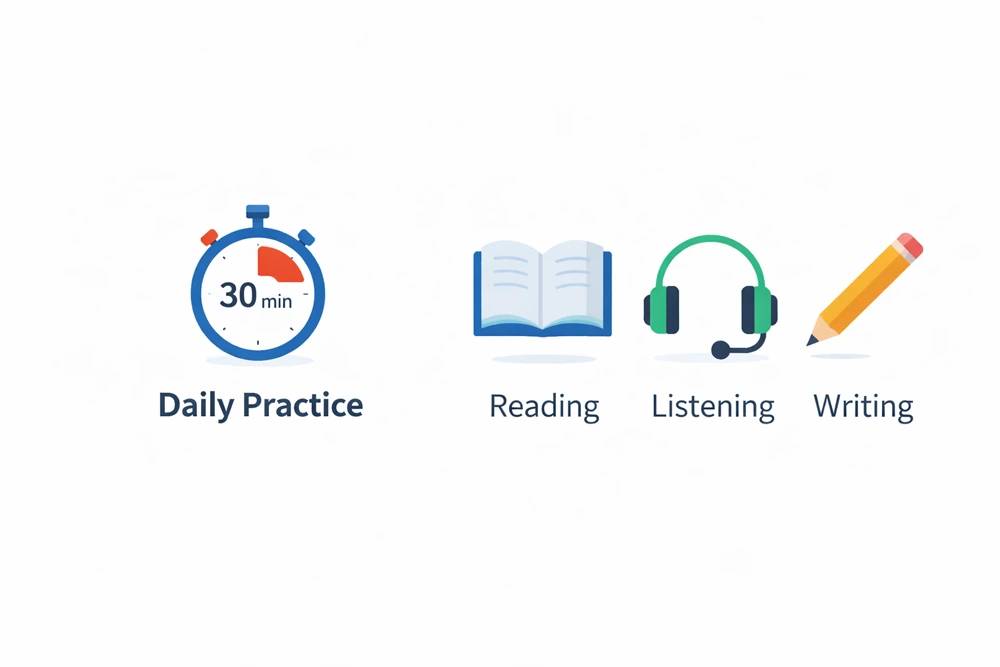
A study plan should match both the time available and the learner’s current level. A short daily plan is often more effective than long irregular sessions, because repetition improves recall and keeps weak areas visible. One of the most useful language test tips is to plan for consistency first. A realistic schedule also lowers panic in the final days, because the work has already been spread across the preparation period.
Preparation works better when skills are ranked instead of treated as equal. Many learners spend too much time on areas that feel familiar and too little on the parts that actually affect the score. Good language exam practice starts with priorities. The test format, scoring, and your current level should determine where most of the effort goes.
Not every skill carries the same weight in every exam. Some tests place more pressure on reading and listening, while others require stronger writing or speaking performance. That changes how time should be divided.
A useful first step is to check:
Weak areas tend to limit the total result, even when the other sections look stronger. That is why it helps to identify the weakest skill early instead of discovering it after several practice rounds. A short diagnostic test can make that clear more quickly.
Testizer can be useful at this stage as a benchmark tool. A fast test result helps show whether the real problem is listening speed, reading accuracy, grammar under pressure, or another weak point that needs earlier attention.
Practice is most useful when it trains performance, not just recognition. Many learners improve their knowledge but still underperform because practice does not resemble the real testing situation. The closer the exercise is to the actual format, timing, and pressure of the exam, the more helpful it becomes on test day.
Time changes how people use what they know. Under pressure, hesitation becomes more visible and small mistakes multiply faster. That is why timed practice matters. It trains pace as well as accuracy.
Review matters just as much. A finished exercise is only useful when the learner checks where time was lost, which errors repeated, and which questions caused uncertainty. That is how speed and accuracy start improving together.
Sample questions help the learner get used to task style before the real exam. Full mock tests go further: they reproduce the rhythm of the experience and make the pressure more familiar. This makes language exam practice more realistic and easier to evaluate.
For anyone asking how to pass a language test, repeated exposure to the real format is one of the most practical steps. Familiar tasks reduce hesitation, and mock tests make decision speed more stable under exam conditions.
Preparation often becomes less effective because the same patterns repeat without correction. Learners may spend time on useful activities, but without feedback or structure, mistakes remain unchanged. Over time, this reduces progress and creates false confidence before the test.
Common issues include:
When these patterns are identified early, preparation becomes more focused and results improve more consistently.
The final days before the exam are not the time to learn new material. They are best used to stabilize what is already known and reduce uncertainty. Light review helps reinforce patterns without adding extra pressure. This stage is about control, not expansion.
One of the most practical language test tips is to keep the workload predictable. Short review sessions, familiar tasks, and clear routines make performance more stable. Reducing stress and avoiding sudden changes in study habits often has a direct effect on how confidently the learner performs on test day.
Effective preparation usually comes down to three things: structure, focus, and realistic practice. A learner may know the material, but results depend on how well that knowledge holds up under actual test conditions. Clear planning makes that easier and reduces unnecessary stress before the exam.
A quick test can also help check readiness before the real date. Testizer can be useful here as a fast benchmark for identifying weak areas and seeing whether the current study plan is working.
That depends on your current level, the test type, and the score you need. If the goal is ambitious, it helps to start earlier so there is time for skill-building as well as exam practice. For a simple placement check, the preparation window can be much shorter.
In most cases, shorter daily sessions work better. They keep the material active and make it easier to review mistakes regularly. Longer sessions can still help, but they are less effective if they happen too rarely. Consistency usually matters more than session size.
Both matter, but test practice should start early. Grammar is useful when it supports performance, not when it stays separate from exam tasks. A good balance is to review grammar through the kinds of questions the test actually uses. That keeps preparation practical.
Start with a diagnostic check. A quick assessment gives you a clearer picture of your level and shows which skills need the most attention. That makes the study plan easier to build. Without a starting point, preparation often becomes too general.
Repeated mistakes usually mean the problem has not been analyzed closely enough. Instead of doing more random practice, group the errors by type and look for the pattern behind them. That may reveal a timing issue, a grammar gap, or a weak skill area. Systematic review works better than repetition alone.
Yes, it is possible if the plan is structured and the practice is consistent. Many learners prepare successfully on their own by using sample questions, timed practice, review, and targeted materials. A teacher can help, but independent preparation still works when feedback and planning are built into the process.