
You’re in an interview, and the recruiter points to your resume: “So… are you fluent?” You pause, because the question sounds simple, but it isn’t. In everyday language, proficiency vs fluency gets blurred: one label feels like speaking smoothly, the other feels like being advanced, yet real communication and real assessment don’t line up that neatly.
This guide breaks down proficiency vs fluency in practical terms, so you can describe your level accurately, choose the right goal, and avoid overpromising. You’ll also see where proficiency vs fluency matters most – in exams, careers, and day-to-day conversations – without turning the topic into theory.
In this guide you’ll learn how to:

In real life, the labels get mixed because people use them for different purposes. Job ads may say “fluent” when they mean “can work independently,” while school programs might use “proficient” as a catch-all for passing a level. On LinkedIn, both words often become shorthand for “good enough,” so the nuance disappears. The core mix-up is simple: many treat proficient vs fluent as synonyms, but they describe different things.
Where the confusion comes from
Two quick examples: a fluent talker speaks smoothly but keeps recycling basic vocabulary; a proficient student scores well in reading and writing, yet hesitates in live conversation.
Fluency is about flow: the speed and rhythm of your speech, fewer long pauses, and the ability to keep a conversation moving without getting stuck on every sentence. It’s also a spectrum and often topic-dependent – you can sound fluent ordering food, then slow down sharply when you need to explain an opinion. Calm realism: you can make mistakes and still be fluent if the listener understands you easily.
People usually call someone fluent when conversation feels steady and natural, even if it isn’t perfect. Here’s what what is considered fluent in a language often looks like in practice:
Context matters: fluent for travel is not the same as fluent for academic discussion or work meetings.
Fluency is powerful because it’s visible fast: you sound comfortable, you respond quickly, and real-life interaction becomes less stressful. That confidence often leads to more speaking time, which accelerates progress.
But fluency can hide gaps. Smooth speech may rely on safe phrases, limited grammar, and familiar vocabulary. Writing and reading can lag behind, and accuracy issues may persist if you never slow down to fix patterns. Practical takeaway: fluency is a strong signal for conversation, but it’s not the full picture of language ability.
Language proficiency is your overall ability to use a language across skills – speaking, listening, reading, and writing – with enough accuracy and range to get real work done. The key test is unrehearsed context: can you handle a new topic, an unexpected question, or a practical task without relying on a memorized script?
This is why proficiency matters in exams, academic programs, and formal workplace situations. Meetings, reports, client emails, and data-heavy discussions all demand more than smooth speech – they require comprehension, precision, and the ability to adapt. In simple terms, language proficiency is the difference between sounding okay in a familiar chat and performing reliably when the stakes or complexity rise.
“Proficient” becomes clearer when you translate it into observable behavior. What does proficient mean in practice is that you can explain, summarize, and respond with control – not just keep talking.
A compact litmus test: if you can walk someone through a process, handle questions, and tidy it up in writing afterward, you’re operating in proficient territory.
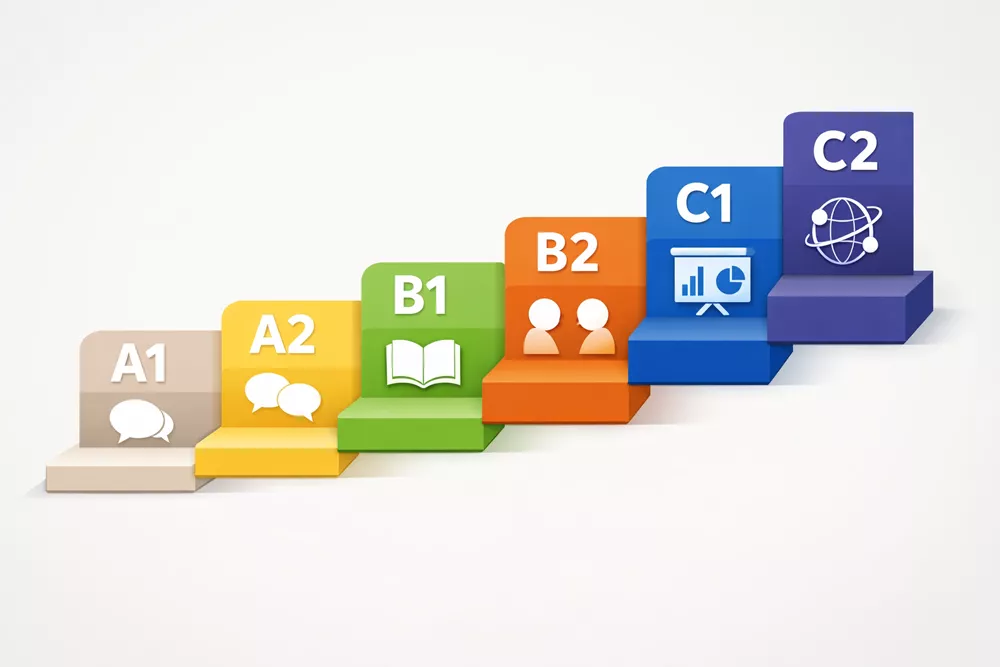
In many contexts, proficiency is reported through frameworks and tests so other people can interpret your level consistently. In Europe, CEFR (A1–C2) is the reference most recruiters recognize, because it turns vague claims into shared expectations. That’s the core value of scales: they standardize what “good enough” means for reading, writing, listening, and speaking.
A practical tip: if a job post says “proficient,” ask whether they mean a CEFR band or specific tasks (presentations, client calls, written reports). If you want a quick, structured way to document your level for applications, Testizer positions its online tests as a practical proof point alongside formal scales.
Here’s the clean way to frame it: fluency is how your language sounds in motion, while proficiency is what you can reliably do with it across real tasks. People often misreport levels because they choose the label that feels more impressive on a resume, even if it doesn’t match their day-to-day performance. Below is a simple, side-by-side breakdown of proficient vs fluent – first through speaking versus overall competence, then through accuracy and complexity.
Speaking fluency can look strong even when reading and writing still lag behind. Proficiency implies broader reliability: you can switch between tasks, channels, and topics without falling apart when the context changes.
|
Situation |
What it reveals |
|
Smooth small talk in a meeting |
Fluency can be high even with limited range |
|
Client email + short report summary |
Proficiency shows up in structure, precision, and clarity |
Accuracy is grammar control under pressure – not perfection, but fewer errors that change meaning. Complexity is the ability to vary sentence structure, choose precise words, and qualify ideas without sounding unsure. Control is staying clear when interrupted, challenged, or forced to rephrase on the spot. Put together, these traits explain why someone can sound fast and confident, yet still struggle with demanding tasks that require careful language.
Proficiency matters most when the stakes are higher than sounding smooth: exams, academic writing, regulated industries, client-facing documentation, and formal presentations. In these settings, accuracy and range protect outcomes – fewer misunderstandings, stronger credibility, and fewer costly errors that come from a vague term, a wrong nuance, or an unclear sentence.
Choose “proficient” wording when you must:
If you need lightweight proof for hiring screens or internal assessment, Testizer certificates are built to be shareable and verifiable via a QR code, a unique ID, and a public verification page.
Fluency matters most when the goal is smooth interaction, not polished language: travel, networking, customer conversations, fast-paced teamwork, and live discussions where you have to respond before you can craft the perfect sentence. In these moments, speed and comfort often beat perfect grammar because the conversation keeps moving, the other person stays engaged, and you can negotiate meaning in real time.
A practical way to build fluency faster is to train “automatic phrases” and active vocabulary for predictable situations. Pick 5-7 common scenarios (introductions, clarifying, agreeing/disagreeing, asking for help, summarizing a point) and rehearse short, reusable chunks. Then practice swapping key nouns and verbs, so the pattern stays fluent even when the topic changes.
Proficiency vs fluency becomes clear once you separate sound from substance: fluency is how smoothly you communicate, while proficiency is what you can reliably do across speaking, listening, reading, and writing. Use the label that fits the situation: fluent in conversation for fast interaction, proficient across skills for exams, work tasks, and formal communication. Official frameworks help standardize expectations, and quick checks help you document progress. With Testizer, you can start free, get results by email, and upgrade to a verifiable certificate for $10 only if you need it.
Yes. Someone can speak smoothly and keep a conversation moving, yet rely on basic vocabulary, repeat safe phrases, and make frequent accuracy mistakes. For example, a learner may chat confidently about travel plans but struggle to write a clear email or understand a detailed article without support.
Not always. An exam can confirm performance on a specific format and set of skills, but proficiency is broader: it includes how you handle new topics, real tasks, and unrehearsed situations over time. Passing a test is useful evidence, yet it does not automatically cover every workplace or academic scenario.
It depends on the role and the tasks. Many employers use the term “proficient” to mean you can work independently in the language, often around upper-intermediate to advanced. A practical check is whether you can join meetings, summarize information, write clear messages, and resolve misunderstandings without switching languages.
No. Fluency is mainly about flow, responsiveness, and keeping meaning intact. You can be fluent while still making occasional grammar errors, especially under pressure or when discussing unfamiliar topics. Accuracy improves clarity and trust, but it is not a gate you must pass before you can sound fluent.