

People usually search this term for a practical reason. They want to place their English level before applying for a course, preparing for a job, or checking whether their study routine is actually working. That is why what is English proficiency test is not just a definition query.
In most cases, what is English proficiency test really means something more concrete: what does this kind of test measure, what do the questions look like, and is an online version worth taking. This guide answers those questions directly. It explains the meaning of the test, the skills it usually evaluates, the formats you may see, and the way online assessment works in real use. The goal is simple: reduce guesswork before you spend time on a test.
The term matters because people usually meet it before a real decision: an application, a placement step, a hiring process, or a personal benchmark. That is where English proficiency test meaning becomes practical. A clear definition should explain not only what the test is called, but also what kind of question it answers about a person’s English.
A test of English proficiency measures how well someone can use the language in tasks that resemble real understanding and real use. The focus is broader than grammar recall on its own. Most proficiency tests try to estimate how well the person reads, understands, recognizes correct language patterns, and in some cases writes or speaks at a given level.
That is why the result is usually expressed as a level or range rather than as a course grade. The purpose is to locate practical language ability within a known framework, often CEFR, so the score says something about usable English rather than just completed study.
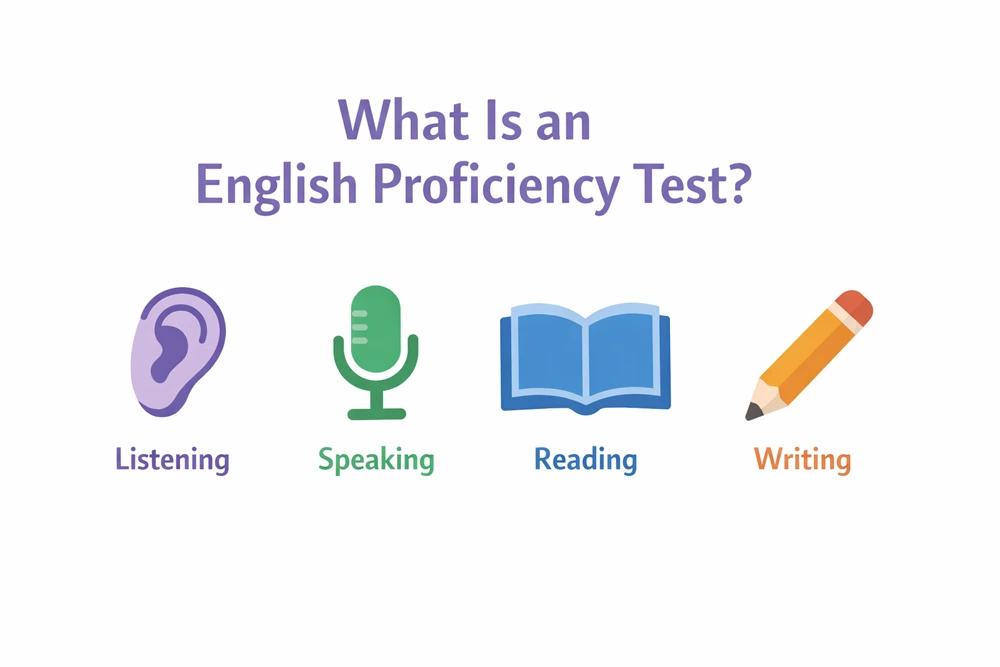
An English proficiency assessment test is useful only if you know what it actually checks. Some tests are broad and aim to capture overall language ability. Others are narrower and work better as quick benchmarks. That difference matters because a result is only meaningful when the reader understands which skills were included and which were not.
A full proficiency test may assess four main skill areas, but not every format includes all of them. Shorter online tests often narrow the scope so they can stay practical and easy to score.
Common skill areas include:
In longer or formal exams, all four may appear. In shorter online formats, reading, grammar, vocabulary, and sometimes listening are more common because they fit timed, browser-based delivery more easily.
Results usually summarize performance across the sections or tasks included in the test. That makes the score useful as an estimate of current level, especially when it is linked to a scale such as CEFR. At the same time, no result should be read too literally.
A test of English proficiency can show a strong level of reading and language recognition without fully capturing how easily the person speaks or writes in real situations. That is why shorter tests are often best for fast benchmarking, while broader exams are better for fuller evaluation.
Not all proficiency tests are built for the same job. Some are meant for formal decisions such as admission or immigration, while others are used for placement, hiring support, or personal benchmarking.
Some exams are designed for formal use by universities, visa systems, and other institutions. In that setting, an English proficiency assessment test usually has a longer format, stricter administration, and broader skill coverage, often including writing and speaking as well as receptive skills. These exams are built for reporting that outside organizations can rely on.
They are commonly used for:
Online tests usually serve a different need. They are often chosen for self-assessment, quick benchmarking, hiring screens, or early placement because they are faster to access and easier to complete from home. That makes them practical when the goal is to estimate the level without committing to a long formal exam.
For readers asking how to test English language proficiency online, Testizer is a clear example of this shorter format. Its browser-based English test is positioned around about 25 questions and roughly 25 minutes, with one correct answer per item and results delivered by email.
For many learners, the format matters more than the label. People often worry less about the name of the exam and more about whether they will understand the task style once the timer starts. That is why English language proficiency test questions deserve attention on their own. Once the format feels familiar, preparation becomes more focused and the test itself feels less unpredictable.
Most proficiency tests reuse a small group of practical formats. The exact mix changes from one exam to another, but the core patterns stay familiar. Shorter online tests usually favor tasks that can be scored quickly and consistently.
Common English language proficiency test questions include:
In Testizer-style online formats, each item has one correct answer, the test is timed, and once you move to the next question, you cannot go back and change the previous one. That structure rewards clear recognition and steady pace.
The easiest way to understand a proficiency test is to look at the kind of decisions it asks you to make. Good items do not only ask whether you know a rule. They ask whether you can choose the right language in context.
Example 1:
You’ve got such a bad cold, you really need to look after (...).
Example 2:
The meeting was delayed because the manager had to (...) the final report before sending it.
Example 3:
The instructions were (...), so everyone knew exactly what to do.
These tasks test grammar, vocabulary, and language use under realistic constraints.
The reason for taking the test usually matters more than the test name itself. That is part of the real English proficiency test meaning in practice: people use these assessments for different decisions, and those decisions shape what kind of test makes sense. Some need a formal document for an application. Others want a realistic benchmark before choosing a course, applying for a job, or checking whether recent study has produced measurable progress.
Common use cases include:
Online testing is often the most practical option when the goal is speed and clarity rather than formal certification. For many users, how to test English language proficiency comes down to choosing a format that is easy to access, quick to complete, and clear in its results. Short online tests work well as a starting point, especially when the task is to estimate level before making a larger decision.
A useful approach is to check a few basic criteria before starting:
For example, Testizer provides a browser-based test with an instant report sent by email, followed by an optional PDF certificate. The certificate includes a unique ID and QR code, and it can be verified through a public page. The upgrade is positioned as a low-cost option, typically around $10, which adds a formal proof layer to the result.
An English proficiency test becomes useful once the user is clear about two things: what the test measures and what kind of result is actually needed. Some formats are built for formal decisions, while others work better for quick benchmarking, placement, or self-checking. If the goal is speed, convenience, and a realistic level estimate, a short online format can be a practical starting point. If the goal is official reporting, a broader exam may be the better choice.
Choose the test format that matches your goal, then take one benchmark test and use the result to plan your next step.
A proficiency test is used to measure your overall level. A regular English exam usually checks how well you learned one course, unit, or syllabus. The difference is purpose. If you need placement, benchmarking, or proof of level, proficiency testing usually fits better.
Yes, many modern proficiency tests can be taken online from home. The exact setup depends on the format and the purpose of the test. Short browser-based tests are common for benchmarking and self-assessment. Formal high-stakes exams may have stricter rules or separate delivery conditions.
Short online tests are useful for estimation and quick benchmarking. They can give a realistic level signal, especially for reading, grammar, vocabulary, and sometimes listening. At the same time, they are less complete than longer exams with writing or speaking. Their strength is speed, not total depth.
No, not every proficiency test includes both speaking and writing. Coverage depends on how the test is built and what it is meant to do. Shorter online tests often focus on skills that are easier to score quickly and consistently. Broader formal exams are more likely to include productive tasks.
It usually makes sense to retake the test after a meaningful period of study, not every few days. A gap of several weeks or a few months is often more useful, depending on intensity. That gives the result time to reflect real progress. Retesting too often can show noise rather than change.
Beginners can take one too. These tests are often designed to place learners across a wide level range, not only to confirm advanced ability. A beginner result is still useful because it shows where the learner is starting. That makes the next study step easier to plan.