

English is now the default working language in many companies, even when no one on the team is a native speaker. Meetings, reports, and cross-border projects often run in English because teams need a shared way to coordinate. So it is natural that many people ask: why is business English important? This question usually appears at the moment when work requirements become real, not theoretical.
In practice, understanding why is business English important helps clarify how language affects everyday tasks, communication with colleagues and clients, and access to better roles. This article explains where Business English is used, what changes it makes in real work situations, and when it starts to influence career growth.
Before looking at meetings, emails, or career growth, it helps to see why English holds such a strong position in modern business at all. The importance of English in business starts at the system level. Companies need one practical working medium across offices, suppliers, clients, software, and markets, and English often fills that role because it reduces friction in everyday operations.
English gained its business role through a mix of trade, multinational growth, finance, technology, and the spread of education and professional resources in English. Over time, that made it the most convenient choice for companies operating across borders, even when English was nobody’s first language.
Its position also reinforces itself. Once one language becomes common in contracts, presentations, training, and reporting, using the same language becomes cheaper and faster than constantly switching between systems. That is why English remains central in business today: the wider the adoption, the stronger the incentive for others to follow.

Business English matters most in the places where work actually moves: meetings, emails, reports, follow-up notes, and coordination with other teams. That is where the importance of English in business communication becomes visible. In business, unclear language is not a minor flaw. It slows decisions, weakens trust, and increases the chance that people understand the same message in different ways.
A large share of business work is discussed, confirmed, or recorded through routine communication formats. That is why the importance of English in business communication is tied to precision more than style. When wording is weak, the result is usually practical rather than abstract: next steps become vague, tone becomes harder to control, summaries lose useful detail, and approval takes longer than necessary.
Common pressure points include:
Shared English speeds up collaboration because people can solve issues directly instead of passing every discussion through translation or through the one colleague with the strongest language skills. That changes how teams work on calls, in project updates, and in day-to-day coordination.
It also affects reliability. When communication is stable, people respond faster, share information more easily, and trust that tasks will be understood in the same way across teams and partners.
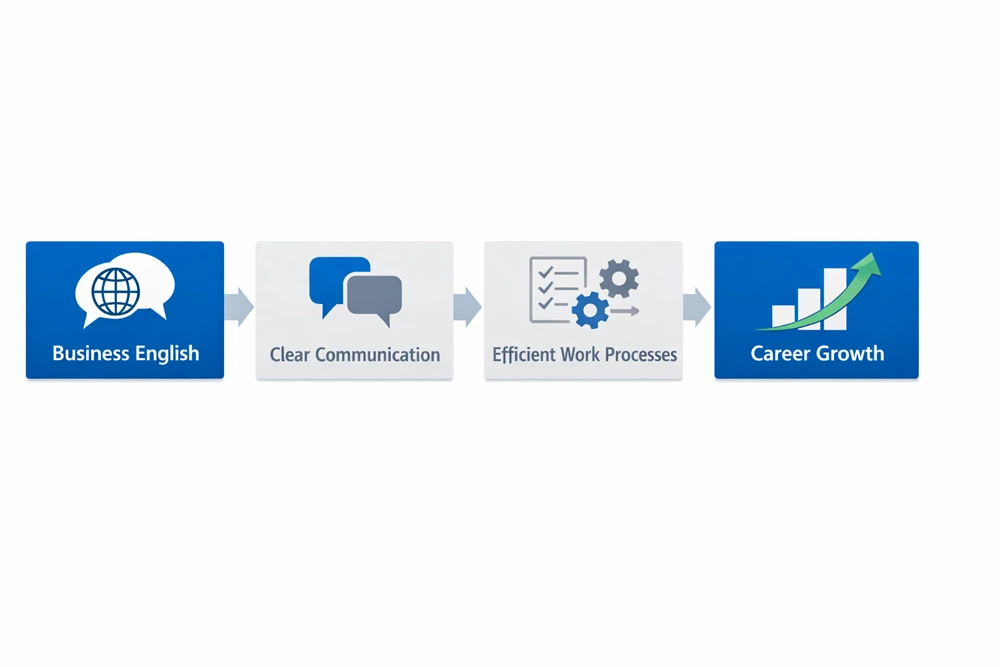
When people ask why English is important in business, the answer often becomes clear during the job search. English does not only improve how someone performs in a role. It also affects which roles are available in the first place. Many positions include communication with international teams, clients, or tools, even when the company itself is local.
In practical terms, this creates three advantages:
At the company level, the issue is no longer only personal career value. International businesses need stable communication standards if they want processes to work the same way across offices, markets, and teams. That is where the importance of English in business becomes operational. A shared working language helps information move through reporting lines, training systems, internal policies, and daily coordination without constant re-interpretation.
International companies rely on Business English to keep decisions aligned across offices, vendors, clients, and regional markets. This matters most when work has to stay consistent across different legal settings, time zones, and organizational layers. Shared language helps teams handle documents, updates, and procedures in a format others can use without rebuilding the message each time.
It also supports standardization. Training materials, internal reporting, templates, and operating procedures become easier to scale when the language stays predictable. That consistency reduces fragmentation between locations and helps the company run as one system rather than as separate local units.
For individual professionals, the value of Business English shows up in everyday tasks. The importance of business English is closely tied to independence. When language skills are limited, people often rely on colleagues to correct messages, rephrase emails, or handle communication with clients. This slows work and reduces visibility. Stronger Business English allows professionals to manage tasks directly, respond faster, and participate more confidently in meetings and written communication.
It also affects how others evaluate competence. Clear and appropriate language makes ideas easier to understand and signals reliability in professional contexts. Over time, this supports earlier involvement in discussions, smoother client interaction, and more consistent performance across tasks.
A practical next step is to check your current level: a short Business English test on Testizer can help identify gaps and guide focused improvement.
Business English becomes more valuable as a career develops. At early stages, it helps with access and basic workplace communication. Later, it affects how well someone handles presentations, negotiation, reporting, leadership communication, and coordination across teams. That is another reason why English is important in business over the long term: higher-level roles usually demand more visible communication, not less.
This changes the weight of the skill over time. When responsibility grows, work shifts away from individual execution and toward alignment, influence, and representation. At that point, language quality affects how clearly a person can lead discussions, explain decisions, and work across departments. Business English supports growth because its value compounds as communication stakes rise.
Business English matters for several connected reasons. It supports daily communication, improves access to career opportunities, helps international companies operate more smoothly, and becomes more valuable as professional responsibility grows. The importance of business English is practical: it changes how clearly someone can work, collaborate, and move forward.
The most useful next step is not abstract improvement, but role-based improvement. Readers can use a business-focused test on Testizer to benchmark their current level and see which areas need attention first. Check the communication demands of your current or target role, then test your level and build the specific Business English skills that role requires.
Yes. The grammar base is the same, but the communicative demands are different. Business English focuses more on professional tone, task-based vocabulary, meeting language, email structure, and clear reporting. It is shaped by workplace use, not casual conversation.
Sometimes yes, but it depends on the role. Some positions involve limited external communication, while others depend on calls, reports, client contact, or cross-border teamwork every day. In those roles, weaker Business English can limit both performance and growth.
It matters most in roles with a high communication load. That includes sales, account management, consulting, recruitment, project coordination, management, reporting, and many client-facing or international operations roles. The more the job depends on structured interaction, the more Business English matters.
That depends on your starting point and how often you use the language. In most cases, visible improvement takes months of focused practice rather than a few days of study. Progress is faster when the practice matches real work tasks such as emails, meetings, and presentations.
Often yes. General fluency does not always cover professional tone, concise writing, meeting participation, reporting language, or negotiation wording. Workplace communication has its own expectations. Someone can speak English comfortably and still struggle in business contexts.
Yes, because promotion often brings broader communication responsibility. As roles grow, people are expected to present ideas clearly, coordinate others, communicate with stakeholders, and represent work more visibly. Strong Business English supports that shift by making professional communication more reliable and effective.