
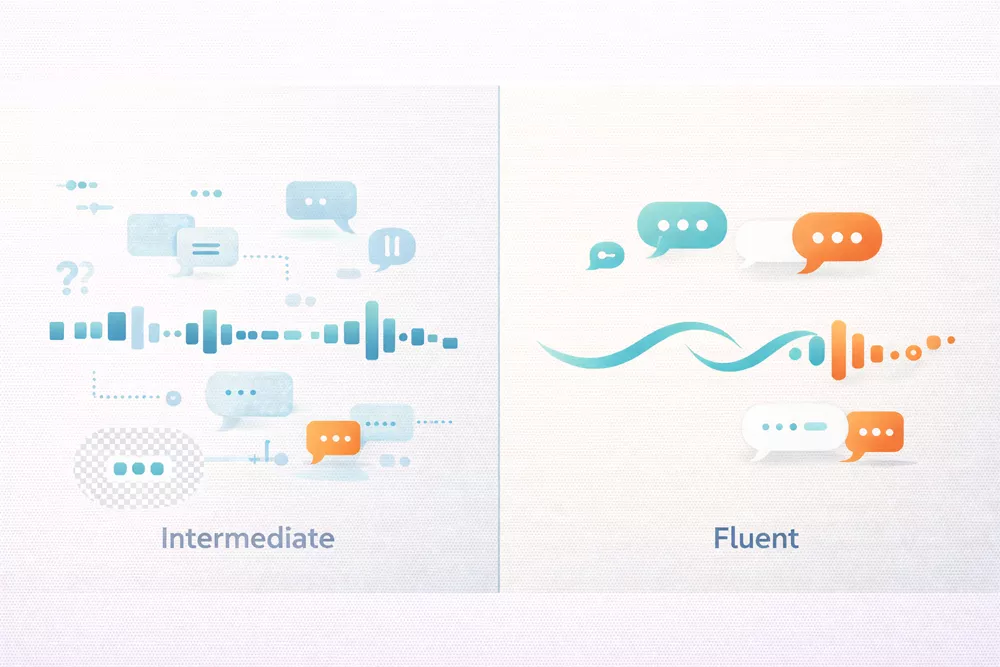
Language learners often see the terms fluent vs intermediate in course descriptions, resumes, and job requirements, yet the meaning behind these labels is not always clear. One platform may call someone fluent, while another describes a similar ability as intermediate. Because of this inconsistency, learners can struggle to evaluate their real progress or describe their skills accurately. Understanding the practical difference between fluent vs intermediate helps avoid these misunderstandings. In this article, you will find concrete indicators of each level and examples of what learners at these stages can actually do in real communication. If you want a quick reference point, Testizer offers a short online level check with results sent by email, and a certificate is optional when proof is needed.
When learners ask “what does intermediate mean”, the answer usually comes down to functional independence on familiar topics. At this stage, you can manage everyday communication without relying only on memorized phrases. Conversations may still require pauses, but you are able to explain basic ideas, ask questions, and handle predictable situations.
Typical intermediate tasks:
At the intermediate level, learners already create their own sentences rather than repeating fixed expressions. This allows them to describe familiar experiences and manage practical communication.
However, speed and precision often drop when the topic becomes unfamiliar or the discussion grows more complex. A simple self-check helps: you can usually explain what you mean, but not always exactly how you want to say it.
Signs you’re intermediate, not beginner:
Fluency is often misunderstood as perfect grammar or flawless speech. In practice, being fluent in a language means maintaining a conversation with relatively little effort. You can express ideas without long pauses, heavy planning, or constant translation from your first language. Even if a specific word is missing, you usually keep the conversation moving by explaining the idea in another way.
Fluency often looks like fewer stalls: you don’t mentally translate each line, and you recover quickly after a mistake. Your listener usually doesn’t need to slow down much or rephrase repeatedly to keep you with them.
It’s also normal to be fluent and still have an accent or occasional grammar slips. For example, you can explain a work issue on a call, respond to follow-up questions, and adjust your wording on the fly – without scripting it first.
You’ll often see people describe their levels of language fluency with simple words like intermediate or fluent. The problem is that these labels don’t always mean the same thing. A language school, an employer, and a certification exam may all expect different abilities behind the same word.
Because of that, many institutions rely on official proficiency scales. These frameworks give a clearer reference point when someone needs to describe their language ability more precisely. In everyday conversation people usually keep the simple labels, but in applications or exams a structured scale is easier to interpret. If you want a quick way to check where you stand, Testizer offers an online level test that sends results by email. A certificate is available if you later need documented confirmation of your level.
|
Where the label appears |
Why clearer levels help |
|
Resumes |
Employers try to understand whether you can actually work in the language or only manage basic conversations |
|
Job advertisements |
The stated level usually hints at how complex the communication in the role will be |
|
Language courses |
Level descriptions help place learners in a class that is neither too easy nor too difficult |
|
Exams |
Standardized scales make results easier to compare across different candidates |
In the CEFR framework, intermediate ability typically falls around B1–B2 depending on the specific skill. The label “fluent” is often used informally for learners who operate at a strong B2 level or higher in everyday communication. Other frameworks, such as ACTFL, use different terminology, so the exact wording may vary across institutions.
When to use CEFR wording:
The choice between an intermediate level and a fluent language ability depends largely on what you need the language for. The question is fluent or intermediate better usually comes up when learners try to match their skills with real situations such as work, study, or daily communication. In practice, the “better” level is the one that reliably supports the tasks you face most often.
If you’re unsure which label fits your current ability, take a quick level check and use the result as your reference point.
Intermediate means you can handle real tasks, but you feel some friction – you simplify, pause, and lose speed when the situation changes. Fluent means you can keep the conversation moving with low effort, recover fast after gaps, and paraphrase without freezing. Describe yourself based on what you can do today in the settings that matter most, then set one measurable target to reach the next label. If you need shareable proof, a Testizer certificate is optional.
Yes – if you can complete familiar tasks consistently, even with pauses or simpler wording. You should be understandable without relying on memorized scripts. Practical step: record a 60-second explanation of a familiar process and count pauses and restarts.
Yes – speaking and writing can develop at different speeds, so it’s fair to specify “spoken fluency” if that’s accurate. Writing often exposes accuracy gaps more clearly than speech. Practical step: write a short email and check whether mistakes change the meaning.
It’s speed plus recovery: fluent speakers keep going, rephrase on the fly, and don’t get stuck after one missed word. Intermediate speakers often lose the next few seconds while searching. Practical step: take one sentence and paraphrase it three different ways.
It varies with weekly hours, feedback quality, and how much real input you get, so exact timelines rarely hold. Progress is faster when practice includes live listening and correction, not only passive exposure. Practical step: run a 4-week plan with one real conversation per week and one measurable check.