
Before taking the exam, most people pause over the same issue: what changes after certification, and is the result worth the effort. That is why the question is Google Ads certification worth it comes up so often among beginners, students, freelancers, and junior marketers. The concern is usually practical. Time is limited, the platform is broad, and not every credential creates visible value. In that sense, is Google Ads certification worth it is less about curiosity and more about decision-making.
This article looks at the question from that angle. It examines what the certificate actually proves, where it helps, where it falls short, and which situations make the investment sensible. The goal is not to sell certification as universally necessary. The goal is to make the trade-off easier to judge based on role, experience level, and intended use.
A Google Ads certificate shows that the holder understands the platform at a functional level. It points to familiarity with campaign structure, core tools, bidding concepts, targeting logic, and the terminology used in Google Ads training and testing. In other words, it confirms that the person has learned how the system is built and how its main parts work together.
It does not prove that the person can run profitable campaigns in live conditions. Certification cannot show how someone reacts when results drop, budgets tighten, or client priorities change. That boundary matters. The credential is more useful when it is read as evidence of platform knowledge rather than evidence of proven advertising performance.
Google Ads certification is modular, which means there is no single starting route that fits everyone. That is why the question which Google Ads certification is best depends less on the platform itself and more on what kind of work the learner expects to do first. A clear starting point is usually more useful than trying to cover every path at once.
The main certification paths generally follow campaign type, so each one reflects a different practical environment.
Common options include:
The right choice usually depends on where the learner plans to work, not on which exam appears first in the catalog.
Search is often the most practical place to begin. It is closest to many entry-level tasks and introduces several core ideas that appear across paid advertising work: keyword intent, bidding trade-offs, ad structure, match types, and performance metrics. That makes it useful even for people who later move into broader campaign environments.
It also transfers well. Someone who understands how search campaigns are built tends to grasp performance logic more quickly in other formats, because the underlying ideas of targeting, relevance, and optimization remain important there too.
The barrier to entry is low, which is one reason many beginners consider starting here. Still, low cost does not mean no effort. The real investment is time: learning the platform, understanding how questions are framed, and getting fast enough to work under exam pressure. In that sense, Google Ads search certification cost is usually less about money and more about preparation discipline.
Yes, the exam itself is free. What people actually spend is time: reading, practicing, reviewing mistakes, and sometimes preparing for a second attempt. That is the part many candidates underestimate. A free exam can still be expensive if preparation is rushed and repeated.
A basic feel for the interface helps, but it is not the main factor. More important is understanding how campaign settings affect outcomes – keywords, bids, targeting, and performance signals. Speed also matters, because timed questions reward recognition more than slow recall.
A short practice cycle can make that easier. Testizer offers free-to-start practice tests in a quick format, with results delivered by email, which makes it useful for checking weak areas before the official attempt.
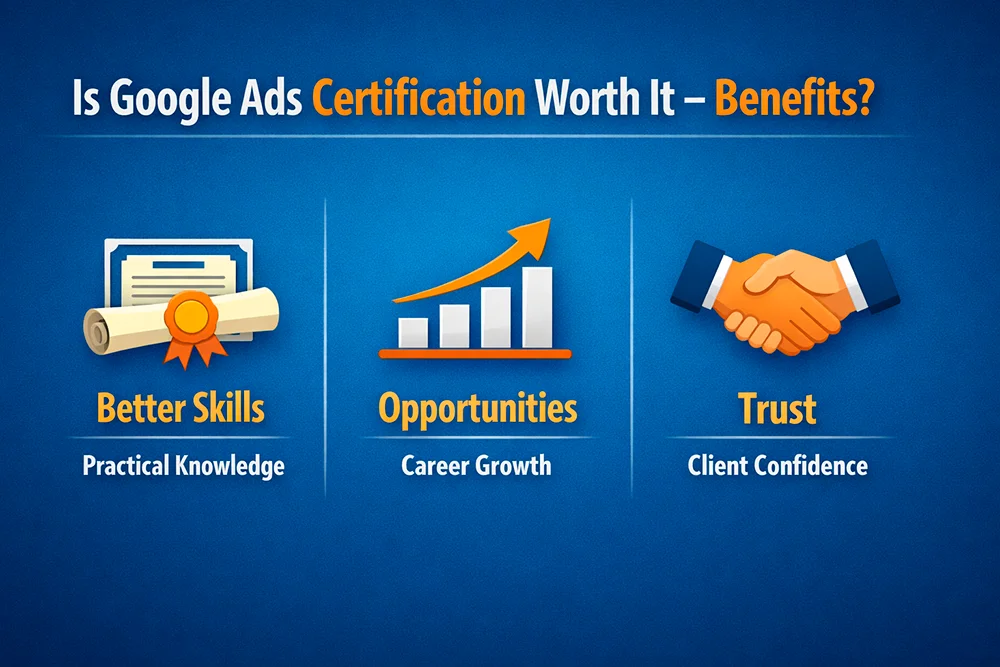
The career value of certification is usually strongest at the point where someone else has to assess your profile quickly. It works as a signal, not as a guarantee. Hiring teams, clients, and managers often make first-pass decisions with limited time, so any credential that reduces uncertainty can make that early review easier.
For junior applicants, certification can help the profile look more concrete. It shows that the candidate has followed a structured path through the platform and understands its core terms, tools, and logic. That does not replace hands-on results, but it can make early-stage screening more efficient when experience is still thin. In practice, it helps recruiters separate general interest from tested baseline knowledge.
For freelancers and independent specialists, trust often has to come before results. A certificate can support that first layer of credibility in proposals, profiles, and introductory conversations, especially when the client has not worked with the person before. It gives the buyer one more reason to take the next step.
Testizer can support that early proof layer as well. Shareable results and quick validation make it easier to add a practical signal to a portfolio or profile before a longer track record is in place.
Certification makes the most sense when it matches the learner’s stage. It is usually a good fit for someone entering digital marketing, moving from a general role into paid media, or trying to build structured baseline knowledge before handling real campaigns. In those cases, the value comes from timing. The credential gives shape to learning at a moment when the person still needs clear structure and an external benchmark.
A useful checklist looks like this:
The credential tends to help most when it supports the next step, not when it is expected to stand in for experience.
Google Ads certification can be worth the effort, but its value depends on context. It helps most when the goal is to build a clear baseline, strengthen a junior profile, or add a recognizable signal before deeper practical experience is in place. On its own, it is limited. Combined with practice, it becomes much more useful.
Testizer can add a practical proof layer after preparation or benchmarking. Its certificates are designed to be shareable and verifiable through a unique ID, QR code, and a public verification page, with the certificate upgrade advertised as $10.
Start with one practice test, check your weak areas, and decide whether certification fits your current goal.
Many companies do care, but usually as a first filter rather than a final hiring decision. It helps signal that the candidate understands the platform and its core concepts. That matters most in junior hiring, where experience is often limited. After that stage, practical results and role fit usually matter more.
It is possible for some entry-level roles, especially when the job includes training or narrower responsibilities. On its own, though, the certificate is usually not enough to carry the whole application. Employers still look for signs of practical thinking, communication, and reliability. The certificate helps most when it supports, rather than replaces, other evidence.
The exam is more manageable for people who know the platform than for people who only know general marketing ideas. Questions tend to reward familiarity with campaign logic, terminology, and settings under time pressure. That makes platform exposure more useful than abstract theory. Practice usually matters more than memorization.
No, real advertising experience is not required before taking the exam. A beginner can still prepare and pass with structured study and practice. Experience helps because it makes the logic behind questions easier to interpret. The exam is accessible without live account work, but practical exposure usually improves confidence.
Yes, especially at the beginning. A certificate can help support credibility in profiles, proposals, and first client conversations when there is not yet much case-based proof. It gives potential clients one more reason to take the next step. Over time, campaign results become more persuasive than the credential itself.
Google Ads certification usually requires periodic renewal rather than permanent validity. That cycle reflects the fact that the platform changes over time: features shift, campaign types evolve, and best practices get updated. Renewal keeps the credential current. It also gives learners a reason to refresh knowledge instead of relying on an old result indefinitely.