
Many learners get an HSK result and then face a second question right away: what does that score mean outside Chinese-specific testing? That is why HSK to CEFR comparisons matter. A level becomes far more useful once it can be read in another framework. For students planning exchange programs, degree applications, or long-term study goals, HSK to CEFR is less about labels and more about interpretation. The same is true for self-assessment. A learner may know their HSK band, yet still need a clearer sense of where it sits in a broader proficiency scale such as HSK to CEFR.
This guide focuses on that comparison problem directly. It explains what each system is built to measure, where the overlap is helpful, and why no chart can turn one result into a perfect equivalent.
Before comparing levels, it helps to look at what each system is designed to measure. The gap between HSK vs CEFR starts at that point. Each framework answers a different question about language ability, so treating them as identical scales can lead to misleading conclusions.
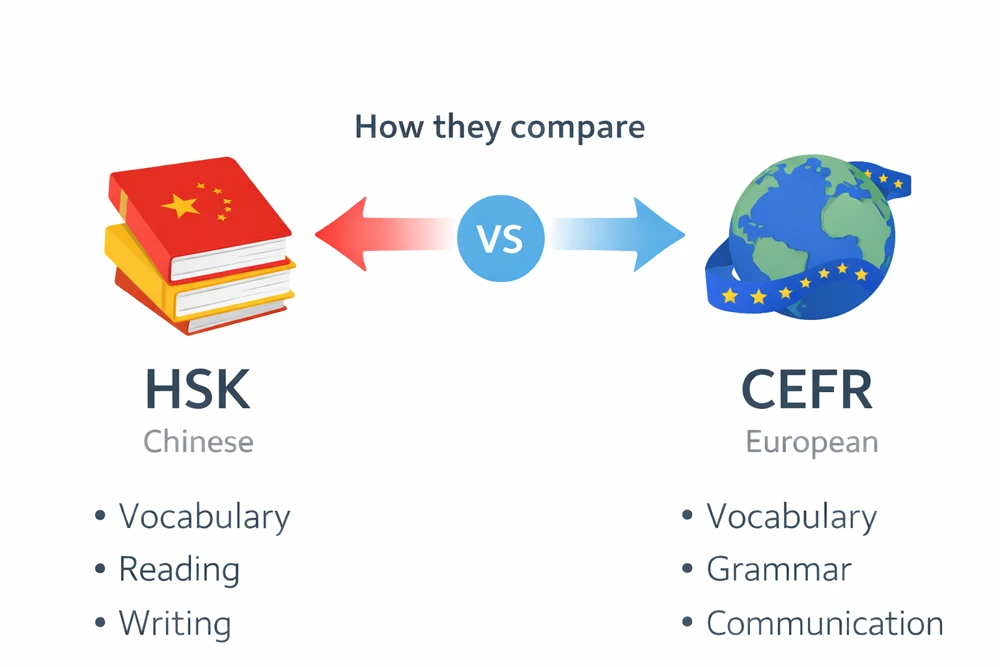
HSK is a structured Chinese proficiency test built around clearly defined levels. Each level reflects a combination of vocabulary knowledge, reading and listening ability, and familiarity with common language patterns used in learning contexts. Progression follows a staged path, where each level adds complexity in controlled steps.
HSK also operates within a Chinese-specific environment. It is widely used by universities and language programs for admissions and placement decisions. When learners try to map HSK levels to CEFR, they are effectively translating a result that was originally designed for use inside this system.
CEFR works differently. It is not tied to one exam or one language. Instead, it describes what a learner can do across levels A1 to C2 using functional ability rather than test-specific content. This makes it widely usable across institutions and education systems.
In practice, this framework is built around three core ideas:
Comparisons between the two systems are useful, but only if they are treated as ranges. HSK levels compared to CEFR can help learners orient themselves, especially when they need to translate a Chinese test result into a more familiar proficiency scale. Still, the comparison works best as an estimate. One score may point to a zone of ability, not to one exact match.
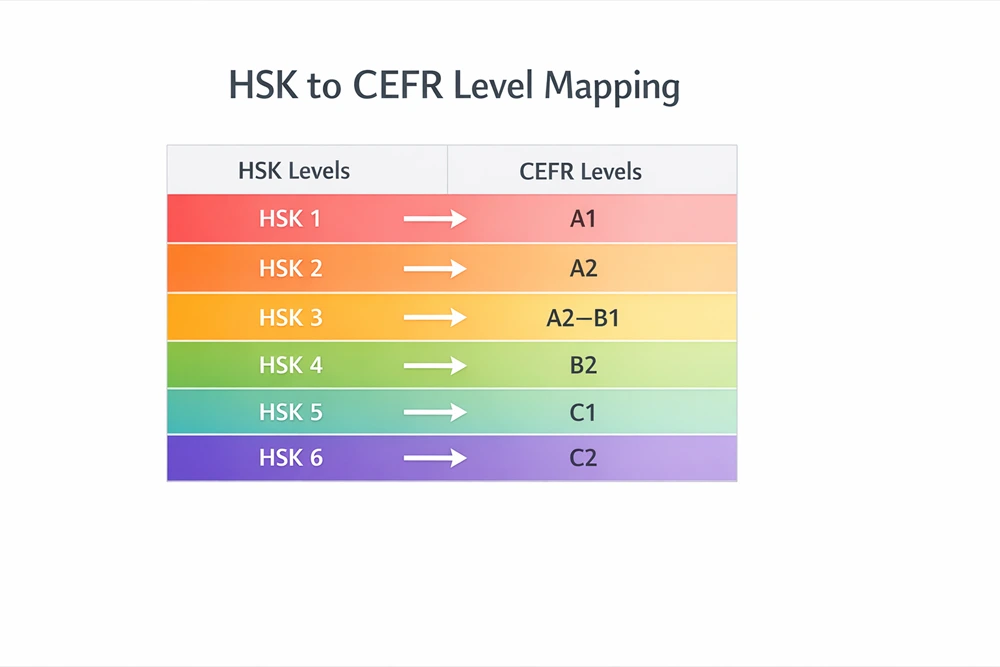
The lower HSK bands are usually linked to beginner CEFR stages because both systems describe limited, practical communication. At this point, learners tend to manage short everyday exchanges, basic recognition, and simple vocabulary tied to familiar topics. That makes the overlap easier to read than at higher stages.
A rough HSK levels CEFR equivalence at the beginner end is often presented like this:
|
HSK stage |
Approximate CEFR zone |
|
HSK 1 |
A1 |
|
HSK 2 |
A1-A2 |
|
HSK 3 |
A2 |
The middle bands are where comparison becomes more useful and less stable at the same time. A learner may read and recognize much more Chinese than they can produce comfortably in conversation. That gap matters, because intermediate ability is rarely balanced across all skills.
When HSK compared to CEFR is discussed at this level, the answer often depends on what the comparison is for. For academic progression, a higher reading-heavy estimate may seem reasonable. For spoken interaction, the same learner may feel clearly lower. This is why intermediate mapping often looks tidy in charts but messier in real use.
At the advanced end, broad alignment becomes much less precise. Higher HSK levels are often associated with upper CEFR bands, but that does not mean every learner at that stage functions like a stable C1 or C2 user in all contexts. The further up the scale you go, the more hidden variables start to matter.
What complicates HSK levels CEFR correspondence most at this stage is the weight of deeper abilities:
A high-level result may signal strong tested Chinese, but it still does not flatten all differences in fluency, control, and task range.
Any comparison between the two systems stays approximate because they were not built as mirror scales. The issue is not that comparison charts are careless. The issue is that the exams were designed around different assumptions, different reporting habits, and different ideas of what a proficiency label is supposed to capture. That is why HSK CEFR alignment can be useful and still remain imperfect.
HSK measures Chinese through a Chinese-specific testing progression. CEFR, by contrast, is a broader framework used to describe language ability across many languages and many exam systems. That difference affects what a score actually means.
Three structural differences matter most:
Even when two labels look similar on paper, they may come from different testing logic.
Different comparison charts often rely on different kinds of evidence. One source may lean heavily on vocabulary targets, another on estimated teaching hours, another on university expectations, and another on what learners can actually do in practice. That is why one mapping may look stricter while another looks more generous.
The variation usually comes from the comparison method:
This kind of disagreement is normal. It does not always mean one source is wrong. More often, it means the source is answering a slightly different question.
The comparison becomes useful when it helps a real decision. It is less helpful when treated like a badge conversion exercise. Most learners do not need a perfect formula. They need a practical way to understand what one result suggests in another system, especially when applications, study plans, or progress checks use different reference points.
This comparison often appears when learners prepare for exchange programs, degree entry, or scholarship planning. A student with an HSK result may need to explain that level to an institution that usually works with CEFR-style language benchmarks. In that situation, HSK vs CEFR functions as a translation tool.
It still has limits. Admissions decisions depend on the policy of the institution, not on an informal chart. A university may ask specifically for HSK, or it may accept several forms of proof and treat them differently. The comparison helps the learner estimate where they stand, but it does not override published requirements.
For learners, the comparison is most useful as a planning tool. Someone who already knows CEFR from English, French, or German study can use it to place Chinese progress into a more familiar frame. That makes study goals easier to interpret and easier to explain.
HSK levels compared to CEFR work best as orientation, not as proof. They can help answer questions like whether a learner is still in an early stage, moving into functional independence, or approaching advanced reading demands. Testizer can also serve as a quick supplementary checkpoint here: its public catalog includes Chinese tests positioned around HSK levels and broader language benchmarking, which makes it useful for learners who want one more practical reference alongside formal systems.
The more useful question is not only what level you have, but what that level lets you do in real situations. A score becomes meaningful when it connects to tasks: reading a short article, following a classroom discussion, writing a message, or handling a basic conversation without heavy support. That is where interpretation becomes more realistic.
An HSK result usually shows tested proficiency under structured conditions. It can indicate how well a learner handles the kind of vocabulary, reading, and listening demands built into that level. It does not automatically mean full communicative control in daily life, work, or study.
A practical way to read the score is this:
Some learners can read noticeably better than they speak. Others do well on structured tasks but hesitate in live conversation.

The safest way to estimate a CEFR zone from HSK is to treat it as a working estimate, not as an official conversion. One score becomes more useful when it is checked against real tasks: Can you follow normal-speed listening? Can you write a short explanation? Can you speak clearly on familiar topics without stopping every few words?
That kind of cross-check is usually more reliable than a chart alone. A supplementary online benchmark can help here as well. Testizer positions its language tests around CEFR-style outcomes, with quick completion and results sent by email, which makes it a practical second reference point for learners who want to test whether an HSK-based estimate feels realistic in practice.
HSK and CEFR can be compared, but only in broad terms. The gap between them comes from design, purpose, and the kind of language ability each system is built to describe. One result can suggest a likely zone in the other framework, yet it cannot replace direct evidence of what the learner can actually do.
That is why the most useful next step is practical, not theoretical. Keep the score, but pair it with task evidence: reading, listening, speaking, and writing in situations that matter to you. If you want a shareable checkpoint after benchmarking, Testizer certificates are built to be verifiable through a unique ID, a QR code, and a public verification page, with the certificate upgrade advertised as $10.
Use your current HSK result as a starting point, then test the real skill level behind it with one additional benchmark or practical task check.
Many Chinese universities rely heavily on HSK, but the exact rule depends on the institution and the program. Some accept only HSK, while others may consider additional proof in special cases. The safe approach is to check the official admissions page of the university itself. General advice online is less reliable than the published policy.
Yes, that can happen. Some learners develop reading and listening faster than speaking, especially when most of their preparation is test-based and highly structured. A passing result shows real proficiency, but it does not guarantee equal strength in every skill. Spoken ease often lags behind recognition skills.
Higher HSK levels usually take much longer than early ones. Vocabulary load grows sharply, texts become denser, and accuracy matters more. Progress also stops being linear: moving from one advanced stage to the next often requires much more exposure than moving through beginner levels. Consistent reading and listening volume start to matter a lot more.
Some employers do, especially when they need a fast standardized signal during screening. At the same time, many will also look at live communication, writing quality, or job-specific language use before making a final decision. In practice, HSK can open the conversation, but task performance usually carries more weight at the final stage.