
When Korean becomes part of a real plan, informal self-evaluation stops being enough. University applications, job requirements, and formal certification usually require a recognized result. That is where people begin asking what is TOPIK and why it matters. In practical terms, what is TOPIK is a question about proof. The TOPIK Korean test is the main standardized Korean proficiency exam for non-native speakers, and its result is reported through levels that institutions can actually use.
Many learners know the exam name long before they understand how it works. They may know that it is important for study or work in Korea, but not how the structure is divided, what the levels mean, or which skills are measured. This article closes that gap. It explains how TOPIK is organized, what the levels show, and when the exam becomes relevant in real decisions.
Before looking at levels, sections, or scores, it helps to understand why the exam exists at all. Formal language exams are created because institutions need comparable evidence, not just personal claims. TOPIK serves that role for Korean. It gives schools, employers, and learners one shared system for evaluating Korean proficiency across different goals and backgrounds.
At its core, TOPIK exists to measure Korean ability in a standardized way. It evaluates how well a learner can understand and use Korean, then turns that performance into a level that institutions can interpret. That makes the Korean language exam useful not only for certification, but also for learning direction. A result shows where the learner stands and what range of language use has already been reached.
This matters because universities and employers need consistent evidence. Without a common exam, each institution would have to interpret Korean ability through grades, personal statements, or informal impressions. TOPIK reduces that inconsistency by giving formal decisions a clearer reference point.
The TOPIK Korean test is taken by a broad group of learners. International students use it for university admission, job seekers use it for employment or public-sector applications, and independent learners may use it to confirm their level formally. It is also relevant for overseas Koreans who use Korean as a second language in practice.
There is no narrow eligibility barrier beyond the fact that the exam is intended for non-native use. That broad audience matters. The certificate carries more weight because it is used across study, work, and personal certification contexts rather than within one limited track alone.
The exam becomes much easier to understand once it is divided into its two main tracks first. After that, the sections, scores, and timing make more sense. This matters because the structure shapes both preparation and performance. It shows what kind of Korean is being tested and how the difficulty rises from one stage to the next.
TOPIK is organized into two exam tracks rather than six separate tests. TOPIK I covers beginner use and leads to levels 1 and 2. TOPIK II covers intermediate to advanced use and leads to levels 3 through 6. That means the TOPIK test levels come from two broader exam structures, not from six independent versions.
The scoring system reinforces that progression. TOPIK I is scored out of 200 points, while TOPIK II is scored out of 300. This split helps institutions and learners distinguish between basic functional Korean and the more complex language needed for study, work, and extended communication.
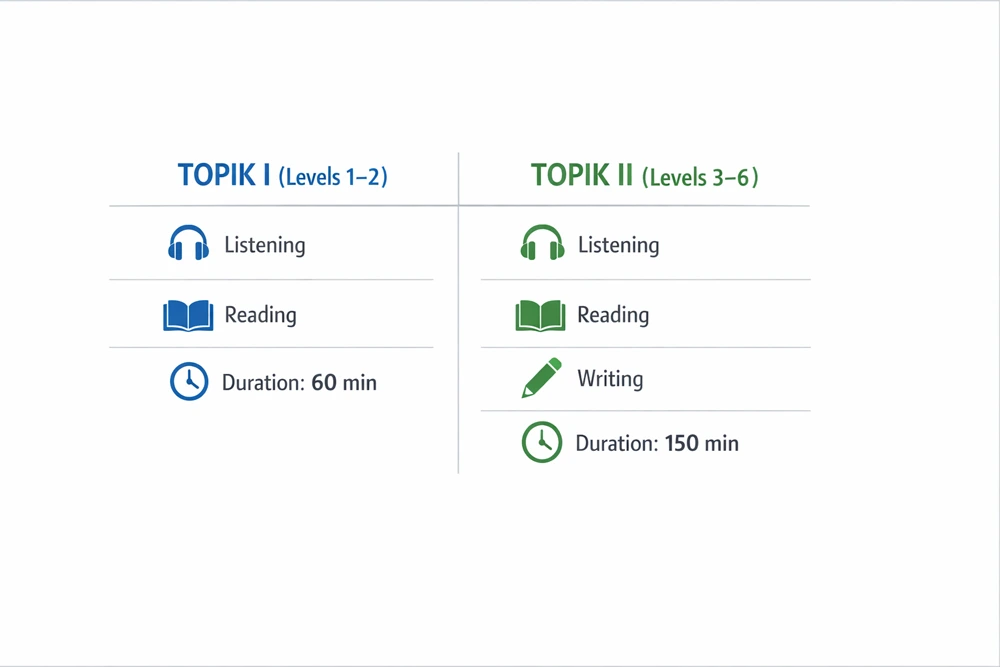
The section design changes sharply between the two tracks. TOPIK I includes Listening and Reading only. TOPIK II adds Writing, which changes the demands of the test in Korean in a significant way. At beginner level, the focus is on comprehension. At higher levels, the learner must also produce language.
The timing reflects that shift. TOPIK I has 70 multiple-choice questions and takes 100 minutes. TOPIK II has 104 total questions and takes 180 minutes. Its writing section includes 4 tasks, with short-answer items and essays. This is why TOPIK II is not simply a harder version of TOPIK I. It tests additional output skill, especially written control under time pressure.
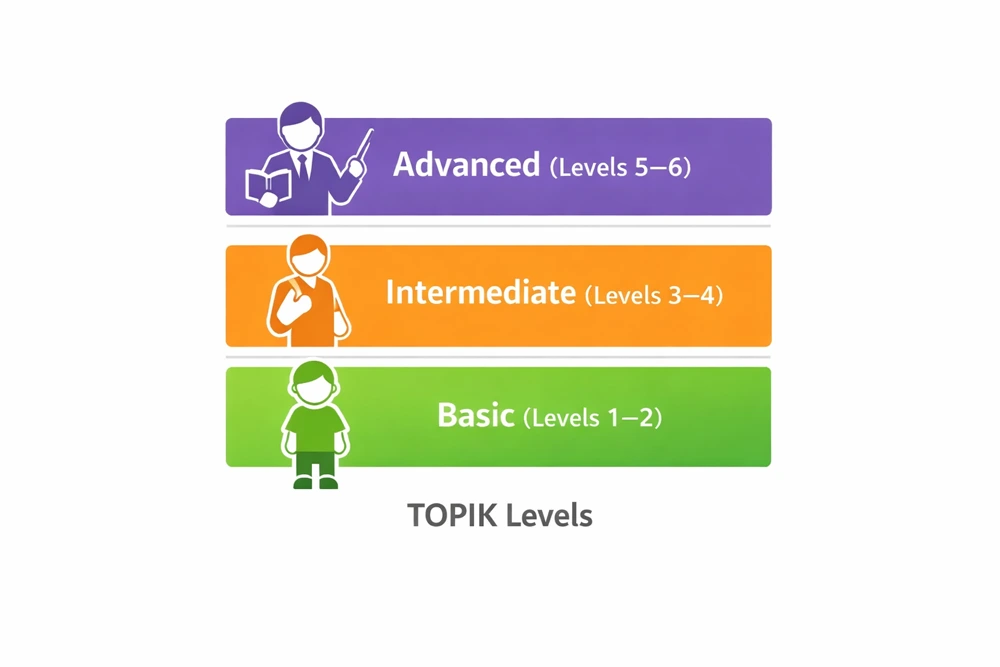
Level labels only become useful when they are tied to real language ability. A number on its own does not explain much. What matters is what a learner can actually do at that level: how they handle conversations, texts, and more complex situations. This is how TOPIK results are meant to be read.
Levels 1 and 2 represent the beginner range. At this stage, Korean is used mainly for everyday survival situations and familiar topics. Learners are expected to manage simple exchanges, build basic sentences, and understand common patterns used in daily interaction.
Level 1 is typically linked to a vocabulary of around 800 words and covers tasks such as greeting, ordering, or making simple requests. Level 2 expands this range to roughly 1,500-2,000 words. It also adds better control over familiar topics and clearer distinction between formal and informal use. These levels show whether a learner can function independently in basic situations rather than rely on memorized phrases.
Levels 3 to 6 mark a shift from everyday use to broader communication. The TOPIK test levels in this range require more than vocabulary growth. Learners need to understand abstract topics, follow longer texts, and adjust language depending on context.
Level 3 includes public interactions and maintaining social relationships. Level 4 adds the ability to understand news and general issues with more accuracy. Levels 5 and 6 move into professional and academic use. At this stage, Korean is used to discuss complex topics, handle formal communication, and operate across different contexts with greater control.
TOPIK does not measure Korean in a vague or general way. It tests specific skills through specific task types, and that matters for preparation. Once the learner understands which parts of the language are actually being measured, study becomes easier to direct. Reading, listening, and writing do not create the same kind of pressure, so they need to be viewed separately before they are combined in a final score.
Reading and listening form the base of the exam across both TOPIK I and TOPIK II. TOPIK I is built entirely from these two areas, and TOPIK II keeps them as major parts of the test. These sections measure how well a learner can process written and spoken Korean under time limits, not just whether the content looks familiar.
A large part of the challenge comes from speed. Many tasks are multiple choice, which means the learner has to understand, compare options, and decide efficiently. Strong receptive performance depends on quick recognition, accurate comprehension, and stable control over common patterns.
Writing enters the exam at TOPIK II and changes its character in an important way. At that point, the learner is no longer only recognizing correct Korean. They also have to produce it. That raises the difficulty because writing reveals organization, control, and the ability to express meaning without options on the page.
The writing section in TOPIK II includes four tasks. Two are short-answer responses, and two are essays, including one longer response that may require around 600-700 characters. This is one reason TOPIK II feels harder: writing exposes weaknesses that multiple-choice sections can sometimes hide.
Most people take TOPIK for clear, practical reasons: study, work, formal certification, or simply to confirm their level in a structured way. The Korean language exam is widely recognized by universities and employers, which gives it value beyond personal learning goals. It turns language ability into something that can be verified.
In many cases, scores are required for university admission or job applications, and the official report acts as formal documentation. Certificates are valid for two years, so timing can directly affect application plans. Even self-learners often take the exam to move from informal progress to measurable proof. Institutions do not rely on self-assessment, so TOPIK works as a standardized signal of real ability.

Preparation works better once the learner understands what the exam is actually asking for. Many people begin with vocabulary lists or grammar review, then realize later that they were not training for the right task type. For TOPIK Korean, efficient study starts with the structure of the exam itself. Once that is clear, materials become easier to choose and practice becomes more targeted.
Format knowledge is part of preparation, not an extra detail. TOPIK I lasts 100 minutes and tests only Reading and Listening. TOPIK II lasts 180 minutes and adds Writing, which changes both the skill demands and the pacing. The question mix is also different across the two tracks, so learners should not prepare for them in the same way.
This matters because confusion costs points. A learner may know the language reasonably well and still lose score by mismanaging time, misunderstanding section demands, or arriving unprepared for the writing load in TOPIK II. Familiarity with the structure protects performance.
Practice materials help most when they match the real exam. Past papers are useful because they show recurring formats, section rhythm, and the level of difficulty a learner should expect. Mock exams add another layer: they train timing, concentration, and recovery under pressure.
This is especially important for TOPIK because the sections are fixed and the writing tasks in TOPIK II need rehearsal, not just review. Repeated simulation improves stability. It also creates better feedback, since the learner can compare results over time instead of guessing progress.
As an additional checkpoint, a learner can use Testizer as a quick online benchmark before taking the formal exam. It works well as a readiness check alongside longer TOPIK-style practice.
TOPIK is the main formal Korean proficiency test for non-native speakers, and it matters because its results are used in real academic and professional decisions. Its structure, level system, and skill design all reflect a clear progression from basic comprehension to more demanding written and professional use. For that reason, the exam is most relevant when Korean is tied to a concrete goal rather than casual interest alone.
A practical next step is to check your current level before building a full study plan. Testizer can be used as a quick Korean benchmark for that purpose. Check your current level, understand which TOPIK track matches your goal, and start preparing with materials that reflect the real exam structure.
Anyone who needs formal proof of Korean ability may need TOPIK. That usually includes university applicants, job seekers, and learners who want recognized certification. The deciding factor is not learner type alone. It is whether an institution, employer, or application process requires documented language evidence.
TOPIK I is built for beginners, but that does not make it effortless. The exam still requires enough vocabulary, listening control, and reading speed to work under time limits. A learner at an early stage can pass, but only if the basics are already stable. Beginner level and exam readiness are not the same thing.
That depends on your starting point and the level you want to reach. Preparing for TOPIK I usually takes less time than preparing for TOPIK II, because the higher track adds writing and broader topic demands. The distance between current ability and target level matters more than the calendar alone.
Often yes, but the exact rule depends on the university and the program. Some institutions require a specific TOPIK level for admission, while others may set different language conditions. The only reliable answer comes from the school’s own admissions policy. General assumptions are less useful than published requirements.
TOPIK is offered multiple times per year, often up to six sessions annually depending on domestic and overseas administration. That matters for planning, especially if you need time for a retake or want results before an application deadline. Frequency gives learners more than one chance, but it still helps to plan around official schedules.